
Welcome to the Ongoing Situation
Please form a strong opinion before reading on
Because uncertainty has somehow become more offensive than ignorance
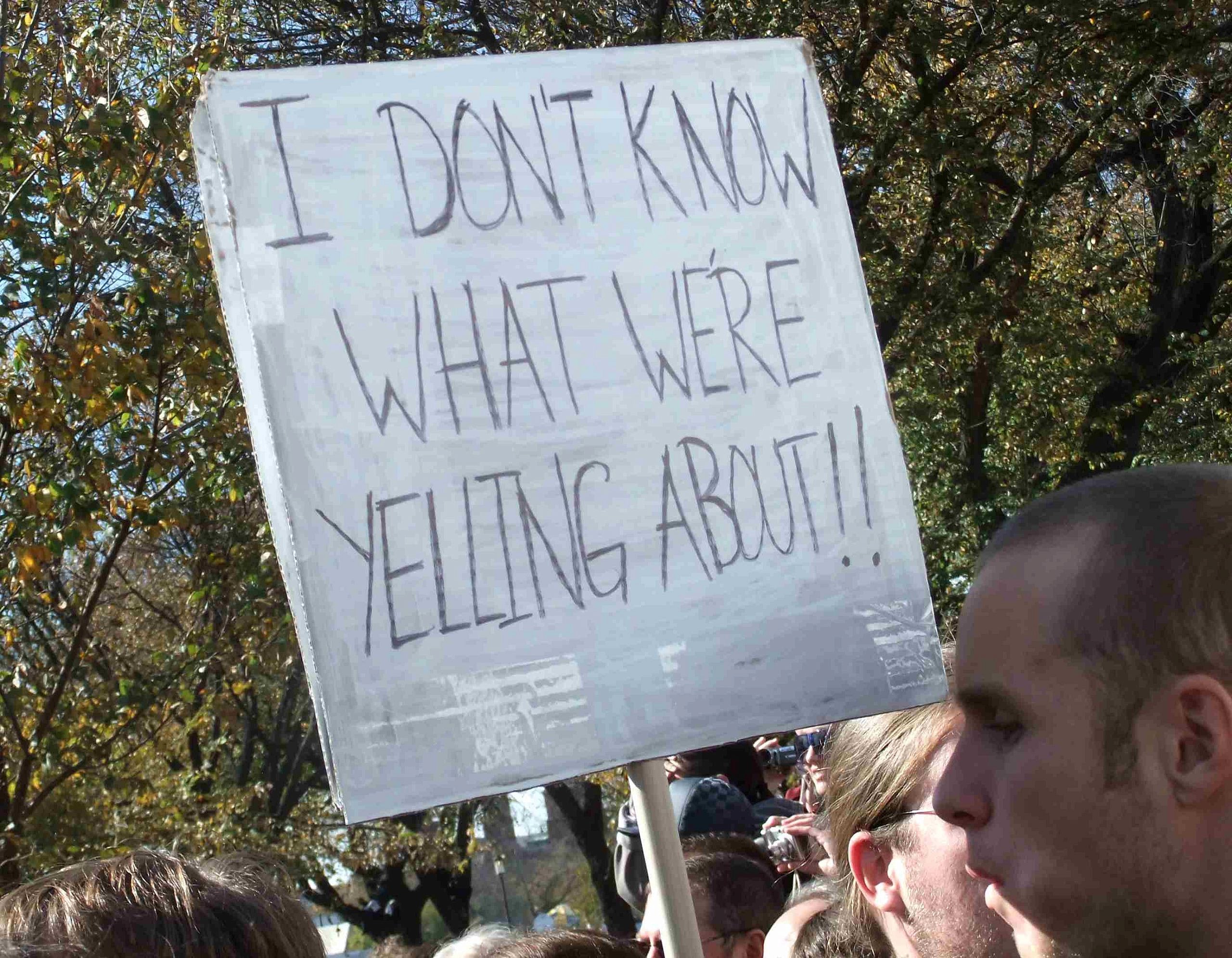
Protester holding sign reading 'I Don't Know What We're Yelling About!' (Martha Soukup/Flickr)
Not knowing something used to be considered the first step toward learning.
Today, it feels more like disgracing seven generations of your family.
Somewhere along the way, admitting uncertainty became socially riskier than confidently repeating something you saw fifteen seconds ago on X, accompanied by a blurry screenshot, three fire emojis and the words “DO YOUR RESEARCH.”
We’ve reached the point where everyone is expected to have an informed position on geopolitics, constitutional law, epidemiology, artificial intelligence, military strategy, macroeconomics, climate science, the Middle East and whichever obscure historical event has suddenly become the internet’s personality because someone explained it porly in a 37-second TikTok.
I don’t know exactly when this happened, which I appreciate is a dangerous way to begin an essay. But if I had to guess, I’d award partial custody to social media.
The algorithm doesn’t reward curiosity. It rewards certainty. Nobody has ever gone viral by saying, “That’s an interesting point. I’ll read a few books and get back to you in six to eight months.”
Confidence gets clicks. Curiosity gets ignored. Whether the confidence is justified has become little more than a technicality.
The danger is that this habit hasn’t stayed online. It’s escaped into everyday life.
Conversations feel less like opportunities to exchange ideas and more like oral exams where everyone has already decided whether you pass or fail. You’re expected to declare your position immediately, defend it relentlessly and, under no circumstances, update it in light of new information. Changing your mind isn’t viewed as growth anymore. It’s treated like getting caught cheating.
Asking questions can be enough to make people suspect you’re secretly on the other side.
Nuance, meanwhile, has developed an unfortunate reputation for looking suspiciously like weakness.
Israel is probably the clearest example of this in today’s discourse.
The international conversation leaves room for only two acceptable roles: prosecutor or defence attorney. If you attempt to acknowledge uncomfortable truths on both sides, many people assume you’re either intellectually dishonest or morally confused. The possibility that reality might simply be complicated has become totally unfashionable.
Which is ironic, because the people who know the most about almost any subject tend to speak with the greatest humility.
Spend five minutes with a historian and you’ll discover every sweeping conclusion comes with at least six annoying exceptions. Ask a scientist a simple question and the answer usually begins, “Well, it depends.” Lawyers have somehow built entire careers around the word “possibly.” Doctors routinely remind us that medicine is a game of probabilities, not guarantees.
Experts spend decades discovering the limits of their knowledge.
The rest of us spend twenty minutes on Wikipedia and emerge ready to moderate a panel discussion.
Though I’ve noticed this most when people discuss Israel, it’s hardly unique. Every major issue now demands instant certainty. Every breaking story requires a hot take before all the facts have unraveled. Every tragedy must somehow confirm whatever worldview we were already carrying around yesterday.
Acting thoughtfully has become too slow. Acting immediately is where the likes are.
Which is why three of the bravest words in the English language might now be:
“I don’t know.”
Those words interrupt the performance. They reject the comforting illusion that every complicated question has a simple answer waiting just beneath the comments section.
For me, personally, they are three of my favorite words.
They leave room to ask better questions instead of rushing toward convenient ones. They remind me that changing my mind isn’t evidence that I was stupid yesterday. It’s evidence that I learned something today.
That feels like a trade worth making.
Besides, confidence and accuracy have become so thoroughly divorced from one another that we’ve started mistaking volume for wisdom and certainty for intelligence.
Perhaps the smartest person in the room isn’t the one with an opinion about everything.
Perhaps it’s the one who’s still willing to admit they don’t know.
Then again…
I could be wrong.
Related Topics
Related Posts