London based entrepreneur, cybersecurity analyst doing a PhD in AI
Poetry in Motion – An Ode to Roger Federer.
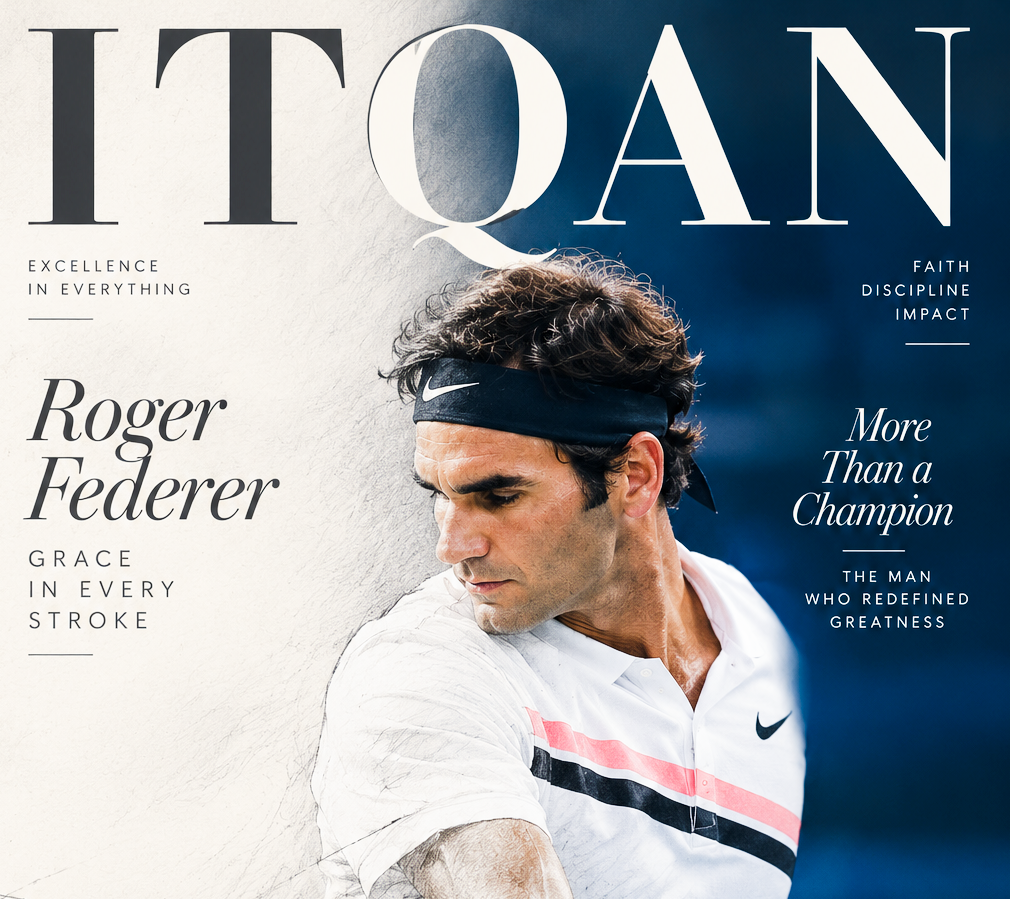
Federer transcends the court not because of his gameplay, but because of the way he carried himself.
Poetry in Motion
Roger Federer, the psychology of mastery, and what happens inside a point
There are athletes who win.
There are athletes who dominate.
There are athletes who change their sport.
And then there are athletes who make you reconsider what the word beautiful means.
For me, Roger Federer belongs in that last category.
He won 20 Grand Slam singles titles, eight Wimbledon titles, 103 ATP singles titles and spent 310 weeks ranked world No. 1, including 237 consecutive weeks. But statistics do not explain the particular experience of watching him.
Federer, when asked about Wallace’s description years later, called it “just a slight exaggeration.”
Perhaps.
That in and of itself is revealing about Federer. He is grounded, humble.
But watching Federer raises a serious psychological question.
What was actually happening inside the player who made mastery look effortless?
The following is an imagined reconstruction of a Federer point. The words are not presented as his literal private thoughts. They are constructed from what Federer himself has said publicly—especially in his 2024 Dartmouth commencement address—and from the psychological literature on expertise, emotion regulation, attention, pressure, procedural skill, learning and adaptation.
The point begins.
The serve
The ball is in my hand.
Breathe.
Look at him.
I know what I have trained.
Federer’s first lesson at Dartmouth was blunt:
“Effortless” is a myth.
He explained that people had assumed he barely tried because his tennis looked easy. In reality, he had worked extremely hard before tournaments, often when nobody was watching. He described discipline, patience and managing himself as forms of talent in their own right.
Psychology gives us a more precise description of what “effortless” can mean.
Expertise develops through extensive practice, but the popular idea that performance is simply the product of accumulating a certain number of hours is not supported by the evidence. Macnamara, Hambrick and Oswald (2014) found that deliberate practice explained around 18% of the variance in sports performance. Their later sport-specific meta-analysis found something even more striking: among elite performers, deliberate practice accounted for only about 1% of performance variance (Macnamara, Moreau & Hambrick, 2016).
There is a pop psychology version of this – 10,000 hours of practice. Popularised by Malcolm Gladwell in his book “Outliers” and based on the work of the Swedish Psychologist, Anders Ericsson.
Practice matters enormously.
It is simply not the whole explanation.
At elite level, performance emerges from interacting systems: technical skill, perceptual processing, decision-making, physical capacity, attentional control and psychological regulation.
So when Federer stood behind the baseline looking relaxed, the relaxation was sitting on top of an enormous amount of acquired information and a mindset. The mindset is quite often missed.
The spectator saw simplicity.
The player had thousands of hours of encoded movement.
This is one of the characteristics of expertise: the conscious burden of executing a skilled movement can decrease as the underlying procedure becomes increasingly automated.
That matters because the less conscious attention required for basic execution, the more attention remains available for the changing environment.
The ball is coming.
I don’t need to think about how to swing.
I need to see what is happening.
That is the first part of the Federer mind:
Trust what has already been learned.
The return
The opponent serves.
Fast.
Wide.
Federer moves.
There is no time for a lecture in his head about tennis technique.
This is precisely where the literature on skilled performance becomes important.
Beilock and Carr (2001) demonstrated that highly practised motor skills can be encoded procedurally, allowing performance without step-by-step conscious control. Under pressure, however, skilled performers can begin explicitly monitoring movements that normally run automatically. That additional self-monitoring can disrupt execution—the phenomenon known as choking under pressure.
So the Federer mind cannot be:
Don’t miss.
Don’t mess this up.
Everyone is watching.
This is an important match.
That would shift attention away from the ball and toward the performer.
The better internal state is narrower.
See.
Move.
Hit.
Federer’s later career was remarkable partly because he learned to protect this attentional state.
Psychology calls the underlying capacity attentional control: maintaining goal-directed attention rather than allowing anxiety, threat or irrelevant thoughts to capture cognitive resources.
This is why composure is not merely an attractive personality characteristic.
It is functional.
Calmness protects computation.
Read that again – don’t just skim it.
- Maintain Goal Directed Attention.
- Don’t allow anxiety (of the future), threat (of failure or the opponent) or irrelevant thoughts (just imagine how many people watching from the stands)
- To “capture” – take your limited “attentional resource” – away from the task at hand.
The rally
Now the point accelerates.
Forehand.
Backhand.
Short ball.
Federer moves forward.
The crowd reacts.
Stay here.
Not in the last point.
Not in the next game.
Here.
Federer’s second Dartmouth lesson was:
“It’s only a point.”
His statistics make the psychology impossible to ignore.
Across 1,526 singles matches, Federer won almost 80% of his matches.
But he won only 54% of the points.
That means losing was not an interruption to Federer’s career.
Losing points was built into the structure of virtually every match he played.
His solution was temporal.
While the point was happening, it received total importance.
Once it was over, it lost that importance.
Federer explained it himself: while playing a point, it is the most important thing in the world; once it is behind you, it is behind you.
Psychologically, this is an elegant form of attentional disengagement.
The mind has to allocate resources somewhere.
If a previous mistake continues occupying working attention, less attention is available for the present task.
This is particularly important because pressure can produce two different problems. Distraction theories suggest that worry and irrelevant thoughts consume attentional resources; explicit-monitoring theories suggest that performers can interfere with automatic skills by consciously controlling them. Both mechanisms have experimental support, depending on the task (Beilock & Carr, 2001; Beilock & Gray, 2007).
Federer’s reset therefore solves a cognitive problem.
The previous point is finished.
There is nothing to execute there.
The next ball is the only ball available.
The mistake
He misses.
The ball goes into the net.
For a fraction of a second:
That was poor.
Then:
It is over.
This is where Federer’s own history becomes particularly revealing.
As a junior, Federer was famous for losing his temper. He later explained that he had worked with a psychologist because he was getting too upset and needed to change how he thought and behaved on court.
By 2004 he was explicitly describing the problem in terms of lost energy: he wanted to concentrate on tennis rather than throwing rackets, screaming or becoming angry at mistakes.
That is almost a textbook example of emotion regulation.
Gross’s process model of emotion regulation distinguishes between experiencing an emotion and regulating the response to it. Gross and John (2003) found that people who habitually used cognitive reappraisal tended to report more positive emotion and less negative emotion, while habitual suppression had a less favourable emotional profile. Gross (2002) similarly distinguished reappraisal—changing the interpretation of an event—from suppression, which primarily inhibits its outward expression.
The important distinction is this:
Federer did not need to become a person who never felt frustration.
He needed to become a person whose frustration did not dictate the next action.
I missed.
Why?
Late contact.
Adjust.
Next.
That is regulation.
Not emotional emptiness.
Functional recovery.
The pressure rises
The score is tight.
The crowd becomes louder.
The match matters more.
This is where the apparent stillness of Federer becomes psychologically significant.
Under pressure, the skilled performer is vulnerable precisely because the skill has become automatic.
Beilock and Carr’s experiments demonstrated that expert putting could be disrupted when pressure caused performers to focus consciously on procedural aspects of a movement that normally operated automatically.
Federer’s solution was not to think more.
It was to think about the right thing.
The literature on the “quiet eye” is relevant here. Quiet-eye research examines the period of stable visual attention immediately before and during skilled movement. A meta-analysis of 27 studies found substantial relationships between quiet-eye duration and successful performance, while intervention studies suggested that training the skill could improve performance (Lebeau et al., 2016).
The latest evidence continues to point toward interventions that stabilise attention under pressure. A 2026 meta-analysis of 21 studies found that quiet-eye training, pre-performance routines, mindfulness, self-talk and related interventions could reduce performance decrements under pressure, although effects were stronger and more consistent in closed-skill tasks than in open-skill sports (Zeng et al., 2026).
So reconstruct Federer’s mind here and it becomes very simple.
Not:
What does this mean?
Not:
What happens if I lose?
Not:
What will everyone say?
But:
Ball.
Opponent.
Space.
Decision.
The mind returns to the task.
Fire and ice
Yet Federer was never simply calm.
That would misunderstand him.
He needed aggression.
He needed commitment.
He needed intensity.
His ideal state was often described as something like fire and ice: competitive intensity combined with behavioural control.
This distinction matters because psychological regulation is not the same as reducing arousal to zero.
A performer who is completely flat may lack the activation required for maximal performance.
The problem is uncontrolled activation.
Anger that changes decision-making.
Anxiety that captures attention.
Excitement that accelerates execution beyond control.
Federer’s achievement was therefore not becoming emotionless.
It was learning to remain highly activated without becoming behaviourally chaotic.
That is consistent with contemporary sport psychology’s movement away from simplistic ideas of “mental toughness” toward regulation, attentional control and context-sensitive coping.
The fire remains.
The ice controls it.
The opponent changes the problem
Now the opponent adapts.
The original plan is no longer working.
This is another moment where Federer becomes psychologically interesting.
At Dartmouth he described a major change in his approach around 2003. Instead of avoiding an opponent’s strength, he began trying to meet it: baseliners from the baseline, attackers by attacking, net-rushers at the net.
His explanation was revealing:
He wanted a whole arsenal of strengths, so that if one broke down, something else remained.
Psychologically, this is not simply confidence.
It is adaptive flexibility.
A rigid performer has one successful response and tries to reproduce it regardless of context.
An adaptive performer preserves the goal while changing the response.
The literature on psychological flexibility describes inflexibility as rigid responding to internal or external events in ways that interfere with valued action. A 2024 meta-analysis found a substantial association between psychological inflexibility and poorer well-being, while broader ACT research suggests that increasing flexibility can reduce distress (Macri & Rogge, 2024).
Federer did not become attached to one particular version of Federer.
He remained attached to winning the point.
That distinction allowed the method to change.
This isn’t working.
Change it.
Not:
I have to prove that my original plan was right.
The next point
The rally ends.
Maybe Federer wins it.
Maybe he loses it.
Psychologically, the process is the same.
If he wins:
Good.
Reset.
If he loses:
Why?
Adjust.
Reset.
This is perhaps the deepest principle in Federer’s Dartmouth speech.
The world’s greatest players do not become great because they win every point.
Federer explicitly said they become great because they know they will lose again and again and learn how to deal with it.
The literature supports the underlying architecture.
Deliberate practice builds capability, but does not explain elite performance by itself.
Procedural learning allows skilled execution, but pressure can disrupt it.
Emotion regulation prevents affective reactions from consuming useful resources.
Attentional control keeps the performer oriented toward the task.
Pre-performance routines and attentional interventions can protect performance under pressure.
Psychological flexibility allows adaptation when the environment changes.
And recovery determines whether one event contaminates the next.
Federer’s genius was not that he escaped these psychological problems.
It was that he learned to manage them.
The Federer Technique
What emerges is not a personality type.
It is a method.
1. Prepare until execution becomes increasingly automatic.
Train deliberately, but understand that practice is only one component of expertise. Build technical, perceptual, physical and psychological capacity.
2. Regulate emotion rather than trying to eliminate it.
Feel frustration.
Do not hand it control of behaviour.
3. Protect attention.
Under pressure, return attention to the task rather than monitoring yourself performing the task.
4. Make the present point disproportionately important.
While the event is occurring, commit completely.
5. Make the completed point disproportionately unimportant.
Once it is finished, extract the information and release the event.
6. Maintain an arsenal.
Do not construct a life, career or skill set around one capability. Build redundancy.
7. Preserve the objective and change the method.
When circumstances change, adaptation is not failure. It is the mechanism of continued competence.
8. Train recovery.
The crucial psychological skill is not never being disrupted.
It is returning to effective functioning quickly.
That is the Federer method.
And importantly, it is not a theory derived retrospectively from his trophies. The elements are visible in Federer’s own account and correspond to independently developed psychological constructs. His Dartmouth speech gives the phenomenology; the psychology literature gives us mechanisms through which that phenomenology can be understood.
The Islamic Dimension: Wisdom Belongs to the Believer
There is an Islamic principle that provides an appropriate framework for taking psychological knowledge from outside the Islamic intellectual tradition.
The Prophet ﷺ is reported to have said:
“The word of wisdom is the lost property of the believer. Wherever he finds it, he is most worthy of it.”
The Qur’an similarly praises:
“Those who listen to speech and follow the best of it.”
I have written about this particular point in a previous article on “Triaging Speech”.
A Muslim does not need to reject psychology because a psychological finding emerged from a Western university.
Nor should a Muslim accept a theory merely because it appears in an academic journal in my opinion.
The method is:
Listen. Examine. Retain what is sound. Reject what is false.
The psychology of Federer contains several principles that sit naturally alongside Islamic concepts of striving, discipline, responsibility and reliance upon Allah.
The Prophet ﷺ said:
“The strong believer is better and more beloved to Allah than the weak believer, although there is good in both. Strive for that which benefits you, seek the help of Allah, and do not feel helpless…”
And then, after something has happened:
“If anything befalls you, do not say, ‘If only I had done such and such,’ rather say, ‘Allah has decreed and whatever He wills, He does.’”
The psychological structure is striking.
Strive.
Seek help.
Do not become helpless.
Then do not become trapped in counterfactual rumination.
This does not mean abandoning reflection.
It means distinguishing learning from the past from living inside the past.
The Qur’an says:
“And that there is not for man except that [good] for which he strives.”
— Qur’an 53:39
The emphasis is on striving.
Federer could not control every point.
No athlete can.
No human being can control every outcome.
The Islamic conception therefore creates a useful distinction between responsibility for effort and submission regarding outcome.
This is where tawakkul (reliance on Allah) is psychologically different from passivity.
It is not refusing to act because the outcome is uncertain.
It is acting fully despite uncertainty.
And the ethic of itqān—excellence, precision and soundness in one’s work—provides an appropriate description of the standard.
Not perfection.
Excellence within human limitation.
Federer’s mastery was never the absence of failure.
That is perhaps why Wallace’s description remains useful.
The beauty was never that Federer had somehow transcended being human.
It was the opposite. He looked good losing. Even when Federer lost point, to me, he looked like he “won”.
What remained was poetry in motion.
That’s why Federer will be unmatched in my opinion in the history of sport.
References
Beilock, S. L., & Carr, T. H. (2001). On the fragility of skilled performance: What governs choking under pressure? Journal of Experimental Psychology: General, 130(4), 701–725.
Beilock, S. L., & Gray, R. (2007). Why do athletes choke under pressure? In G. Tenenbaum & R. C. Eklund (Eds.), Handbook of Sport Psychology. Wiley.
Gross, J. J. (2002). Emotion regulation: Affective, cognitive, and social consequences. Psychophysiology, 39(3), 281–291.
Gross, J. J., & John, O. P. (2003). Individual differences in two emotion regulation processes: Implications for affect, relationships, and well-being. Journal of Personality and Social Psychology, 85(2), 348–362.
Lebeau, J.-C., Liu, S., Sáenz-Moncaleano, C., Sanduvete-Chaves, S., Chacón-Moscoso, S., Becker, B. J., & Tenenbaum, G. (2016). Quiet eye and performance in sport: A meta-analysis. Journal of Sport & Exercise Psychology, 38(5), 441–457.
Macnamara, B. N., Hambrick, D. Z., & Oswald, F. L. (2014). Deliberate practice and performance in music, games, sports, education, and professions: A meta-analysis. Psychological Science, 25(8), 1608–1618.
Macnamara, B. N., Moreau, D., & Hambrick, D. Z. (2016). The relationship between deliberate practice and performance in sports: A meta-analysis. Perspectives on Psychological Science, 11(3), 333–350.
Macri, J. A., & Rogge, R. D. (2024). Examining domains of psychological flexibility and inflexibility as treatment mechanisms in acceptance and commitment therapy: A comprehensive systematic and meta-analytic review. Clinical Psychology Review, 110, 102432.
Zeng, Z., Yan, W., Mohammadi, A., Toumi, Z., Sun, H., & Soh, K. G. (2026). Counteracting choking under pressure in sport: A meta-analysis of interventions. Psychology of Sport and Exercise, 85, 103130.
Wallace, D. F. (2006). Federer as religious experience. The New York Times, 20 August.
Federer, R. (2024). 2024 Commencement Address. Dartmouth College, 9 June 2024.
Further Notes
— Sunan al-Tirmidhi, 2687 (The chain of narration here is weak, but the example of Salman Al Farsi, his “mashwara” or consultation at the Battle of the Trench of a technique in Persian warfare, shows the meaning is sound in my opinion, and Allah knows best.)
Related Topics
Related Posts