
Political Aggression Is Now Normal in the West

Last week in Florence, Italy, I watched a woman get physically attacked near an anti-Israel protest in front of my home.
On May 18, Italy participated in a nationwide general strike against military spending and in support of Gaza and the Hamas-backed flotilla. The numbers for the recent strike aren’t in yet, but at the last strike in October, more than two million Italians reportedly participated. Trains were blocked. Many schools were closed or unable to hold classes because of teacher and staff participation. One protest even featured a hang glider flying over Florence, an eerie echo of the Hamas militants who used paragliders to invade Israel and slaughter civilians at the Nova music festival.
Prime Minister Giorgia Meloni dismissed both strikes as politically motivated. But such massive collective actions have fueled the conflation of criticism of Israel with hostility toward Jews. And, as I noticed a few weeks ago when I woke up to more than 600 comments on social media–most wishing violent things would happen to me–many people have stopped saying it’s “Zionists” they have a problem with and are now saying what they meant all along: Jews. I had simply reposted an article from the Jerusalem Post that explored the rise in antisemitism in Italy. It didn’t have anything to do with Israel, but being Jewish was enough to get caught up in the deluge of hate.
But last week, as demonstrators crossed a bridge over the Arno River, familiar slogans filled the air: “Free, free Palestine,” “Stop the genocide,” and “Israel away away.” Protesters carrying Palestinian flags shouted toward pedestrians and tourists and blocked roads and bridges.
Protest is part of public life, especially in Italy, where the sciopero—the strike—is as culturally important as espresso and wine for many people.
What I witnessed, however, crossed into something else.
A woman standing along the river and looking toward the bridge teeming with protesters shouted toward them with passion: “You are the fascists! You are the hypocrites! You know nothing about Gaza!”
It was hard not to appreciate her bravery. These days, it’s not easy to express an opinion that goes against the mainstream, socially-acceptable one.
But then I saw that one of the protestors, a man carrying a large Palestinian flag on a large stick, had left the group and was making his way back toward the woman.
He moved toward her aggressively. I began recording as he struck her physically with his full body, using his hands and his flag as well. She screamed for the police and they were there in seconds, keeping the man at bay as I offered to provide video footage and a witness account.
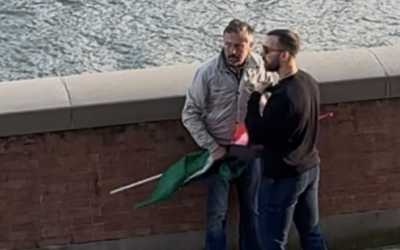
What disturbed me most was not the attack itself, but the reaction around it. People barely watched. No one, other than a friend of the woman–who had walked back when he heard the commotion–intervened. In broad daylight, in the center of one of Europe’s most beautiful cities, a woman was assaulted near a political demonstration and it seemed almost routine.
And, even if it wasn’t routine, few people will dare to come to the rescue or assistance of someone who is being attacked or berated by someone holding a Palestinian flag.
And why is that?
Perhaps it’s because so many of us have ceded the moral high ground to activists on the left. We are afraid to call out the one carrying the Palestinian flag lest we be labeled a fascist, a racist, or, even worse, a Zionist.
Especially in Italy, there is no worse insult than “Zionist.” Recently, a hotel owner in Tuscany refused to allow Israeli guests who had booked a room to stay unless they denounced Zionism. Italians, by and large, applauded this decision. As a simple exercise, I posted a question for the owner on Instagram: Do you also ask Russians to weigh in on Ukraine, and Chinese on Taiwan, or is it only Jews and Israelis who are singled out in this way? The onslaught of hatred I received for this question was enormous. It was violent and chilling.
Europe has every right to debate Israel, Gaza, war, nationalism, and the conduct of governments. But something dangerous happens when political movements begin to tolerate intimidation and violence in the name of moral certainty. It’s happening in Europe and it’s happening in the US.
What I saw in Florence was not merely anger about a war. It was the normalization of political aggression in public life. It was the assertion that there is only one side to take, and that failing to do so makes one deserving of any violence that comes their way. The woman, who later said she was a Brazilian-Jewish tourist, was not waving a flag or making threats. All she did was stand by herself along the river and have the audacity to shout back at a group of angry people who, once again, had shut down the entire city to make their political viewpoint known.
Democracies do not become illiberal over night. They crumble little by little: when intimidation becomes activism, when public aggression becomes morally excusable, and when bystanders begin to accept political violence–whether online or in real life–as part of ordinary life.
The west prides itself on its democratic culture. But democracies depend on more than elections and slogans shouted from bridges and streets by people who want a day off from work. They depend on social norms strong enough to restrain ugly, tribal hatred before it hardens into acceptance and permission.
The woman was not a politician. She was not armed. She was not threatening anyone. Yet in one of Europe’s great cultural capitals, she was attacked the moment she was perceived to stand on the wrong side of a political cause.
This fact should alarm people regardless of where they stand on Israel or Gaza.
Political protest is essential to democratic life, whether we like it or not. But political intimidation is not. What I witnessed in Florence was a reminder of how quickly the line between the two can fade. It’s something for all of us to think about. And, in the meantime, be careful what you say in Italy.