
Popular Israeli Music of the Year BEFORE October 7
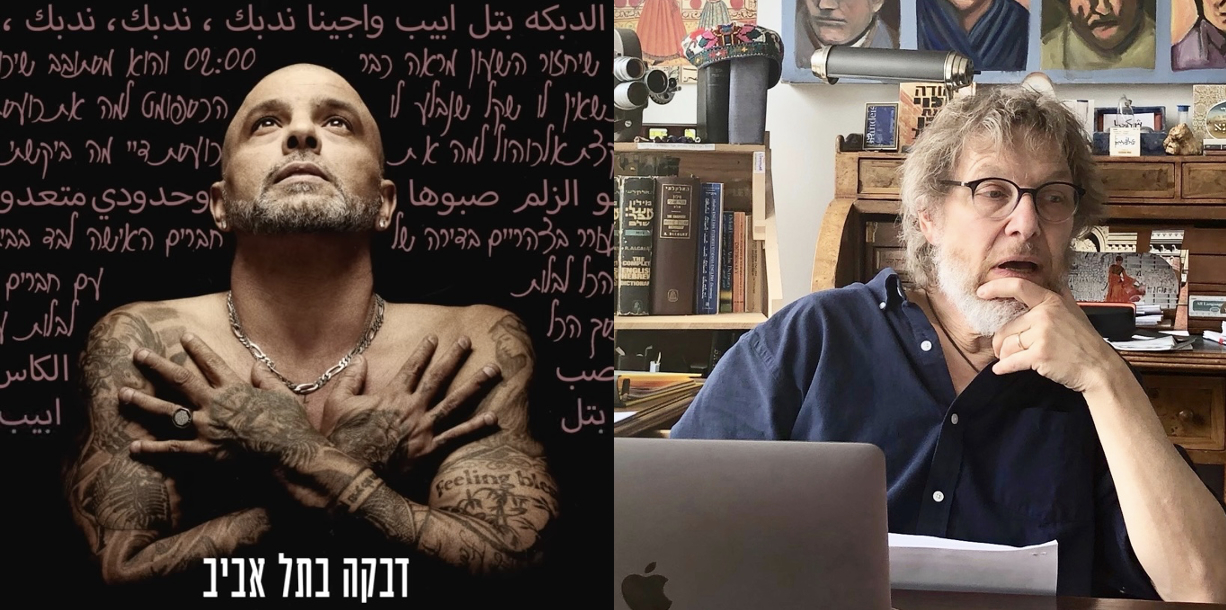
What was the music scene like in Israel BEFORE October 7?
That is the question at the heart of a research project that Benjamin Rubin has conducted. He calls it a form of “time travel” – to go back to an earlier era, back to a stretch of the river of energy and information known as Time, before the bend in that river known as October 7.
Rubin will present his findings as a live public presentation on Sunday evening November 16 at First Narayever, the “traditional egalitarian” congregation in downtown Toronto near the University of Toronto. The presentation is a curated audiovisual playlist that combines music, video and analysis, with printed lyrics in Hebrew and their English translation.
“Israel is half of modern Jewish civilization,” says Rubin. “So I study the music scene in Israel not only as a music lover, but as a cultural historian. By learning about the artists, music and lyrics of Israel’s musical scene, we learn something – many things – about the society that created them. I hope this audiovisual presentation will open attendees’ eyes, ears and minds to the artists, music and lyrics of half of modern Jewish civilization.”
Popular Israeli Music of the Year BEFORE October 7 is the second program of a series being organized by Narayever Israel Committee this year called Lev Yisrael – The Heart of Israel.
Lev Yisrael represents an important and emerging Jewish Diaspora response to the current virulent outbreak of Judeophobia. Judeophobia is a word coined by Toronto blogger Jacob Citron to refer to the phenomenon formerly known as antisemitism. Judeophobia is defined as “fear, hatred or hostility to modern Jewish civilization, which includes: the Jewish religion, Judaism; Jewish peoplehood; the Jewish state, Israel; and citizens of the Jewish state, Israelis.”
Instead of focusing on the Judeophobia so prevalent in the world today, Lev Yisrael focuses on the heart of Israel: the dynamic society of the modern Jewish state, the land in all its complexity, the diverse people and their remarkable accomplishments.
Here the focus is on popular music. “By listening to the contemporary popular music of Israel before October 7, we can open a window into Lev Yisrael, the heart of Israel. We can open a window of insight into Israeli culture, society and politics.”
Israeli music is incredibly rich, complex and diverse, reflecting its location between Africa, Asia and Europe. It contains the strong influences of Hebrew, Arabic and English. Israeli music navigates the tensions between an individualized urbanized Western economy and traditional religious societies, with roots in dozens of lands worldwide.
Music has always played, and continues to play, an outsized role in Israeli society and culture. It is a musical tradition deeply rooted in the Jewish world. Miriam and the Israelite women played music and danced at the shores of the Red Sea; King David played a lyre, danced and composed the Psalms. It is a musical tradition of synagogue prayers set to tunes and sung as songs; of the weekly Torah reading that is not read but, with a musical notation, chanted; it is a song-writing tradition rooted in the inclusion of Solomon’s erotic poem, the Song of Songs, in the Jewish canon of core Hebrew sacred texts. But music is also part of the orally transmitted Jewish tradition of women, such as for example songs of Jewish Yemenite women passed down from mother to daughter; and in the enduring Hasidic traditions of group singing, such as Shabbat Zmirot. And then, in the first half of the 20th century, among the Jewish pioneers in the land of Israel, this evolved into a robust national folk-song tradition.
That deeply rooted musical tradition has evolved in Israel, over three-quarters of a century of statehood, along the way incorporating multiple new influences and currents.
One very strong current is what is sometimes called “Mediterranean” (“Yam Tichoni”) or Mizrahi (“Oriental”) musical styles, often featuring singers whose families came from Arab countries, and the use of Arab musical instrumentation, such as the stringed oud, the darbuka drum, and the vocal quavering semitone often heard in Arab music. We also see increasingly the incorporation of Arabic language words and phrases.
Another strongly developing current in Israeli popular music has been spirituality. Sometimes associated with Jewish religious practice, more often it’s a more generalized spirituality, sometimes with inspiration from Jewish memes or quotations from Jewish texts. That is in marked contrast to the musical mindset of more old-fashioned Israeli popular music that many still think of as “Israeli popular music”, based on old Eastern European folk song traditions, and often secular. Whole new generations of musicians, many being grandchildren of those who came from Arab lands, while not expressly observant, have a “kipah b’lev”, a “kipah in their heart”, meaning a warm place for traditional Jewish yearnings, references, texts.
The music is played on the radio on popular music stations; in many live musical performances throughout the country; at weddings, where music and dance are dominant in both secular and religious celebrations; and through electronic media such as YouTube. And it is extremely popular. Some of the YouTube videos included in the presentation have as many as 42 million views, in a world where only about 10 million people speak Hebrew.
Since in the limited time of the live presentation it’s not possible to cover the vast range of musical offerings on the Israeli musical scene, Rubin has selected 18 songs from the period January-September 2023 which were either very popular, or reflect the spirit of the time in its complexity, or are representative of the main underlying themes, styles and currents of contemporary Israeli popular music.
Ron Riesenbach, head of Narayever’s Israel Committee and originator of Lev Yisrael, hopes the Lev Yisrael series, of which Rubin’s presentation on Israeli music is the second installment, will present the positive side of Israel that doesn’t make daily news.
Says Riesenbach, “Lev Yisrael hopes to push aside the gloom and to instead shine a spotlight on the amazing creativity of Israeli society and some of its accomplishments.”
Benjamin Rubin’s public audiovisual presentation on Israeli Music of the Year BEFORE October 7, accompanied by Israeli wine and snacks, will take place at First Narayever Congregation on Sunday November 16 at 7:00 pm. Attendance is free, but registration required: https://www.narayever.ca/form/Israeli-Music-pre-October-7