
Carrie Bradshaw of the Middle East
Populism Vs. Secure Attachment
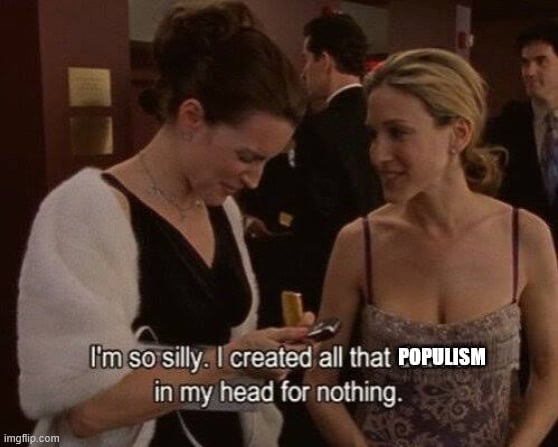
Adapted meme based on a scene from Sex and the City (HBO), included here for cultural commentary.
Earlier this year I went on a few dates with a guy recently out of a relationship who was focused on handling his anxious attachment style. He was in therapy, had taken up making sourdough bread, and was viciously going through Insecure in Love: How An Anxious Attachment Can Make You Feel Jealous, Needy, and Worried and What You Can Do About It. These were green flags, by the way. We love a man focused on personal growth.
Therapy Guy asked me about my attachment style on our first date. I wasn’t sure how to define it. It’s never been that much of an issue for me. Thanks to therapy, I’ve determined I mostly have a secure attachment style with some anxious tendencies, which doesn’t mean I don’t spiral, but it does mean I come back from spiraling quickly. He was used to intensity.
Intensity can feel normal. Expected. An indicator of health. The absence of anxiety and drama sometimes leaves us wondering if the thing we’re pursuing can really be love. Our brain wants to live in extremes. Therapy Guy was doing the hard work of getting to the middle.
It all comes down to core childhood wounds, or so I’m told. We all have those. We want deep emotions. It’s no wonder the middle isn’t a popular place to be. The more I thought about it, the more I realized attachment styles aren’t just romantic. They shape how we move through the world.
The Colombian presidential elections are finally over. A country that’s been fighting between populisms finally arrived at a candidate from the far left, Iván Cepeda, or another from the far right, Abelardo de la Espriella. The far-right candidate, toting support from Trump, and yes, Netanyahu, won with 49.66% of the votes. The far-left candidate lost with 48.70% of the votes.
Neither of them was my candidate, but because of my personal ties to Colombian politics, I voted for the one I felt would persecute my family less.
It’s hard work to be in the middle. I had wanted to vote for a ticket that tried to land in the center and rode on the coattails of a dead populism, Uribismo, believing that would sway others to back them. It didn’t work. As polls closed and counting began to show the far rights slight victory, I was surprised to see streets flooded with supporters wearing Colombian soccer jerseys, claiming our new president as the defender of democracy.
It’s easier to file things away if they’re clearly black or white. Reality is much more confusing. I told Therapy Guy that I wasn’t sure of my attachment style. I had been through all of them. I think it’s okay to be nervous about someone texting you back but also hold on to your space and independence. Secure attachment isn’t the absence of feeling. It’s the ability to tolerate uncertainty without immediately turning it into a story. Politicians need us to do the opposite.
The center requires us to live with uncertainty. In relationships, that means trusting someone before you have proof. In politics, it means accepting that no candidate is coming to save us. Both require the same thing: faith that reality can be complicated and still be okay. Maybe secure attachment isn’t certainty at all. Maybe it’s learning to sit with the fact that someone can disappoint you without becoming a villain, and someone can help you without becoming a savior. Relationships need that. Democracies do, too.
I was enjoying getting to know Therapy Guy. It didn’t feel particularly exciting, but he was smart, kind, and took me to new restaurants. But we weren’t compatible. He wasn’t as ambitious as I know I need someone to be, and I was too ambitious for him.
Populism and insecure attachment don’t present a long-term solution to real problems, only a brief respite from ambiguity. I wanted a cleaner story. A red flag I had missed. A warning sign. Something that would make the ending make sense. Instead, there was only the truth: he was a good man, I was a good woman, and we weren’t right for each other.
Related Topics
Related Posts