
Rooted in Hope, Driven by Vision
Post-Mamdani, It’s Time to Redesign Aliyah 2.0
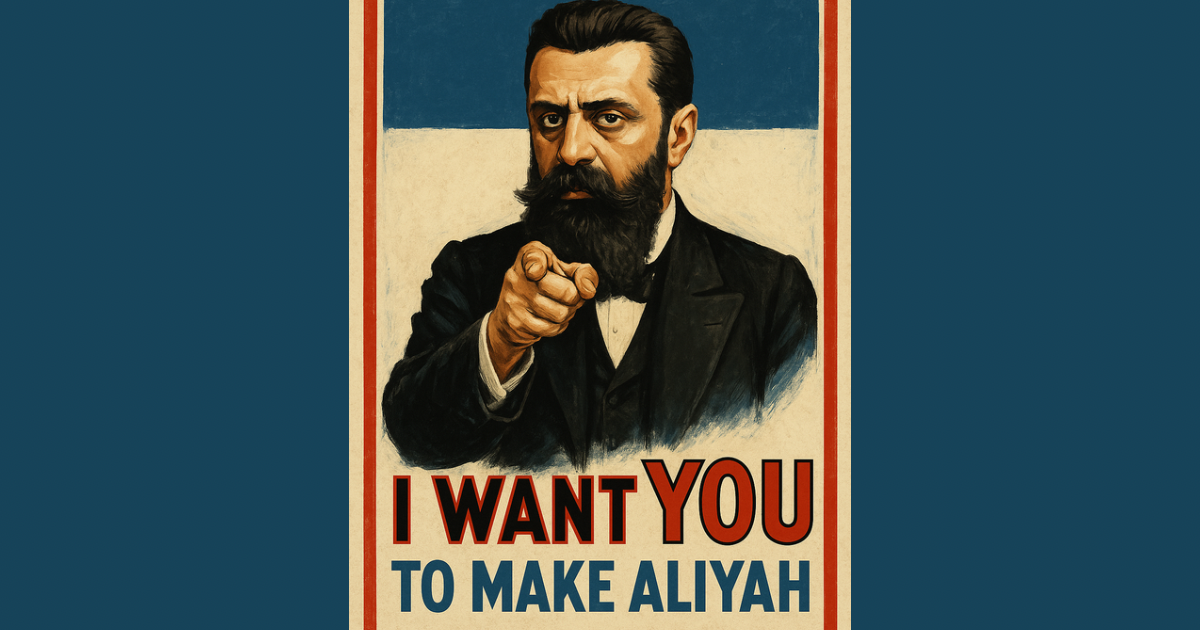
Aliyah 2.0 by Revivalist Collective
There are moments that don’t just sting — they clarify.
Mamdani’s mayoral victory in New York City might look like just another political upset. But to many American Jews, it feels like a canary in a coal mine. The city that once embodied safety, culture, and purpose now celebrates a man whose rhetoric reflects a deeper fracture — one where anti-Zionism has not only won as a campaign strategy this time, but will surely influence future campaign strategies aimed at courting a cultureless, clueless Gen Z.
It’s not about one election. It’s about what it reveals: a civilization slowly forgetting what it stands for.
On the latest episode of Honestly, Bari Weiss and philosopher John Vervaeke called it a “crisis of meaning” — the slow collapse of the moral architecture that once held the West together. When belief in God became “unenlightened,” and faith was replaced by the scientific method; when religion became suspect and was therefore removed — a vacuum was created. A vacuum of emptiness, of nothingness, of purposelessness. And now, as nature itself is replaced by screens, that vacuum has become our collective home.
You can feel it in the streets of New York, in the scroll of social media, in the quiet exhaustion of people who no longer know what story they’re in. Vervaeke traces it back to the Enlightenment’s bargain: trade mystery for measurement, transcendence for proof. The result is a generation drowning in data and starving for meaning.
But Jews know this terrain. We’ve lived through civilizational collapses before. And we’ve rebuilt.
If exile is starting to feel like exile again, maybe it’s time to remember that return was never only about geography. It was about recovering purpose — the sacred rhythm between people and land, idea and action.
Maybe it’s time for what I’ll call Aliyah 2.0 — not an immigration program, but a cultural revival cohort. A generation choosing not just to live in Israel, but to relearn how to live as a people: intentional, interdisciplinary, land-based, community-driven.
Imagine young Jews coming not only to find safety, but to find meaning — to study language, rebuild shared rhythms, and reconnect to a story bigger than politics. This isn’t nostalgia; it’s revival. It’s taking an old model that worked and revamping it to make it just as effective for today.
The First Aliyah rebuilt the land.
This one might rebuild the spirit.
I’m not here to pitch a pilot program — not yet. But I do believe something needs to rise in the space between despair and disillusionment, between those who are spiritually homeless in America and those of us trying to build a new cultural center here. Revival doesn’t happen through institutions alone. It starts with vision — and with people brave enough to try.
And for the record, I’m not only speaking metaphorically. I’ve got two bedrooms for rent in the bottom of my house starting in January — and a whole lot more where that came from.
Revival begins with the brave. Always has.
Related Topics
Related Posts