
Bridging faith. Defending truth. Confronting hate
Postmillennialism: Why the Israel Debate Has Been Theologically Misdiagnosed
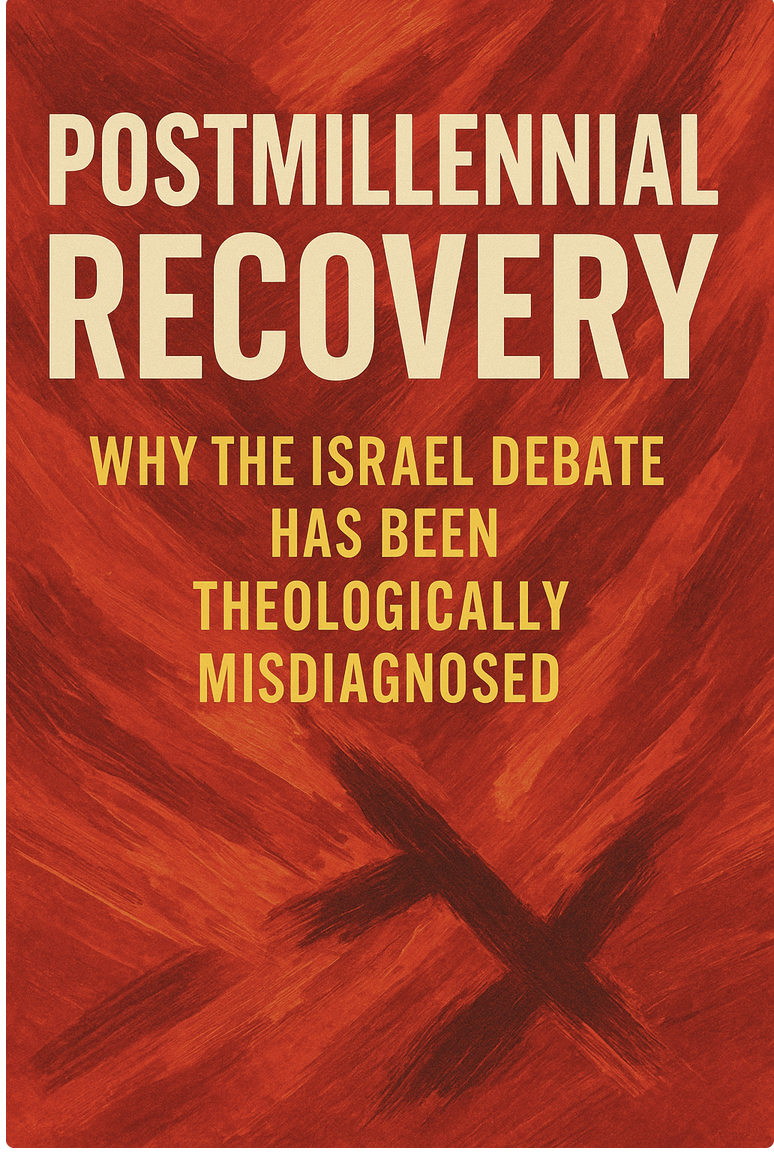
The image was created by Tim Orr using ChatGPT on Nov. 26, 2025
For years, conversations about Israel inside the church have been forced into a cramped little frame, as if the only positions available were dispensationalism on one side and covenant theology on the other. The whole conversation got squeezed into a tiny frame, and in the process everyone forgot something that should’ve been obvious. Historic premillennialists never stopped affirming Israel’s place in God’s purposes—and they managed to do it without the entire dispensational apparatus attached to them like a warning label. Their testimony should have been enough to unsettle the whole “two camps only” script, but somehow it never did. In a lot of Reformed circles, anything faintly sympathetic to Israel was treated like someone had slipped a Scofield reference into the liturgy. The suspicion wasn’t argued—it just settled in, the way bad lighting slowly becomes normal. And then October 7 happened, and those old instincts didn’t hold up the way people assumed they would.
Once you start restoring the larger Christian map, everything looks different. The moment postmillennial and historic premillennial voices are allowed back into the room, you see the same pattern rising to the surface again and again: Christians who expect God to actually move in history—real history, with real nations and real promises—tend to leave space for the Jewish people without making a big show of it. The Puritans didn’t treat any of this as strange. They simply read their Bibles and assumed God meant what He said about the Jews, so they prayed accordingly. No charts, no timelines—just the sense that God doesn’t walk away from His own promises. But somewhere in the twentieth century, all of that got smothered under academic arguments that tried to turn Israel into nothing more than a stand-in for the church. And now, oddly enough, you can hear hesitation creeping back into amillennial and covenantal circles, mostly because Romans 11 won’t stay put. The old formulas aren’t holding.
The recent postmillennial interest in Israel isn’t some novelty. It’s more like people remembering something they forgot they knew. Their hope has always rested on the idea that God moves in history—which means real people, real nations, real covenants—and Israel sits right there in the middle. October 7 jolted that instinct awake. It exposed how thin some modern Reformed assumptions had become and how far the tradition had drifted from its early imagination. And once that older layer resurfaced, postmillennialists started realizing they’d been living inside a smaller story than the one they inherited.
Several voices helped give shape to this recovery. Doug Wilson made it plain that Romans 11 fits easily inside a vision of the world gradually coming under the reign of Christ. Canon Press started pulling old Puritan material back into circulation, things most people in the Reformed world hadn’t looked at in decades. Rigney and Isker kept pointing to Israel’s continued existence as something God has made visible on purpose, not a side issue tucked into an academic debate. Even TGC, which usually keeps its distance from these kinds of arguments, pushed readers to drop the ideological filters and actually read the passages in front of them. None of this was planned. It just surfaced, one voice at a time, and suddenly people were realizing they’d ignored a lot more than they thought.
And here’s the point that actually unsettles the whole conversation: when Christians read the Bible as a story that plays out in real history—not as a set of symbolic cues—Israel shows up. Again and again. You can try to file it away, but it keeps coming back. That is why premillennialists, postmillennialists, Puritans, and even some amillennial theologians—coming from utterly different starting points—keep arriving at surprisingly similar conclusions. Israel is not a theological oddity invented by dispensationalism; it is a load-bearing beam in the biblical narrative. The attempt to cordon off Israel as a dispensational artifact was a twentieth-century detour, not the historic Christian instinct. And once that detour is exposed, the old binary collapses, clearing the way for a much older and much broader vision of God’s covenant faithfulness.
Related Topics