Distinguished Fellow Humanities, Hebrew University
The Day of the Blast!
Day of the Blast!
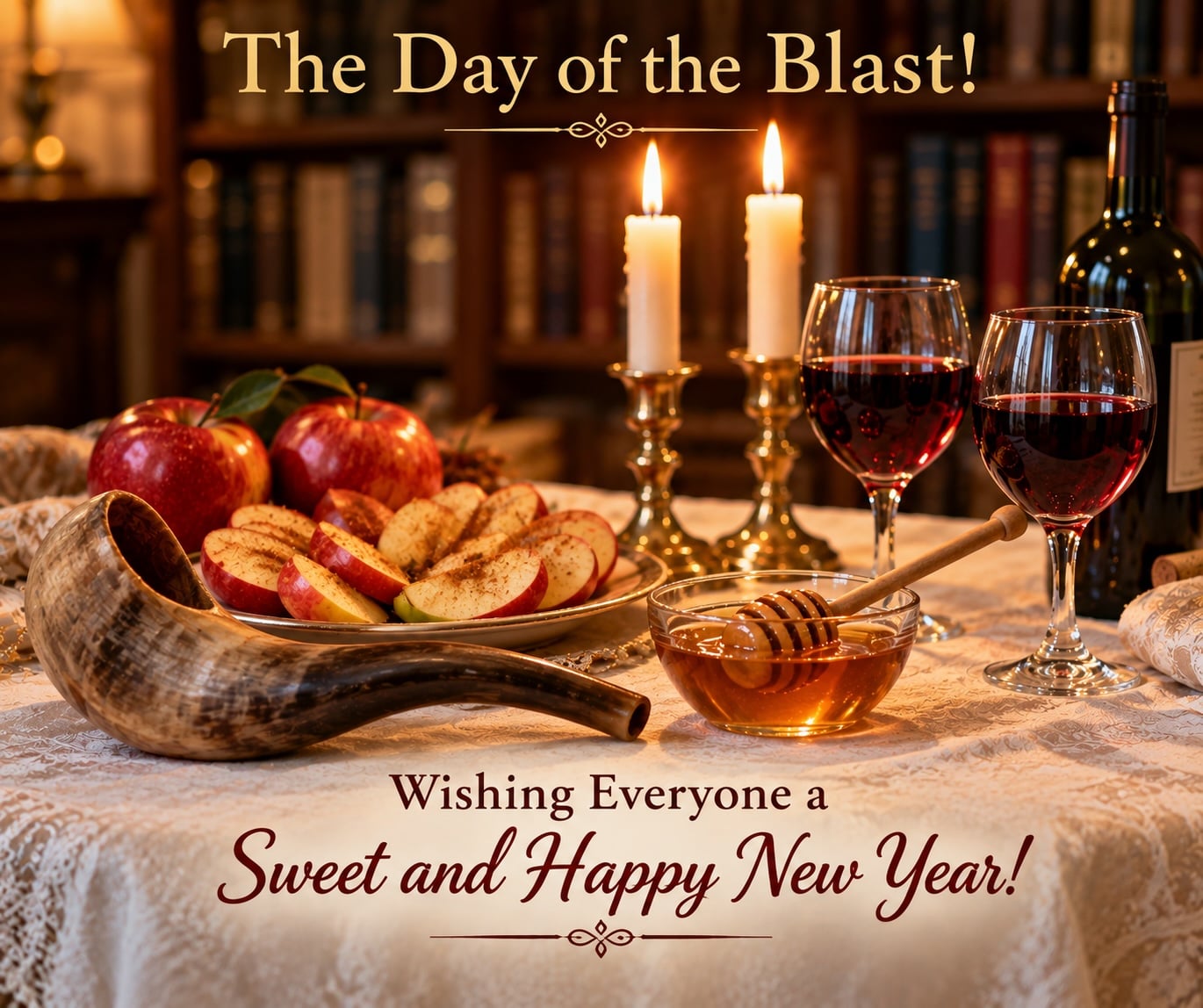 I wish all of you a Happy Yom Teru’ah, the Hebrew term for what is commonly called Rosh Hashanah–(lit. “head of the year”)–or the “Jewish New Year.” In fact, according to some Jewish traditions it is not so much the Jewish New Year, as the remembrance of the “birth of the world,” so to speak. The Rabbis argued back and forth on whether the Genesis 1 account of “Creation” took place on the first of the first month–that is in the Spring, or the first of the seventh month–as it is celebrated today in the Fall. Of course these agricultural markers are meaningless outside the northern hemisphere, where the seasons are opposite.
Based on the ancient tradition of Exodus 12:1-2, the Lunar/Solar calendar year begins in the Spring—with the “turning of life,” as the Hebrew phrase expresses it, whereas the “Day of the Blast” (Yom Teru’ah) aka “Feast of Trumpets” inaugurates the Fall Holidays culminating in Sukkoth, based on the Hillel II mathematical version of the old agricultural Solar-Lunar (observed) calendar. The New Year concept came into play in the late 2nd Temple and post-2nd Temple period, from its place as a kind of civil and economic marker–especially leading to marking the Sabbath years and Jubilee on the 10th of the 7th month. Thus the modern practice of seeing this day as the “Jewish New Year.”
The Jewish calendar and its intercalations, along with the underpinning “19-year time cycles” attempts to keep the twelve lunar months numbering 29.53 days, and the resulting lunar year of 364 lunar days in sync seasonally with the 365.242199 days of the solar year. The so-called “Essene” or “Jubilees” solar calendar, used by the Qumran community, used a different system entirely–ignoring the lunar months, see my lecture on Youtube summarizing the basic differences: “The Dead Sea Scroll Essene Calendar Explained.”
The Muslims follow a solar/lunar calendar but ignore the 13th month intercalations of the Jewish calendar, and as a result the holy 9th lunar month of Ramadan cycles through the seasons of both northern and southern hemispheres–since a solar year is 11.24 days longer than 12 lunar months of 29 days. The standard reference book explaining the modern Jewish calendar is Arthur Spier, Comprehensive Hebrew Calendar—which takes one up to the year 2100 in terms of the Jewish festivals and Torah/Haftorah readings! It should be noted that the Jewish “observed” festivals, tied as they were to agricultural cycles of the northern hemisphere, are opposite in the lands “down under,” as we northerns see things! So to make them global and international, as Jews of course in our time live everywhere, one must turn to a mathematical model.
What is interesting is that no source within the Torah tells us what the meaning of Yom Te’ruah. Its literal meaning is “Day of the Blast” or “Day of the Shout.” So other than the act of noting this memorial proclamation with a Blast—which traditionally became a Shofar, its full and varied meaning in biblical times is not preserved. What one is memorializing is open to discussion. Isaiah 29:13 speaks clearly of an eschatological “Great Shofar” that will be blown, heralding the return of all the Israelites Exiles to the Land. Later Rabbinic tradition expands this to the great day of judgment–hear by year, as well as at the end of the age, when the call to repentance rings out to the nation and to the entire world!
Millions of “Hebrew Roots” oriented Christians today, who have taken up some version of the “feasts” see this day as foreshadowing the “Last Trump” of Paul’s eschatology (1 Corinthians 15:32), as well as in the Apocalypse of John (“Book of Revelation”) in the New Testament. (Revelation 10-11). However in its original settings, it apparently meant something quite differently, tied to the ancient Israelites agricultural and economic calendar. The Blast of the Shofar signaled both the End and a New Beginning–including within the Oral Torah, the heralding the judgment of Heaven and the spreading of the Kingdom of God to all nations, as represented at Sukkoth–extended to all nations (Zechariah 14:16).
So yes, I say L’Shanah Tova to all of you—wishing you a good “Blast” and “sweet” New Year with apples & honey and lots of love. God speed the day when the “wolf and the lamb” lie down together–and those swords are transformed into plows and deeply sunk into the good Earth. Whether taken literally, metaphorically–or both!
Related Topics
Related Posts