
Power First, Rules Second
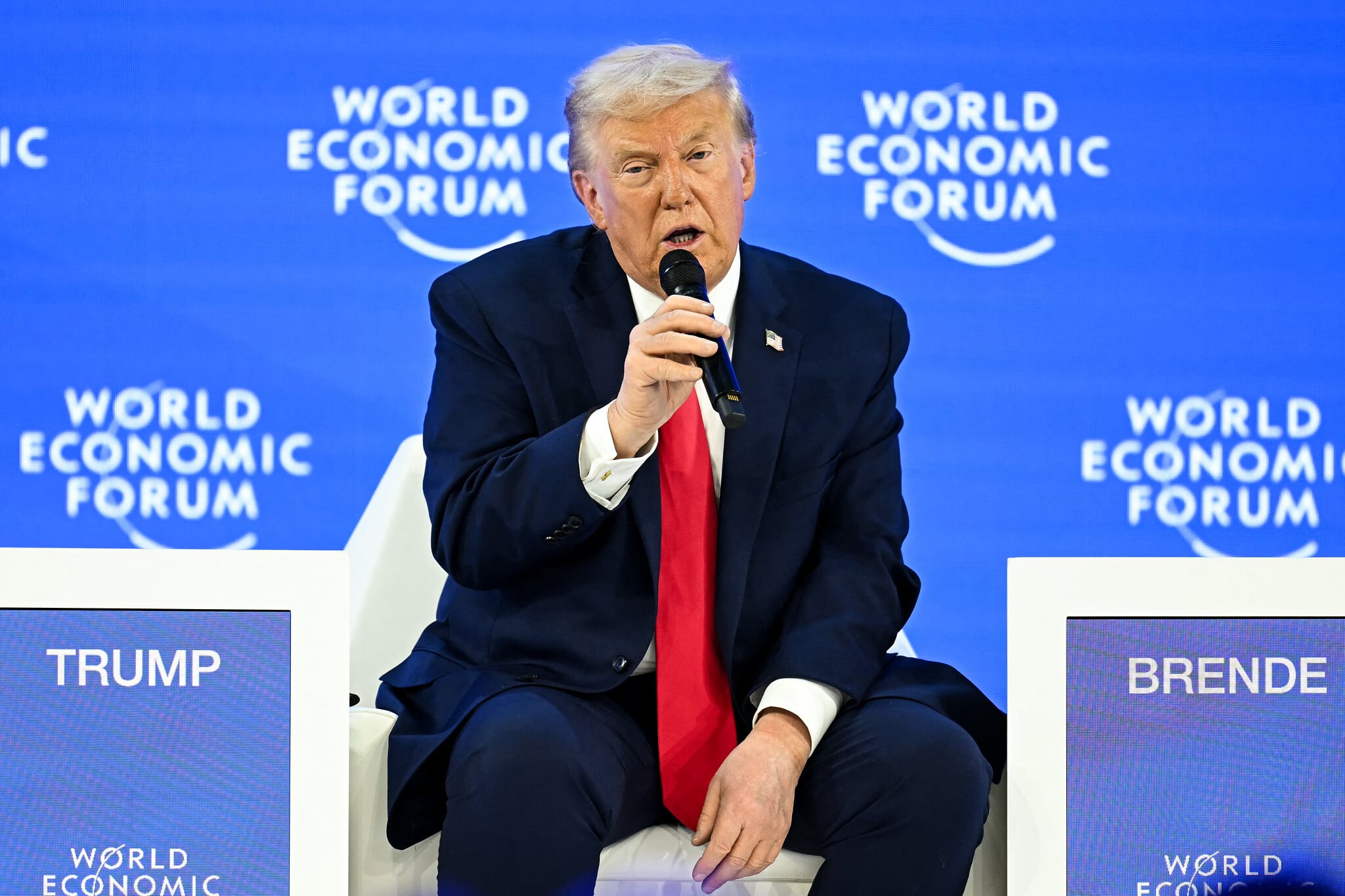
The speech delivered by Donald Trump at the World Economic Forum in Davos is not a simple rhetorical exercise intended for global economic elites. He is part of a much broader strategic sequence, revealing a profound transformation of American diplomacy during his second term. Behind the apparently reassuring formulas—notably the assertion that the United States would not use force to obtain Greenland—there emerges a logic of assumed power, based on political, economic, and narrative constraints.
Davos, by its symbolism, is not a neutral place. By addressing this forum, Trump is not so much trying to convince as to lay down the terms of the balance of power. His speech targets several audiences: American opinion, to which he shows that he uncomplexly defends national interests; the European allies, whom he puts under pressure; and strategic rivals, to whom he reminds that Washington remains the central actor of the international system.
Greenland: securitization and coercion without invasion
The episode of Greenland plays a major role in this speech. Donald Trump affirms that there will be no use of force but insists that only the United States would be able to ensure the “security” of the island. This rhetoric is essential: it comes from the process of securitization, which consists of transforming a space or a political issue into a strategic imperative justifying exceptional measures.
By firmly turning down the military option while demanding quick negotiations, Trump is not giving up on the goal; he is simply modifying the tools. The pressure becomes indirect: diplomatic, economic, and symbolic. This method is part of a strategy of coercion under the threshold, where the use of force is replaced by the creation of a sense of inevitability. The message is clear: the status quo is no longer acceptable, and the outcome will have to go through an accommodation with Washington.
Greenland thus becomes a peripheral theater of a broader rivalry, linked to the Arctic, new maritime routes, and the recomposition of strategic spaces. Even if Trump downplays the issue of resources, the geopolitical dimension is obvious. The goal is not just territorial; it is also normative: to remind that the great powers redefine the rules when their vital interests are at stake.
Europe: from the alliance to the transactional relationship
The Davos speech also reveals the assumed deterioration of the transatlantic link. Europe is no longer presented as a strategic partner sharing common values but as an economic and political actor to be “disciplined.” The tensions with several European leaders, notably French, reflect this evolution.
Trump applies a transactional logic to the Atlantic alliance: protection against concessions, support against alignment. This vision breaks with the post-war multilateral American tradition. NATO and the European Union are no longer structuring frameworks but platforms from which the United States negotiates on a case-by-case basis.
This position weakens the unity of the West. By publicly pressuring its allies, Washington creates internal fissures that weaken the collective capacity to respond to revisionist powers. However, from the perspective of Trump and his supporters, the resulting fragilization of alliances is a secondary concern; their primary objective is to reaffirm hierarchy rather than maintain the illusion of equality.
An implicit doctrine: power, unpredictability and constraint
Taken as a whole, the elements of the Davos speech draw an implicit doctrine. It is not a pure and simple return to militarism but a redefinition of the instruments of power. The armed force remains present in the background, but it is replaced by a combination of economic pressure, rhetorical shock, and calculated unpredictability.
This strategy recalls the power logics of the early 20th century, adapted to a globalized world. It marks a turning point: multilateralism is no longer a binding framework but a backdrop; alliances are no longer guarantees but adjustment variables.
Donald Trump’s speech in Davos should not be read as an isolated provocation but as a strategic clarification. It announces a world in which stability is no longer based on shared rules, but on assumed power relations. This signifies the resurgence of power politics, not through outright conflict, but through ongoing restraint.