
President Netanyahu the Unifier?
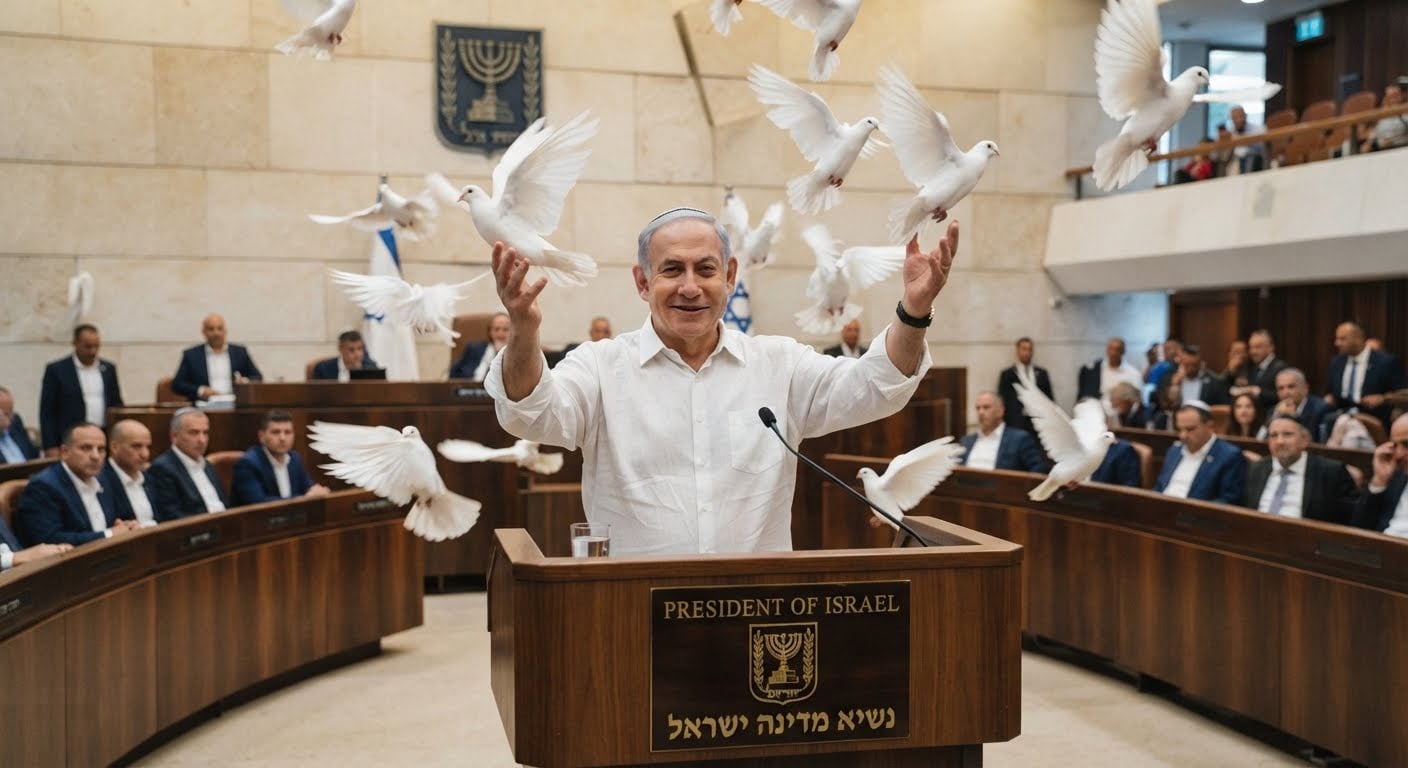
Here’s another hare-brained suggestion on how a new government might be formed after Israel’s October 2026 election.
Let’s cut to the chase. There are four possible routes to a governing coalition and only one is realistic.
First option – the change bloc does a deal with the Arab parties. Not realistic because, even if Eisenkot could stretch his four principles, and the Arab parties opted to fulfill them, then Bennett and even more so Liberman are dead set against it, and they’ve made commitments to their voters.
Second option – the change bloc could form a coalition, or a minority government, with charedi support. Not realistic, it’s obvious why, but let’s take the opening sentence of prime minister (PM) Netanyahu’s own comment on this matter just for starters: “For four years, we saw unbridled attacks on the charedi sector, morning and evening, by the media and the left-wing bloc.”
Third option – the PM peels off ‘change bloc’ part(ies) to join his existing coalition. Not realistic because (i) Eisenkot saw what happened to Gantz when he did the same; (ii) Beyachad, the Democrats and the Arab parties are dead set against it; (iii) the Democratic sweep in the US Mid Terms has made the existing coalition even less appealing than before; and (iv) the only viable party that may do so is Liberman, but he doesn’t bring the numbers, and has again come out against serving under Netanyahu committing to his voters, “neither Bibi nor Tibi”.
Fourth option – and the only realistic one among them – is a so-called ‘unity government’. This has Likud with Eisenkot, Beyachad and Liberman. As Gil Troy has well-argued, there is ideological alignment across these four centre-right-leaning parties. With a little flexibility, they could agree a common platform that builds consensus on how to address key national priorities – national security, military service, public diplomacy, judicial reform, cost of living, Arab integration and crime, settler violence. Others where an unbridgeable divide remains – e.g. October 7th independent enquiry – may be put aside ‘for the sake of national unity’. This would create a governing coalition which commands a 67-seat majority in the Knesset.
However, the main blockage to this arrangement would be PM Netanyahu himself. This is not only about the personalities and their complex history. It is also about the kind of ‘change’ that the ‘change bloc’ promised their voters. A ‘change bloc’ government with Netanyahu still as PM is simply not any kind of change that their voters voted for.
The problem, then, is, what could persuade Netanyahu to stand aside as PM so the change bloc leaders can join a unity government with Likud?
Now, here comes the hare-brained scheme.
Let’s make Bibi the president.
I might be wrong, but this seems quite easy in practice to accomplish. With reluctance, but in the national interest, President Herzog agrees to resign. He does so by sending a resignation letter to the Speaker of the Knesset. The office of the president officially becomes vacant 48 hours from receipt of the letter. Under an agreement among the four parties wielding their majority, the Knesset votes to appoint Netanyahu as president. Netanyahu steps down as PM, allowing Eisenkot (presumably) to take over (either for the full term, or in agreed rotation with other leaders). The cabinet posts are then filled from the four parties based on negotiation.
There are two obvious problems with this suggestion:
Problem 1: Netanyahu would not agree to become a figurehead president who does not have any power to wield.
Problem 2: The other parties would not agree to give Netanyahu power by changing the constitutional role of the Israeli presidency if it simply recreates the functional equivalence of letting Netanyahu stay on as PM.
The solution:
- Netanyahu gets his pardon as a condition of this arrangement. It would be the last duty performed by President Herzog before he resigns. The change bloc parties would be reluctant, but the court proceedings are in any case looking increasingly ridiculous, so it stops this circus before more damage is done to the standing of Israel’s legal community.
- In the one piece of legislation necessary to cement this arrangement, Netanyahu’s term of office is made conditional on the survival of the coalition. If the coalition falls, Netanyahu’s term is over, and Herzog comes back as interim president in the run up to an election and during any caretaker government. Presidential tenure was changed by law in 2000 from a maximum of two five-year terms to a single seven-year term, so it would not be unprecedented to fiddle once more with the role of the presidency. In this case, the change to the presidential tenure could apply in this specific circumstance only before reverting back again in the future.
- Subject to sounding out the Trump Administration on this in light of the Mid Terms, a President Netanyahu could be designated Israel’s interlocutor with the White House, to maintain relations with the US President for the remainder of his term, especially on Iran and other national security questions, while the broader foreign policy remit is given to a new foreign minister better positioned to lead a new public diplomacy drive that aims to improve Israel’s standing. In so doing, Netanyahu would participate in the security cabinet along with Eisenkot, other coalition leaders, and the security chiefs.
- The main remit for a President Netanyahu, however, would be to facilitate and deliver consensus, among the new governing coalition, and across the country on the key areas identified above: national security, military service, public diplomacy, judicial reform, Arab integration and crime, cost of living, settler violence.
At first glance, this is a ridiculous idea. Netanyahu is widely considered to be one of the most divisive leaders in Israel’s history.
However on deeper reflection, it could turn out to be an ingenious move. The primary risk Israel faces today is polarisation. A wrong move on any one of these issues could lead to a repeat of the mass protests that have debilitated the country over the past few years, from the right or from the left.
Netanyahu has always been effective at bringing together – and keeping together – parties and politicians with conflicting viewpoints. He is also Israel’s most effective communicator. Turning these capabilities inward is what the country needs right now above all, not just within government but also across wider society.
It goes without saying, Netanyahu is highly respected on the right, and in particular among the religious and traditional voters. It is these segments most likely to resist movement on the key issues if they were driven by the change bloc alone. Arguably, only Netanyahu has the standing to bring these segments of the country on board.
And contrary to stereotype, Netanyahu himself is neither an ideologue nor an extremist. His positions have been relatively moderate and pragmatic across the board – security, the economy, social welfare, foreign policy, religion.
Let’s try to separate out two things: his notorious thirst for power on the one hand, and his own policy positions on the other. It is the thirst for power, not his policy leanings, that has led him to become an enabler of the far right – a difficult choice (witness his prior refusal to appear with Ben Gvir in public) but the only avenue that became available to keep him in office at the time. And it is this same thirst for power, not policy differences, that has alienated past allies like Liberman and Bennett.
The standard media view of Netanyahu’s thirst for power links to alleged megalomania and character weakness. A more charitable viewpoint is that he just doesn’t trust anyone else to have the understanding of international affairs, the networks, the persuasive capacity, the intellect, the stubbornness and the sheer force of will to keep Israel safe, and I think this is what drives Netanyahu’s enduring popularity with the voters.
In this sense, Netanyahu’s thirst for power could be sated with the assurance of a dignified path towards retirement. He’s 77 now and will be 81 at the end of a four-year term for the next government. If the first four years are successful, an additional term could be agreed, allowing him to step back at the age of 85 with his legacy secured, and his reputation re-oriented much like his Likud predecessor, Menachem Begin, after the 1979 Camp David Accords with Egypt.
In this sense, the presidency for Netanyahu could be positioned as helping him rediscover his ‘true self’:
– a war hero who served his country with distinction
– a reformer who set Israel’s economy on its pathway to incredible growth
– a statesman who recognised overlapping interests with the moderate Arab nations and transformed the region through the Abraham Accords
– a seeker of peace who once said “in my vision of peace, in this small land of ours, two peoples live freely, side-by-side, in amity and mutual respect”
– a secular-traditional family guy who is simply proud of his country and proud of his people.
Most of all, he is someone who has always preached the case for national unity. Among many other quotes, the PM once said: “we need to resolve these issues in a spirit of compromise and a spirit of tolerance. As Prime Minister of Israel, I promise you that I will not permit anything to undermine the unity of our people. Israel must always be a place that each and every one of you can call home.”
Let him finally be given the opportunity to practice what he has repeatedly preached. No excuses any more.