Leadership With Heart
Preventing a Rosh Hashanah Massacre
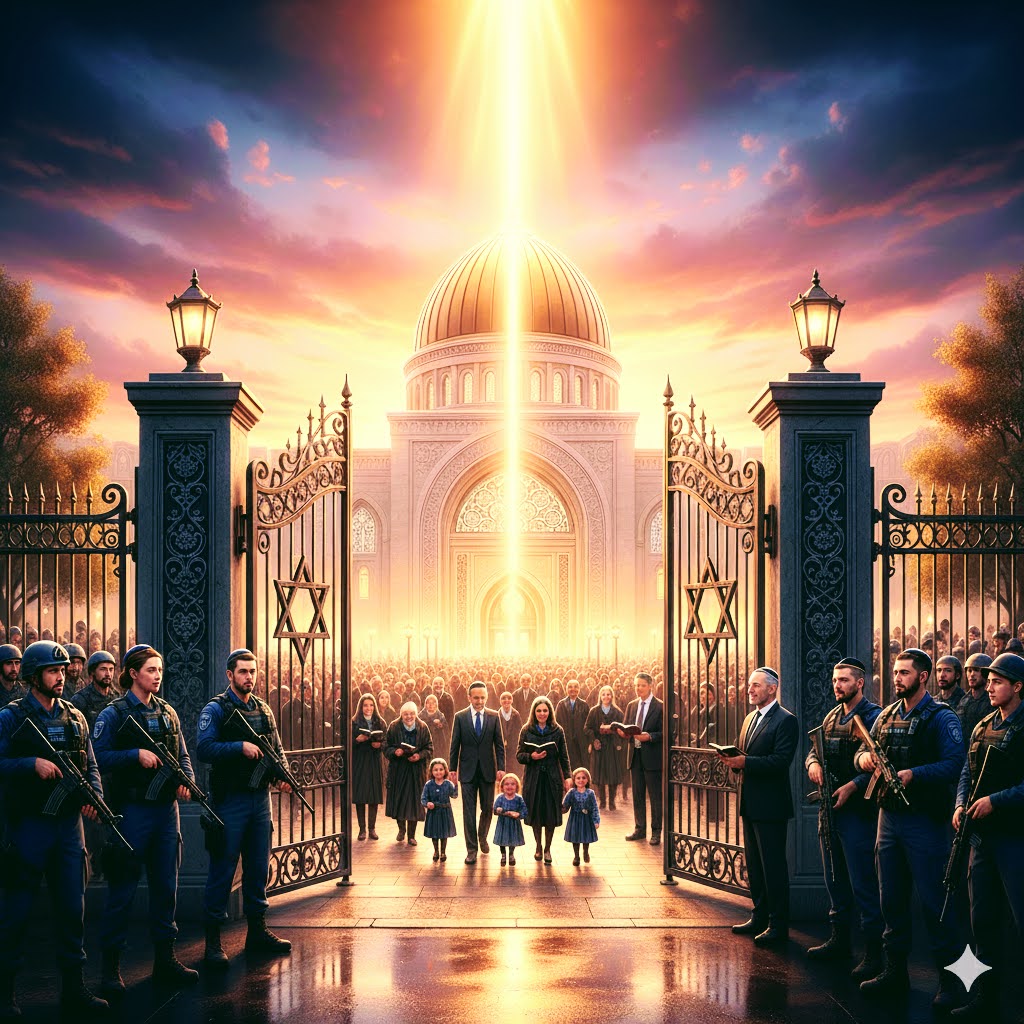
AI generated image via Gemini
The State of Israel and the Israel Defense Forces (IDF) have long shouldered the burden of confronting terrorism from all directions—from Hamas’s October 7 massacre to Hezbollah’s missile fire in the north, Houthi attacks from Yemen, and rockets, missiles, and drones directed from Iran. Israel has fought hard and scored significant victories. However, as Israel continues its determined effort to eradicate Hamas in Gaza City, the global Jewish community—both in Israel and the diaspora—may now be at its most vulnerable point in decades, especially as we enter the sacred cycle of the High Holy Days.
A History of Atrocities
History tragically shows that radical Islamist terrorists exploit moments of symbolism and vulnerability. Devastating attacks include the notorious murder of Israeli athletes at the 1972 Munich Olympics and attacks on the Israeli Embassy in Buenos Aires in 1992, followed by the AMIA Jewish community center in 1994—terrorists have consistently targeted Jews and their allies when they are most exposed. The October 7 massacre on Simchat Torah mirrored this brutal pattern on a scale unseen since the Holocaust. Terrorists kill children in their beds, gun down families at weddings, and defile funerals, demonstrating that for them, nothing is too sacred to desecrate.
Even Yom Kippur, the holiest day of the Jewish year, was chosen by Egypt and Syria in 1973 as the moment to launch a war of annihilation, striking Israel while Jews were fasting and praying in synagogues. That lesson—that the enemies of the Jewish people strike when we are most vulnerable—cannot be ignored.
With Hamas cornered in Gaza but still seeking relevance, Hezbollah looking for revenge, and Iran’s IRGC (Islamic Revolutionary Guard Corps) plotting abroad, the danger is escalating. Attacks on Jewish sites worldwide are not new. For decades, terrorists have targeted Jewish institutions and people globally, demonstrating that no location is truly safe. Examples include:
- The 2002 bombing of a synagogue in Tunisia.
- The 2008 Mumbai attacks, which included a Chabad House.
- The 2012 terrorist attack on Israeli tourists in Bulgaria.
- The 2018 massacre at the Tree of Life Synagogue in Pittsburgh.
- The 2019 shooting inside a synagogue in Poway, California.
- The 2019 Chanukah stabbings at a rabbi’s home in Monsey.
- In 2023, terrorists attacked a Jerusalem synagogue, killing seven people.
- In France, the 2006 torture and murder of Ilan Halimi, the 2012 Jewish school shooting in Toulouse, the 2015 kosher supermarket attack and the 2024 rape of a 12-year old Jewish girl in Paris.
- The 2025 firebombing of a Jewish group protesting for the hostages in Colorado.
- The 2025 double murder of Israeli embassy staff members in Washington, D.C., outside the Jewish Museum.
Terrorists have also struck a wide range of civilian targets to create maximum terror and chaos. They have attacsked Jewish schools, synagogues, and universities, as well as pizzerias, discos, malls, and buses. This pattern shows that for these extremists, no place is off-limits. Each attack bears the same grim lesson: no Jewish community—whether in Jerusalem, New York, or Buenos Aires—is beyond the reach of those who wish us dead.
The Four Necessary Responses: Gates, Guards, Guns, and Government Coordination
Preventing a Rosh Hashanah or Yom Kippur massacre demands more than prayer; it requires vigilance and preparation. The Jewish community must embrace a four-pronged security strategy, supported by faith and resolve.
- Gates: Secure perimeters are essential. Synagogues, schools, and community centers must prevent unauthorized access through layered barriers, controlled entry points, and surveillance systems with cameras and alarms. These measures deter attackers and buy precious seconds for a defense response.
- Guards: A trained human presence is irreplaceable. Visible security teams—whether hired professionals or armed volunteers—deter aggressors, provide the initial response, and reassure congregants. Guards should be trained not only in observation and restraint but also in rapid defensive action.
- Guns: As difficult as it may be, we must acknowledge that sometimes only force can stop force. Trained and licensed individuals within the community must be equipped to respond with lethal countermeasures if terrorists strike. In those crucial first minutes before law enforcement arrives, an armed defender can mean the difference between dozens of casualties and lives saved.
- Government Coordination: Security is a communal and national responsibility. Communities must proactively coordinate with local, state, and federal authorities to conduct threat assessments, station patrols, position armed responders, and build intelligence-sharing pipelines. The FBI, the Shin Bet, and local police must be seen as partners, not afterthoughts.
And above all these, we rely on God. While vigilance and preparation are vital, they are not enough by themselves. The season of teshuva (repentance) commands that we turn inward to repair our souls, outward to strengthen our communities, and upward to plead for God’s mercy. Protection comes from planning, but blessing and deliverance come from the heavens. We seek to be inscribed for a year of life, safety, and resilience—not of mourning.
From Vigilance to Action
It would be foolish, even reckless, to hope that our enemies will give us peace merely because our holidays are sacred. On the contrary, history has shown us they seek Jewish blood precisely on holy days. Whether it was Yom Kippur in 1973 or Simchat Torah in 2023, terrorists take pleasure in shattering Jewish sanctity.
The murder of Rabbi Charlie Cytron-Walker’s congregants at prayer in Colleyville, Texas, in 2022, or the execution-style murder of Jews simply shopping in a kosher supermarket in Jersey City in 2019, reminds us that we cannot afford to dismiss warnings. To fail again would be to play into the terrorists’ hands.
For this Rosh Hashanah, Yom Kippur, and Sukkot, every Jewish community must embrace vigilance as a mitzvah (commandment) in itself. Security is Jewish survival. It is our obligation to guard life with the same devotion as we guard the Torah.
Let us hope—let us pray—that this year the shofar will ring through sanctuaries in peace. But let us also prepare, with all our might and devotion, to ensure that no terrorist forces a massacre onto our people—this year or any year.
Related Topics