99.6% Ashkenazi + .4% Viking = 100% Zionist
Pride and Prejudice: When Inclusion Requires Exclusion
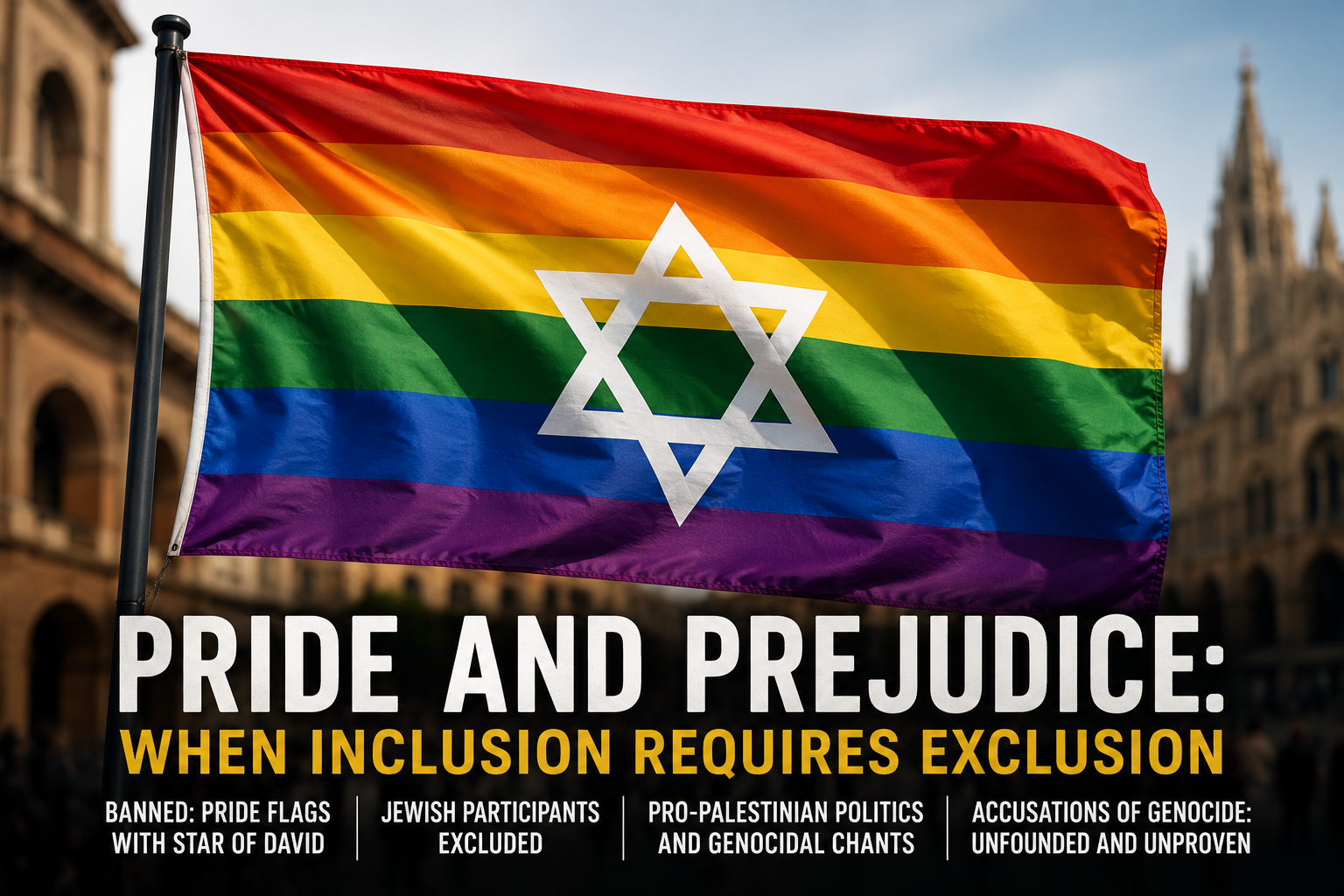
AI-generated Image
Pride is supposed to be a celebration – A celebration of dignity. A celebration of identity. A celebration of belonging.
For decades, LGBTQ activists fought to create spaces where people would not be judged by stereotypes, excluded because of who they are, or forced to hide essential parts of themselves in order to gain acceptance.
Which is why the events surrounding Rome Pride this year raise an uncomfortable question:
When did inclusion become conditional?
Recent reports revealed that Rome Pride organizers excluded a Jewish LGBTQ organization from participating because the group would not embrace the organizers’ characterization of Israel’s actions in Gaza as genocide. Whether one agrees or disagrees with Israeli policy is beside the point. The issue is that participation in an event dedicated to inclusion reportedly became contingent upon accepting a specific political position.
In other words, belonging came with conditions.
History has a peculiar sense of irony.
Nearly two thousand years ago, Rome attempted to weaken the Jewish connection to their ancestral homeland (and they’ve done a hell of a job). Following Jewish revolts against the Roman Empire, Judea was renamed Syria Palaestina, a move widely understood by historians as an effort to diminish Jewish national identity and connection to the land.
Today, Rome once again finds itself at the center of a controversy involving the exclusion of Jews.
This time, however, the exclusion does not come from emperors or legions. It comes from a movement that claims inclusion as one of its highest virtues.
Supporters of the decision will undoubtedly argue that this was not about Jews. It was about Israel.
That distinction sounds reasonable until one asks a simple question:
Would any other minority group be required to pass a political purity test before being allowed to participate?
Would a Christian LGBTQ organization be required to denounce the Vatican?
Would a Muslim LGBTQ organization be required to condemn Saudi Arabia?
Would an American LGBTQ organization be required to publicly accept responsibility for every controversial action of the United States government?
Of course not.
Yet Jewish participants increasingly find themselves judged not as individuals, but through assumptions attached to Israel.
The irony is difficult to miss.
For generations, LGBTQ activists asked society to stop reducing people to stereotypes and collective guilt. They asked to be seen as individuals rather than symbols.
Now some activists appear willing to apply the very same collective standard to Jews.
You may belong… But only if your views are approved.
You may participate… But only if your identity creates no political discomfort.
You may be included… But only after demonstrating ideological compliance.
That’s not inclusion. That’s conformity.
The contradiction becomes even more striking when one considers the broader regional reality.
Israel is the only country in the Middle East where Pride celebrations are held openly and on a large scale. LGBTQ organizations operate publicly. Gay and lesbian citizens serve openly in public life. Pride parades take place without fear for participants and with open arms from Israeli society.
The same cannot be said for much of the surrounding region.
Across large portions of the Middle East, homosexuality remains criminalized. In some countries, LGBTQ individuals face severe penalties, including prison and even death. In territories governed by deeply conservative religious and political forces, gay men and women often live in fear, secrecy, or exile.
One need not support every action of the Israeli government to recognize this reality. One need only to acknowledge facts.
Yet in many Western activist circles, the harshest condemnation is increasingly directed toward the one state in the region where LGBTQ rights are most robustly protected.
That contradiction deserves more scrutiny than it receives. So does the language increasingly employed by activists.
Among the slogans embraced at many demonstrations is “From the River to the Sea.”
Supporters insist the phrase represents liberation. But actions speak so much louder than words and millions hear something very different. They hear a call for the elimination of the world’s only Jewish state.
At a minimum, a movement dedicated to inclusion should be capable of understanding why millions of Jews worldwide perceive the slogan as threatening.
Instead, those concerns are frequently dismissed, mocked, or ignored.
The same pattern appears in the casual use of another word: genocide.
One of the conditions reportedly imposed upon Jewish LGBTQ participants in Rome was acceptance of the accusation that Israel is committing genocide in Gaza.
Notice the wording carefully.
Accusation.
Not fact.
Not finding.
Not verdict.
Accusation.
That distinction matters.
Genocide is not a political slogan. It is one of the gravest crimes recognized under international law. The term, coined as a result of the attempted extermination of the Jewish people, evokes some of humanity’s darkest chapters: the Holocaust, Rwanda, Cambodia, Darfur; the murder of tens to hundreds of thousands in Yemen, Syria, and most recently, Iran, and countless other campaigns of deliberate extermination.
Yet in many activist circles, the accusation has been repeated so frequently that it’s now treated as settled fact rather than a disputed allegation made during the fog of war.
Reasonable people can debate Israeli policy.
Reasonable people can debate military strategy.
Reasonable people can debate civilian casualties, humanitarian conditions, and the future of Gaza.
But demanding acceptance of a contested accusation as a condition of participation is not inclusion.
It’s ideological coercion.
And when that coercion is directed at Jewish participants by organizations that claim to champion diversity, the contradiction becomes impossible to ignore.
Supporting Palestinians does not require excluding Jews. Advocating for Gaza does not require marginalizing Jewish LGBTQ organizations. And criticizing Israeli policies does not require imposing loyalty tests on Jewish participants.
These should not be difficult distinctions to maintain. Yet they seem increasingly difficult for some activists to recognize.
That is unfortunate, because the greatest strength of the Pride movement was never its ability to enforce agreement.
Its strength was its willingness to extend dignity to people who disagreed.
The movement succeeded because it challenged society to widen the circle of belonging. Not narrow it. Not redraw it. Not place new gatekeepers at the entrance.
Widen it.
The question raised by Rome Pride is not whether one supports Israel or Palestine.
The question is whether inclusion still means inclusion when Jews must first prove their ideological credentials before they are allowed through the door.
If inclusion ends where Jewish identity begins, then it was never inclusion at all.
It was merely prejudice wearing the language of progress.
Related Posts