
Bridging faith. Defending truth. Confronting hate
Progressives Supply the Vocabulary. Islamists Supply the Narrative
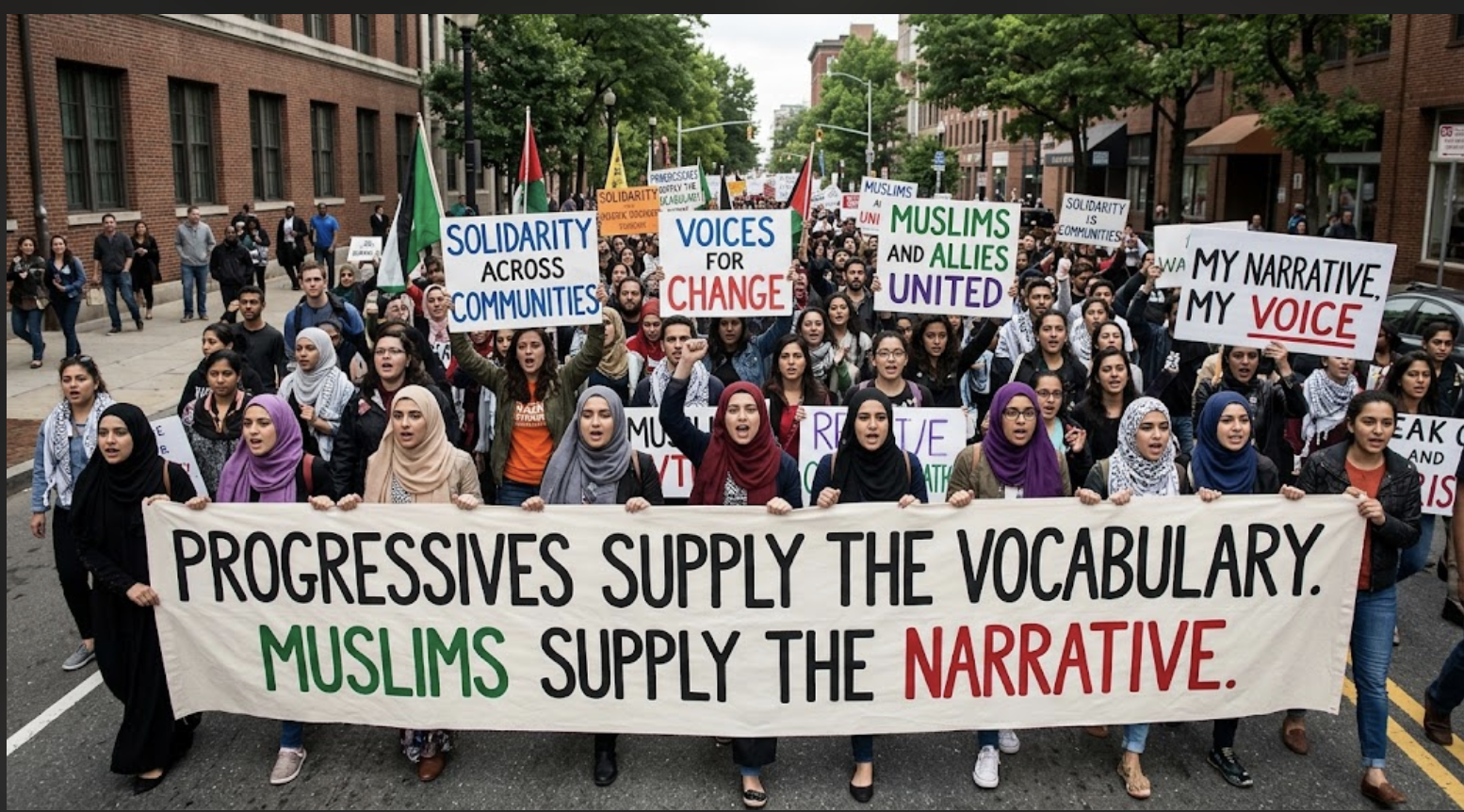
Image created from Google Gemini by Tim Orr
There is something strange about what many refer to as the Red-Green Alliance, a term that describes the alliance between progressives and Islamists. There are certain aspects of the left and Islamist movements that do not see eye to eye on issues such as religion, sex, women, freedom, sharia and what they believe a good society should consist of.
They also help to sustain each other. The Left can offer a moral vocabulary that is intelligible within many Western college campuses, media outlets, churches, labor organizations, causes and NGOs. Islamists, meanwhile, can supply a historical and communal narrative centered on themes such as Israel, the ummah, dispossession, Western domination, resistance, and reclamation. In short, progressives provide the moral vocabulary, while Islamists provide the larger narrative into which that vocabulary is placed.
Obviously, I’m not trying to say that if you stand for the Palestinian people you are an Islamist or that by opposing Israel you necessarily support Hamas.
Beyond the Common-Enemy Explanation
There has been talk about how radical leftism and Islamism can find points of convergence. They both dislike imperialism, colonialism and America, as well as many Western ideals that our government stands for, and how they are able to translate ideas across ideological frameworks.
This brings me to what I call ideological translation. This is where you take an idea from one ideology and translate it into the conceptual framework of another ideology. The original message can change drastically throughout this translation.
So each ideology can perform different interpretive functions when discussing Palestine. Islamists can portray Palestine through categories such as Islamic history, the ummah, Jerusalem, al-Aqsa, dispossession, and resistance, whereas progressives can portray Palestine through categories such as settler colonialism, apartheid, indigeneity, oppression, and liberation. Each gives Palestine meaning within the other’s moral and political framework.
Why Vocabulary Matters
When we use these terms, we are placing the conflict within a moral category. We are determining if it’s an an occupation, a land grab, an apartheid state, a settler-colonial project, or a movement of indigenous resistance. These are all very different things. Each can shape the moral conclusions people draw.
By using the terminology that many on the left have embraced when describing Palestine, we begin to see why many Westerners are able to condemn Israel without ever learning about Islam. Colonialism, indigeneity, genocide, oppression, liberation, and decolonization are all terms carrying strong moral associations. If you place Israel in the position of the settler-colonial power and Palestine in the position of the indigenous people, much of the moral framework has already been established. Much of the moral framework has already been established. One can become very pro-Palestine and have zero understanding of Islam or even the Middle East.
Islamism Tells a Different Story
Palestine can be framed as an Islamic issue by Islamists. Palestine came under Muslim rule during the early Islamic period and contains The region also contains sacred sites, including Jerusalem and al-Aqsa, that carry religious meanings beyond those found in secular Western political frameworks. Palestine can therefore be presented as a concern of the wider Muslim community, not Palestinians alone. This allows the cause to become a shared one with historical and religious meaning.
In the 2017 A Document of General Principles and Policies by Hamas, we can see this narrative at work. Islam provides an ideological framework through which Hamas describes the Palestinian cause. It places Palestine as an Arab and Islamic issue and calls on all Muslims to resist occupation. Resistance plays a big role in the liberation of Palestine. There are also Palestinian nationalist views portrayed in the manifesto so the document is not solely religious in character. But you will see Palestine being located within a broader historical and religious narrative than your typical Western progressive activist would know.
This is where we can separate vocabulary from narrative. We use words like oppression, colonialism and resistance to describe the Palestinian issue. The narrative explains why Palestine matters, what it represents, and where it belongs within a larger story.
Preserving the Conclusion While Losing the Premise
That’s where it really becomes crucial. You can translate an ideology and still arrive at a similar political conclusion while rejecting the original premise. The secular progressive doesn’t need to accept that Palestine is holy Islamic land or that the ummah is obligated to protect it. Those theological claims may carry no authority for that individual.
But certain political conclusions can survive ideological translation. Holy land becomes native land. Restoration becomes decolonialism. And you can resist through these principles as well. So we can see that once we remove the theological claim there is still some room to reach a similar political conclusion. By using different premises, you can get similar results.
Columbia as a Case Study
An example of this can be seen at Columbia University. Palestine has increasingly been incorporated into progressive campus movements through anti-imperialism, anti-racism, indigenous rights, critiques of power structures, and collective liberation.
There has been rhetoric that has moved beyond just calling for divestment and ceasefire but also “Armed resistance”. Columbia University published the Sundial Report that talked about these materials. We cannot know what all the students at Columbia thought. But we should not paint all activists as the far-left activists on campus. It simply shows that once you begin talking about progressive anti-imperialism you can make armed resistance intelligible within that political framework.
How does one make that transition? Once Israel is placed as a Settler-Colony and the Palestinians as Indigenous Peoples fighting for their freedom, you begin to give the language of resistance greater moral and political significance. One does not have to be an Islamist to understand more extreme ideas of resistance. Such ideas can also become intelligible through a progressive political framework.
Khamenei and Reverse Translation
We can see this happening in reverse when we look at Iran’s response to protests on American university campuses. Iran’s Supreme Leader Ali Khamenei proclaimed that American students protesting the war in Gaza were creating “a branch of the Resistance Front” in 2024. These students did not necessarily share Iran’s revolutionary political theology. But Khamenei was able to take their actions and reinterpret them through his own ideological framework.
We can see this occur from both perspectives. A student may identify her actions as promoting decolonialism. Khamenei is also able to take the same actions and reinterpret those same actions as expressions of the Resistance Front.
When these political meanings are able to travel across ideological boundaries between the Middle East and America, we start to create this cycle. Islamist political narratives can cross over into Western movements once translated. Then Islamist actors can incorporate Western protest movements into their own ideological narrative.
Why Palestine Is Such a Powerful Meeting Place
Palestine is especially susceptible to this kind of ideological translation. It can be particularized and universalized simultaneously.
Particularization gives the cause historical and communal specificity. It explains why a particular land and history matter to a specific community. Universalization makes the cause politically portable. It gives those with no religious tie to Palestine a way to connect the cause to issues they already consider important. It answers the question of why it’s important to you specifically and why it should be important to all.
Ambiguity Holds the Coalition Together
The Red-Green alliance The Red-Green alliance also depends on a degree of ideological ambiguity. Resistance, liberation, justice, decolonialism etc. are great terms because they allow different groups of people to invest those terms with different meanings. You could be a socialist, Palestinian nationalist, left-wing activist an Islamist and all use the word liberation. You just don’t know what your common goal will be when we get there.
Resistance is a prime example of this. It could mean protest, boycott, divestment or non-violence to someone. For others, resistance could include armed conflict, while some may understand it through a religious lens. Different groups can rally around the language of resistance while disagreeing about what forms of action resistance actually legitimizes.
When October 7 happened, that ambiguity became much harder to maintain. People who supported the cause were forced to clarify what they meant by resistance. Some people believed Palestinians had every right to resist Israeli occupation, but Hamas took it too far. Others saw what Hamas did as an act against colonial power and therefore regarded it as justified.
Liberation Into What?
It becomes more apparent when you start talking about the political order that should follow liberation. People can support Palestinian self-determination while differing greatly over the political order that should follow: a two-state solution, a single secular state, a Palestinian nationalist state, or an Islamic state. These are very big questions that many people would differ on.
Similar issues arise when discussing religion, sexuality, women’s rights, minority rights, free speech, apostasy, and sharia. Progressives and Islamists may not agree on many of these topics. But as long as the focus is on opposing Israel/Western imperialist powers or colonialism then it’s not as difficult. Once the discussion moves from opposition to governance, those ideological disagreements become much harder to bracket.
So the Red-Green alliance can work hand in hand against their common foe long before they would agree on how to run a country.
What the Red-Green Alliance Really Is
That is why I think the term Red-Green Alliance can be somewhat misleading. What holds the alliance together may be less ideological agreement than ideological translation. Translation can happen in both directions. Islamists can adopt the language of the left to make their claims intelligible within Western progressive discourse and progressives can use Islamist concepts of global struggle to advance their cause. Neither side has to become the other.
As this happens they will begin to develop a shared political vocabulary. settler colonialism, resistance, martyrdom, liberation, apartheid, imperialism, Zionism, and decolonization. All of these words can begin to be used by each side.
That is why I believe translation is a more accurate way to describe this relationship.
It’s as simple as Progressives can supply the moral vocabulary, Islamists the historical narrative, and anti-imperialism the bridge between them. That is how we can all think we are fighting for the same thing when we all want something different to happen once that goal is achieved.
References
- Alsoos, Imad. “From Jihad to Resistance: The Evolution of Hamas’s Discourse in the Framework of Mobilization.” Middle Eastern Studies 57, no. 5 (2021): 833–56. https://doi.org/10.1080/00263206.2021.1897006.
- Columbia University Senate. The Sundial Report: The 2023–2024 Protests at Columbia University. Last updated March 31, 2025.
- Hroub, Khaled. “A Newer Hamas? The Revised Charter.” Journal of Palestine Studies 46, no. 4 (2017): 100–111. https://doi.org/10.1525/jps.2017.46.4.100.
- Islamic Resistance Movement (Hamas). A Document of General Principles and Policies. May 1, 2017.
- Karagiannis, Emmanuel, and Clark McCauley. “The Emerging Red-Green Alliance: Where Political Islam Meets the Radical Left.” Terrorism and Political Violence 25, no. 2 (2013): 167–82. https://doi.org/10.1080/09546553.2012.755815.
- Khamenei, Ali. “Letter to American University Students.” May 25, 2024. Khamenei.ir.
Related Topics
Related Posts