
Prophets not Diplomats: Ahad Ha’am and the Vision of Cultural Zionism
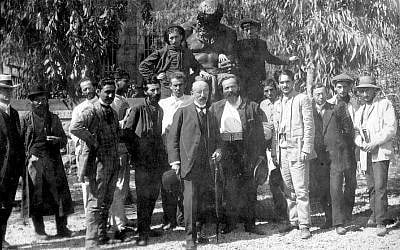
How would you define Zionism? If I polled the average Times of Israel reader on this question I’m sure I would get a huge variety of responses. Zionism is support for Israel. Zionism is the nationalist movement for Jewish self-determination in the land of Israel. I am sure responses like these would come up alongside a plethora of other definitions. One definition I would expect fewer people to offer is that Zionism is the revival of a collective Jewish national culture in Hebrew in line with a secular interpretation of the Tanakh and Hebrew prophets with a center in the Land of Israel. Nevertheless, this is the view expressed by one of the giants of early Zionist theory, Ahad Ha’am.
In the past, I had been taught that Ahad Ha’am and cultural Zionism supported a goal of Zionism in which the land of Israel would function as a spiritual and cultural center for the Jewish people. The implication was that this was a more limited version of Zionism compared to the political Zionism of Theodor Herzl, which would later lead to the creation of the State of Israel in 1948. After now having read a series of essays by Ahad Ha’am, I have come to appreciate the full scale of the thinking of Ahad Ha’am and the movement of cultural Zionism and its value in the modern world.
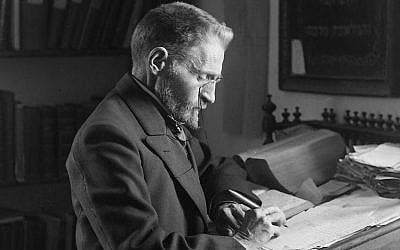
Asher Zvi Hirsch Ginsberg, pen name Ahad Ha’am (Hebrew: אַחַד הָעָם), was born in 1856 to a Chasidic family in what is now Ukraine. Ahad Ha’am is widely considered the father of the idea of cultural Zionism. Cultural Zionism as expressed by Ahad Ha’am arguably had a larger goal than the movement of political Zionism. This goal, from my perspective, is still ongoing today while also already having, since Ahad Ha’am, made exceptional progress. The goal of cultural Zionism was a revitalization of the Jewish nation through recreating a unique Hebrew language and Jewish culture centered in the Land of Israel. This Hebrew culture would allow for the Jewish nation to once again address principles of universal morality firmly rooted in their own culture and national spirit. The revitalized culture would be based on the writings of the prophets in the Tanakh as well as the writings of the rabbis. Ahad Ha’am’s goal was to raise the Jewish nation back to the cultural level that was seen in the time of the prophets and later rabbis through a revival of a unique Jewish culture centered in the Land of Israel.
Ahad Ha’am argued that the current cultural output from Jews in the diaspora was not being created fully in line with the unique Jewish national spirit. In his 1906 essay, “The Time Has Come,” Ahad Ha’am writes, “And if we are a nation, then we must have a national spirit, which distinguishes us from other nations.” According to Ahad Ha’am, the Jewish nation has a distinct national spirit from all other nations. This includes the national spirit of the peoples they live among. My understanding of Ahad Ha’am’s argument is that the Jews in various nations through assimilation have, to different extents, come to partially inhabit the national spirit of the people they live among. This leads to them creating culture partially within these peoples’ national spirits.
While adding to the culture of other countries is a good thing as it adds to culture, it means that the individual Jew is not adding to the collective cultural output of the Jewish nation. In addition he is not fully channeling the unique Jewish national spirit but rather a mix of different cultures. This can lead to some exceptional output but not to a collection of exceptional and uniquely Jewish cultural work. Any work of cultural output becomes partially Jewish and partially British, or German, or Moroccan, etc. This means that while it is possible to point to multitudes of Jews who have contributed to universal culture, it is not from a fully Jewish national spirit but is partially foreign. In addition this collection of Jewish culture from various countries and languages does not form a coherent whole. If a Jew in England and a Jew in Morocco each write a book the works may be culturally comprehensible to a fellow English or Moroccan Jew respectively. Still here the English Jew would struggle to understand the book from Morocco and the Moroccan Jew would struggle to understand the book from England though both are still Jewish culture. While both books are individually part of Jewish culture, they do not together form a collective and coherent Jewish culture.
Ahad Ha’am argues that the Jewish nation should revitalize its own culture from the past in order to fully express the unique Jewish national spirit in a collective way. Ahad Ha’am writes, “And if we value our national spirit, where shall we find it if not in the heritage of our past, and especially in our national language and literature, in which each generation stored up its spiritual treasure, and left to its heirs in the next the best fruits of its thought, its secret longings, its half-uttered sighs.” Ahad Ha’am here is suggesting that the way to revitalize Jewish culture is through recreating a literary tradition. This would serve as a collective continuation of the past language and literature of the Jewish nation. This would allow the Jewish people collectively to fully express their culture in a way that was true to their original and ancient culture as well as being able to be understood among Jews worldwide.
The language here is referring to a revived Hebrew. From a revived Hebrew language, the hope was that there would come an expansive modern Hebrew literature. The main source of literary inspiration for the new Hebrew culture would be from the Tanakh and other Hebrew language texts from biblical and rabbinic times.
Without a Hebrew language or literature, the individual Jews would naturally express a multitude of different national spirits from the many nations they resided among. While this may be authentically Jewish, it would not build a literature that would be collectively Jewish. By basing the new culture in the language and literature of ancient Israel and the rabbis, the new Hebrew culture would be a continuation of the unique national spirit of the Jewish nation. This revitalized culture would allow the individual Jews to express their national spirit through a collective culture both in the Land of Israel and in the diaspora.
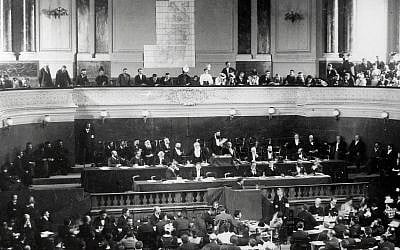
In Ahad Ha’am’s view, a return to national sovereignty using diplomatic means would not be enough to justify the immense historical suffering of the Jewish people. In his 1897 essay, “The First Zionist Congress,” Ahad Ha’am, beginning with a quote from the rabbinic text Ethics of the Fathers, writes, “‘Reward is proportionate to suffering.’ After two thousand years of untold misery and suffering, the Jewish people cannot possibly be content with attaining at last to the position of a small and insignificant nation, with a State tossed about like a ball between its powerful neighbors, and maintaining its existence only by diplomatic shifts.” For Ahad Ha’am, a Jewish return to sovereignty without a cultural revival would mean a rocky existence in which the Jewish nation would become like many other small nations. The state would need to routinely turn to great powers in order to ensure its survival. Therefore, the Jewish nation would have a secure home only insofar as the government of the Jewish state was able to successfully navigate its international relations. At the same time, a small piece of Jewish territory would not allow the Jewish people to truly be safe if the great power that was protecting the state turned on them. While diplomacy could serve to keep the Jewish nation-state safe for decades or even centuries, this is no different than the other small nation-states of the world.
The Jewish nation, rather than relying on diplomacy, should rely on a revitalized culture to change itself from the inside. A revived Hebrew culture would have something that no amount of political, diplomatic, or military solutions could ever achieve. It would allow the Jewish nation to once again express itself collectively all over the world. This would create a huge variety of collective Jewish cultural work. Both individual Jews and individual non-Jews could turn to this cultural work for inspiration or wisdom to make decisions and live a good life. Since this culture would be anchored in the Jewish collective experience, it would be uniquely relevant to the Jewish nation’s future. In Ahad Ha’am’s view, in order to live up to the historic suffering of the Jewish people, a simple return to sovereignty would not be enough to help the nation without also revitalizing the culture.
Ahad Ha’am understood the prophets, such as Moses and the other biblical prophets, as cultural leaders who were able to uniquely express the Jewish national spirit. In his 1904 essay, “Moses,” Ahad Ha’am explains the character of the collective Jewish memory of the prophet Moses. Ahad Ha’am describes this collective memory writing, “This ideal, —I reason — has been created in the spirit of the Jewish people; and the creator creates in his own image.” From Ahad Ha’am’s perspective, the character of the prophet is both a reflection of the Jewish national spirit but also still exists in the Jewish national spirit. If this spirit still exists, it stands to reason that it is possible that through a unique and collective Jewish cultural expression of the Jewish national spirit it could be brought back. According to Ahad Ha’am, in the past, the prophets had been able to channel the Jewish national spirit. This created possibly the greatest contribution to universal culture, the Tanakh. Later on the rabbis also channeled this national spirit to create the rabbinic literature. Ahad Ha’am believed that this prophetic ideal still existed in the national spirit of the Jewish people. Ahad Ha’am even described the speech of Zionist leader Max Nordau, which he delivered at the First Zionist Congress, as prophetic. For Ahad Ha’am the prophet was not someone who spoke for God but instead was someone who channeled an ideal of the Jewish national spirit. Ahad Ha’am understood prophets as expressions of the Jewish national spirit and therefore a thing that could be revitalized and brought back.
Through creating a revitalized Jewish culture, the Jewish nation could then create collective culture with a universal message of justice both for the Jewish nation and the world. This culture would be in line with the message preached by the prophets of Israel and would make both the Jewish nation and the world better. While individual Jews at that time could still create messages of justice the message could not be truly collective since it would be in different languages and cultural contexts. A revitalized culture would start a process of improving the whole Jewish nation. As Ahad Ha’am famously said at the end of his 1897 essay “The First Zionist Congress,” “The salvation of Israel will be achieved by Prophets, not by diplomats.” Politics and diplomacy could protect the Jews for a short amount of time. The way to ensure long-term continuity would be through awakening in the collective Jewish national culture the ideal expressed in its true national spirit.
What would this achieve? This revitalized culture would allow the Jewish people to again channel their Jewish national spirit on the model of prophets as seen in the Tanakh. The revitalized and prophetic Hebrew culture would serve both to strengthen the Jews living in the Land of Israel and also to assist Jews living all over the world through allowing them to collectively express the ideal of their national spirit. This goal, for Ahad Ha’am, was more important than the immediate establishment of a Jewish state since it would begin to create a Jewish nation true to its ideal. This revitalized nation would be capable of living in the world with all the evil and hardship that that entails since internally it would be where it needed to be. With the Jewish nation being true to its ideal it would allow itself to once again create messages of justice both for itself and the world. The revitalized Hebrew language and literature would make this revitalization of the nation ultimately possible since the Jewish national spirit would be inhabited collectively and ideally.
As we look at the ideas of Ahad Ha’am from our perspective in the year 2026, it is possible to see both the immense progress cultural Zionism has made as well as its promise for the future. Since Ahad Ha’am wrote his essays, the Jewish people became the only nation in history to successfully revive their language on a national scale. This was accomplished through the work of Eliezer Ben Yehuda and his successors and maintained today by the millions of modern Hebrew speakers in the Land of Israel and abroad. In addition to this, an impressive and unique modern Hebrew culture and literature firmly rooted in the unique Jewish national spirit has been created. Contributors to this Israeli culture include Chaim Nachman Bialik, Yehuda Amichai, Amos Oz, Naomi Shemer, and many, many more. The full revitalization of Hebrew culture in line with the culture of ancient Israel is well on its way and it has already made almost miraculous progress creating an impressive and unique Israeli culture.
Nevertheless, there is still a long way to go. Through continued expression of the collective Jewish national spirit, the Jewish nation can rise higher and higher towards its ideal as expressed in the prophets. While the outstanding contributions of political Zionism are impossible to ignore, I hope it is possible to see that cultural Zionism has something to offer as well. Through reading Ahad Ha’am I realized, regardless of whether his goal is ever fully accomplished, it is certainly as ambitious as political Zionism and also complements the goals of political Zionism. The hope and vision of cultural Zionism is certainly still relevant today and is well worth understanding. As the increasingly vibrant Israeli culture, drawing on the collective Jewish national spirit, continues to progress, the culture will light the way before us, illuminating the path forward into an increasingly chaotic future.