An Engineer’s Perspective on Israel and Jewish Life
Protecting American Jews in Violent Times
In Pittsburgh, eleven Jews were murdered while worshipping at the Tree of Life synagogue in 2018. A year later, a gunman attacked Chabad of Poway in California, killing one congregant and wounding three others. In March 2026, Temple Israel in West Bloomfield, Michigan, was attacked by a vehicle-borne assailant. The congregation’s security team responded, and staff and children were evacuated safely. These are not abstract threats to religious freedom. They are attacks on American Jews exercising it.
Jewish-owned businesses have also been targeted. In Los Angeles, storefronts displaying mezuzahs were vandalized. In Brookline, Massachusetts, a kosher grocery was attacked with a brick bearing a political slogan. In October 2026, organizers of a private gathering in Riverdale, New York, about purchasing homes in Israel moved their meeting online after activists announced a protest. The organizers said the announced action prompted their decision. See the New York Post report.
On November 8, 2026, demonstrators in Philadelphia called for a boycott of Jewish-owned restaurants and demanded that businesses they identified as Zionist leave the city. The protest occurred on the eve of the 88th anniversary of Kristallnacht, when Nazi mobs attacked Jewish businesses, synagogues, and homes. The organizers denied deliberately choosing the date. But the community responded: counterprotesters rallied in support of the restaurants, and customers lined up to buy food. American Jews should be able to operate businesses and support Israel without fear. The response in Philadelphia demonstrated the value of community solidarity. See Zionism: It’s Time to Stop Playing Defense.
A peaceful boycott is protected expression. The Philadelphia episode is not evidence of a failure of police protection, but it illustrates the pressure American Jews can face because of their support for Israel.
These incidents range from terrorist attacks and vandalism to political pressure and intimidation. They differ in severity and legality, but together they illustrate the vulnerability of American Jews exercising their rights. Where threats or violence occur, government has a fundamental responsibility to protect the innocent.
The social contract is the fundamental bargain between citizens and their government. The concept was developed by political philosophers including Thomas Hobbes and John Locke, whose ideas helped shape American constitutional government. Its principles are reflected in the Declaration of Independence and in the Constitution‘s commitment to establish justice, ensure domestic tranquility, and secure liberty. Citizens accept the authority of government and its laws in exchange for protection of their lives, liberties, and property. Government cannot guarantee perfect safety, but it has an obligation to maintain public order and protect the innocent. When it repeatedly fails to do so, public trust begins to erode. The liberties government must protect include the freedom to worship, speak, advocate, assemble, and participate in public life without intimidation or violence. Government must protect American Jews against violence and intimidation, while Jewish communities must take reasonable precautions to protect themselves. Neither responsibility excuses failure by the other.
Whether a protest constitutes unlawful intimidation depends on what participants threaten or do, but the underlying concern is unmistakable: people should be able to worship, operate businesses, and meet peacefully without fear.
Consider the disproportionate danger American Jews face. Jews constitute approximately 2% of the American population, yet according to FBI data reported by the Jewish Federations of North America, anti-Jewish incidents accounted for 64% of religion-based hate crimes in 2025. See the Jewish Federations’ report on FBI hate crime data. This is not a marginal problem. It is a serious failure of public safety that deserves national attention.
Churches, mosques, businesses, and homes deserve the same protection. The frequency and severity of attacks against American Jews, however, make the question especially urgent: when protest becomes intimidation or violence, who protects the innocent?
Why This Matters Particularly to Jews
For American Jews, the consequences extend well beyond the attacks themselves. Synagogues, Jewish schools, community centers, and Jewish-owned businesses increasingly face the expense and responsibility of protecting people who simply want to worship, study, work, and gather safely. Many employ armed security, hire off-duty police officers, install barriers, and conduct emergency training.
Such precautions are necessary and prudent. But consider what they represent.
A synagogue should not have to function like a fortified compound to permit Jews to worship safely.
Jewish institutions also face difficult decisions about the use of force. What happens when a threatening crowd approaches a synagogue? When does a protest become criminal intimidation? What may security personnel legally do to prevent entry or protect congregants? What if police cannot respond promptly?
The answers differ among jurisdictions. But the underlying governmental obligation should not.
Protecting religious freedom requires more than allowing worship on paper. It requires protecting people against violence intended to prevent them from exercising that freedom.
This principle applies equally to churches, mosques, temples, and every other place of worship.
The Government’s First Responsibility
Peaceful protest is a fundamental democratic right, including protest against Israel or any other government. Offensive opinions are protected. Threatening worshippers, attacking businesses, and destroying property are not protected simply because perpetrators claim a political cause.
No government can prevent every crime. But it must maintain public order, respond to credible threats, and hold violent offenders accountable. It cannot treat violence as an unfortunate but acceptable extension of protest.
Protecting free expression and stopping violence are not competing responsibilities. Both are essential. Police must protect peaceful demonstrators from suppression and protect everyone else from those who exploit demonstrations to commit crimes.
When Protection Fails
During the 1992 Los Angeles riots, Korean-American merchants watched businesses burn while police protection was inadequate. Some organized armed defenses of their stores. See “The Real, Tragic Story Behind That ‘Roof Korean’ Meme You May Have Seen”. Their resistance helped protect businesses, but the danger was real. Edward Jae Song Lee, a Korean-American teenager, was tragically killed by friendly fire. The lesson is not that armed defense is risk-free. It is that government failure can leave innocent citizens facing terrible choices.
In Paris in October 2026, rioters looted and destroyed a bakery built by Jhemima Sheilha and her husband. Employees escaped, but police could not prevent the destruction. The episode shows what happens when public protection fails. See the account in The Free Press.
The French unrest also raised concerns for Jews. Journalist Nora Bussigny reported that pro-Palestinian groups joined radical-left and Islamist activists in demonstrations initially focused on schools and living costs. Bussigny also reported links between some organizers and Samidoun, which the United States sanctioned for supporting the Popular Front for the Liberation of Palestine. These developments suggest that the unrest acquired political objectives beyond its original grievances. See The Free Press, October 21, 2026: See Nora Bussigny’s report .
I know people who have moved into urban areas and are buying firearms for the first time. They are obtaining licenses where required and training at shooting ranges because they worry that widespread disorder could reach their homes before police do. Their experience is not a national survey. It is a telling sign of what happens when people begin to doubt the protection they once took for granted.
This raises a difficult question. If government cannot protect innocent people from violent attackers, what responsibility does it have to preserve their right to lawful self-defense? Any answer must recognize the dangers of firearms, especially in crowded buildings, and the need for trained, responsible self-defense rather than vigilantism.
The Larger Danger of Lost Confidence
Barbara F. Walter, a political scientist at the University of California, San Diego, has studied why civil wars begin. In How Civil Wars Start, she identifies weakened or partially democratic institutions and identity-based political factionalism as major warning signs. See the publisher’s description of How Civil Wars Start . She also examines what happens when groups lose confidence that peaceful political participation can protect their interests.
A riot is not a civil war. Yet Walter’s work helps explain why the erosion of trust in institutions matters. When citizens believe that government cannot protect them or that the law is enforced selectively, some turn inward toward private protection and increasingly distrust other groups. Governments should interrupt that process by protecting everyone impartially and visibly.
What Governments Must Do to Uphold the Social Contract
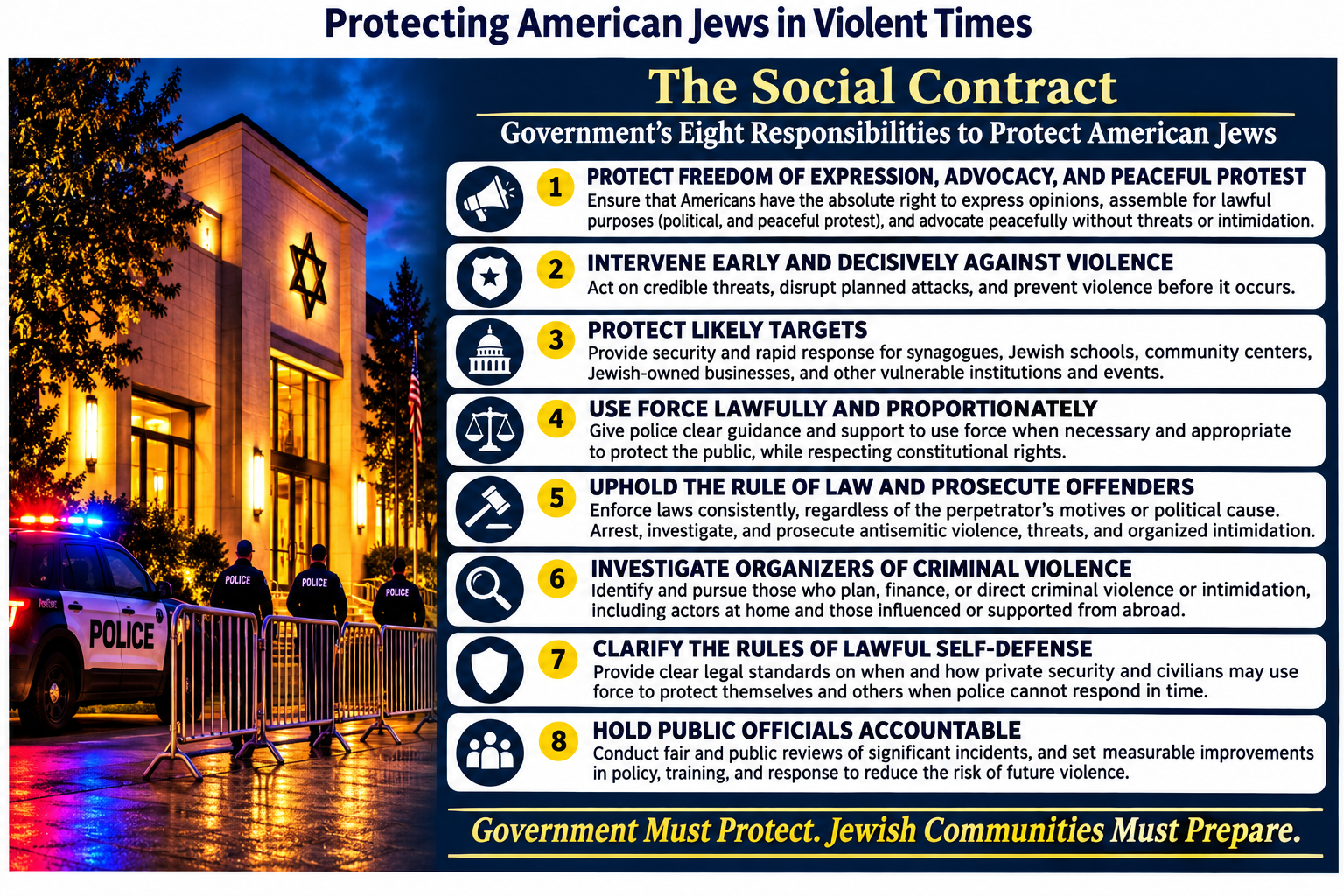
The threats facing American Jews illustrate a larger problem. Government cannot guarantee perfect safety, but it can establish clear priorities, prepare for foreseeable threats, and act decisively when violence occurs. What should that responsibility look like in practice?
First, protect freedom of expression, advocacy, and peaceful protest. American Jews must be free to advocate for their rights, express support for Israel, organize politically, and assemble peacefully without threats or intimidation. The same freedoms belong to those who oppose Israel or any other government. Police must protect lawful demonstrations and distinguish protected speech from threats, trespass, assault, and other crimes.
Second, intervene early and decisively against violence. Authorities need trained personnel, clear command structures, adequate equipment, and plans to reinforce threatened locations before isolated attacks spread. Waiting until buildings are burning is not an acceptable strategy.
Third, protect likely targets. Credible threats to synagogues, Jewish schools, community centers, businesses, and residential buildings should trigger timely risk assessments, coordination with local leaders, and practical protective measures. Police must also preserve lawful access to private gatherings and houses of worship while respecting peaceful protesters’ rights.
Fourth, use force lawfully and proportionately. Officers must be able to stop attackers, including with necessary force when legally justified. Deadly force is not justified merely to protect merchandise or punish rioters. Protecting life remains paramount.
Fifth, uphold the rule of law and prosecute offenders. Laws must be enforced consistently, regardless of the perpetrator’s identity or political cause. Arrests mean little without sound evidence, follow-through, and appropriate consequences. Political motives neither excuse criminal violence nor justify selective enforcement.
Sixth, investigate organizers of criminal violence when evidence warrants it. When evidence points to organized criminal activity across jurisdictions, local police, federal law enforcement, and prosecutors should coordinate their investigations and prosecutions. Authorities should trace planning, financing, direction, and criminal coordination, while scrupulously distinguishing such conduct from lawful advocacy and political association. Riots should not automatically be labeled terrorism.
Seventh, clarify the rules of lawful self-defense. Citizens and trained security personnel should know what they may do when facing imminent danger and police assistance is unavailable. The law should recognize legitimate defense without encouraging reckless confrontation.
Eighth, hold public officials accountable. After major disorder, authorities should explain what failed, whether personnel had sufficient resources and legal authority, and what will change. Public reviews should identify who made critical decisions, what corrective actions were taken, and whether those changes improved public safety.
What American Jews Must Do
Government bears the primary responsibility for protecting its citizens. But American Jews cannot assume that police will always arrive before violence occurs. Synagogues, schools, community organizations, businesses, and individuals must take reasonable steps to protect themselves. This is not a retreat from the social contract. It is a practical response to threats that cannot be ignored.
The Secure Community Network (SCN), established by the Jewish Federations of North America and the Conference of Presidents of Major American Jewish Organizations, provides a national framework for Jewish community security. Working with local Jewish Federations, SCN supports threat monitoring, security assessments, emergency preparedness, training, and coordination with law enforcement. Many synagogues and Jewish institutions already participate in these programs. These efforts demonstrate that American Jews are taking substantial responsibility for their own protection. See the Secure Community Network and the Jewish Federation of San Diego’s community security program
The Temple Israel attack in Michigan illustrates the value of preparation: trained security personnel confronted the attacker while emergency procedures helped protect the children and staff inside. But these substantial investments in private security should supplement, not substitute for, the protection that government owes every citizen.
SCN and local Jewish Federations deserve considerable credit for developing, publicizing, and implementing many of these security measures. Many of these practices are already well established, although implementation and resources vary among institutions. Building on that work, here are eight practical actions for American Jews and their institutions to continue or strengthen:
First, strengthen physical security. Synagogues, Jewish schools, and community centers should conduct professional security assessments and improve entrances, access controls, surveillance, lighting, and emergency communications. Protective measures should make institutions safer without turning them into inaccessible fortresses. Institutions should also seek available federal and state security grants, including funding through the federal Nonprofit Security Grant Program.
Second, develop and rehearse emergency plans. Institutions need clear procedures for lockdowns, evacuation, medical emergencies, and communication with congregants and families. Staff and volunteers should practice those procedures and know who is responsible for making decisions during a crisis.
Third, establish close working relationships with law enforcement. Jewish organizations should maintain regular contact with local police, share credible threat information, and arrange security planning for major gatherings and religious holidays. These relationships should be established before an emergency, not during one.
Fourth, invest in professional security and responsible self-defense. Where risks justify it, institutions should consider trained security personnel, including armed professionals when appropriate. Individuals who choose to own firearms should understand applicable laws, obtain professional training, practice safe storage, and recognize the serious risks of using weapons in crowded places. Firearms are not a substitute for prevention, de-escalation, and sound security planning.
Fifth, organize community-wide security cooperation. Synagogues, schools, Jewish businesses, and community organizations should share security expertise, coordinate threat reporting, and help smaller institutions that cannot afford adequate protection on their own.
Sixth, document threats and demand enforcement. Threatening messages, vandalism, harassment, and violence should be promptly reported to police and, when appropriate, civil-rights authorities. Jewish organizations should follow cases, insist on consistent enforcement, and press public officials for explanations when credible threats are ignored.
Seventh, exercise Jewish rights openly and confidently. American Jews should continue to worship, advocate for Israel, express their convictions, participate in politics, and assemble peacefully. Intimidation must not become a veto over Jewish participation in American life. Security precautions should protect these freedoms, not replace them.
Eighth, hold communal leaders accountable for preparedness. Synagogue boards, school administrators, and Jewish organizations should treat security as an ongoing responsibility. They should establish budgets, review incidents, assess whether protective measures work, and correct weaknesses rather than waiting for a tragedy.
These measures cannot eliminate danger, and they do not relieve government of its obligations. Their purpose is to make Jewish communities safer while preserving the freedom and confidence that security is meant to protect.
The Social Contract Must Mean Something
In an October 2026 essay, the French philosopher Bernard-Henri Lévy warned against the idea that political violence can be justified as a path to liberation. The victims of such violence are not abstractions. They are worshippers, shopkeepers, employees, families, and neighbors. See Bernard-Henri Lévy’s essay in The Free Press .
No American should have to wonder whether attending synagogue, opening a store, or hosting a lawful gathering makes them a target. Nor should citizens feel compelled to arm themselves because they no longer trust government to protect them. Yet when protection fails, their right to lawful self-defense becomes all the more important.
The social contract is not a promise that government will prevent every crime. It is a commitment that government will do everything reasonably within its power to protect the innocent, confront those who threaten them, and hold offenders accountable.
When Jews must worship behind barricades, shopkeepers must defend their businesses against mobs, and families consider buying firearms because they fear the police will not arrive in time, something fundamental has gone wrong.
American Jews have a responsibility to prepare for danger. Government has a responsibility to protect them from it. The first must never become an excuse for neglecting the second. Government cannot demand the public’s trust. It must earn it through action. Protecting the innocent is not one responsibility among many. It is the first obligation of government. And when government fails to meet that obligation, the social contract itself is at risk.
–
Author’s Note: In preparing this essay, I used ChatGPT as an intelligent assistant in developing and editing it, including identifying and checking the historical and Jewish sources, as well as generating the graphic. The ideas and conclusions are my own.
Related Topics
Related Posts