Shaarey Tphiloh's rabbi, sharing views from Israel
Sparing the Turkey: Celebrating Thanksgiving in Israel
The November Holiday Spirit of Portland, Maine and Modi’in, Israel
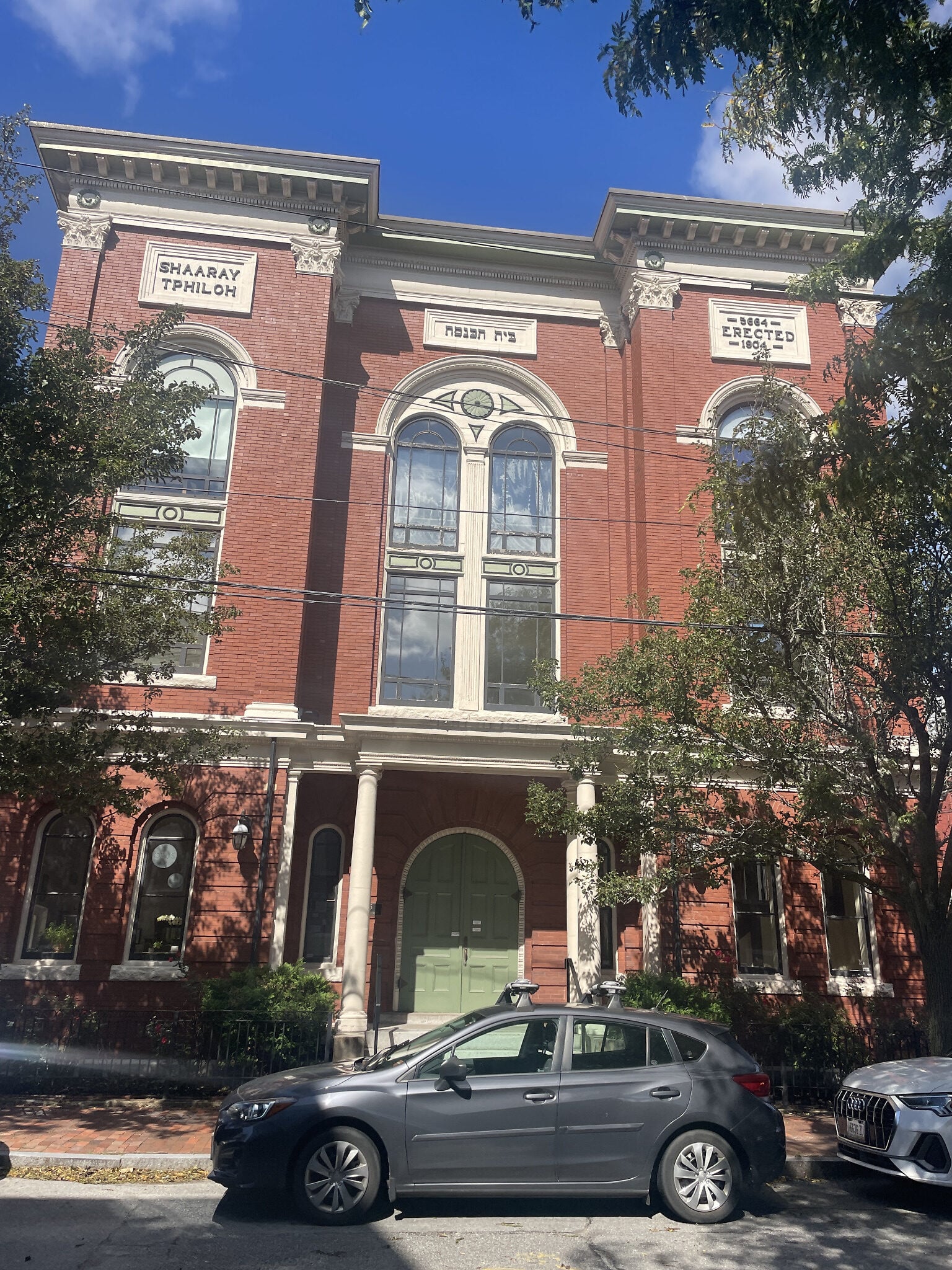
Shaarey Tphiloh Synagogue on Newbury St. Portland, ME
I have a friend in Israel who still invites us for Thanksgiving every year. Her kid is a vegetarian, so she serves fish and no turkey. We are not in America, and her husband is Israeli, so the conversation is all about Israeli politics. There will sadly be no NFL games on the TV, because they are not football fans and anyway we are hours ahead of the USA, so the Cowboys and Lions fans will be waking up for their coffee on Thanksgiving morning while I sit down for my Thanksgiving fish dinner. Can I still celebrate Thanksgiving without turkey, without football, and when I’m so far away from the USA?
In this week’s parsha, Vayishlach, we see a deep connection to Thanksgiving, and it reminds me of why we continue to celebrate the holiday even from a faraway place and country. In Vayishlach, Jacob thanks God for his blessings as he prepares to cross the Jordan and meet his brother Esau. Jacob offers a blessing to God, Who told him to return to his native land. Jacob says, “Katonti,” or “I feel small” in the face of all the kindness and truth that You, God, have shown me. Twenty years prior, Jacob crossed the Jordan River running from home with only his staff, and now he was headed back into his native land with great possessions and a big family. Jacob says that he has become “two camps” with a large family and possessions. Even though he was filled with great fear and uncertainty ahead because war with Esau might await him on the other side of the river, Jacob took a moment for thanksgiving, blessing God for his achievements over the last twenty years.
As I look back to almost twenty years ago in my life, I am filled with thanksgiving as well for all the kindness that God has bestowed upon me. We always have uncertainty in life and don’t know what will happen when we cross the river, like Jacob in the Torah, but in moments of transition, it is remarkable to pause and thank God for the blessings up until that moment.
I remember Thanksgiving in Portland, Maine, nineteen years ago in November 2007, when we celebrated a joint service at Shaarey Tphiloh with Congregation Bet Ha’am. Rabbi Alice of Bet Ha’am and I planned a Thanksgiving prayer service together, and she brought members of her flock over to Shaarey Tphiloh so that together we could make a minyan. How did she manage to do that? How did we make a minyan together? Today I have only the happiest memory of how our two synagogues joined together in prayer on Thanksgiving 2007. In the parsha, Jacob is terrified of meeting his brother Esau, as they were two brothers who walked different paths and lived in different camps. But when they finally met, Esau runs to embrace him, and Jacob says, “Ki al kein ra’iti fanecha kir’ot pnei Elohim.” Jacob told him that “To see your face is like seeing the face of God.” When brother and brother, or sister and brother, come together the journey itself can be transformative, maybe even like Jacob’s moment of fraternal togetherness which was like seeing the Divine.
I tried to find an email about our joint minyan in November 2007, but instead I discovered an opinion I wrote for the Portland Press Herald titled “An Autumn Bar(n) Mitzvah in Maine.” At our shul in Maine, we celebrated the Bar Mitzvah of Arthur Jebediah (a.k.a. A.J.) Wilder Lockman. His family told me of their heritage, that A.J. was a direct descendant of a Mayflower Pilgrim, and a distant cousin of Laura Ingalls Wilder of Little House on the Prairie fame. I also knew that he was a descendant of a Russian rabbi. He honored both parts of his heritage when he celebrated his bar mitzvah on a cold autumn day in Maine. The two paths of a New England Pilgrim and a rabbi came together that day almost twenty years ago. That Bar Mitzvah reminds me that Thanksgiving calls upon us as Jewish Americans to have deep gratitude to a nation whose founders developed ideas that brought the descendants of Pilgrims and rabbis together in Maine for a bar(n) mitzvah. Even from far away, I remain a proud citizen of the USA. I am grateful to those Pilgrims who first settled the land in America and who built a nation whose strength lies in the shared purpose of its diverse citizenry.
Back to the parsha, and we see our patriarch Jacob engaged in a night of wrestling with an angel, before he crosses the river and heads back to the Land of Israel. The Torah says, “Vayavo Yaakov shalem.” This means, “And Jacob arrived whole.” Rashi tells us that Jacob was whole in body, whole in his livelihood, and whole in his Torah, as he reached Israel.
What does it mean to be whole? How can we be full (shalem) on Thanksgiving without turkey, living outside of America, and without the NFL? Jacob explains (33:11) that wholeness means that God has favored me and, “Yesh li kol.” “I have everything,” he declares. “Everything,” in other words, is our state of gratitude. Our patriarch tells us that whether we are eating turkey in Maine or fish in Israel, whether we are with family in D.C., or with old friends from the Galilee, and whether we are debating the shekel conversion rates, or the fourth down conversion play of the Detroit Lions, we carry our whole story with us as we cross the river, or the ocean. Our thanksgiving journey to see our brothers and sisters is itself an act of completion even before the dinner.
I’m looking forward to my holiday meal. With all the problems in Israel and the world, it’s just really nice to take a break with my plate of salmon and reflect on those original Pilgrims of America. They must have had so much good spirit and strength as they settled a new land. I’m also a little bit of a pioneer, as an immigrant, on a journey to live in the homeland of my ancestors. Do you think the Native Americans really brought the pilgrims corn? How beautiful is that story! Whether it’s history or legend, I hope that reflecting on the mythical stories of hope in America’s distant past will lead me and my neighbors in Israel to a better and more bountiful place of blessings in the future.
Happy Thanksgiving! Shalom!
Related Topics
Related Posts