
Educator, Mother, Learner, Wife — Guided by Torah
Public Transit Needs Public Decency
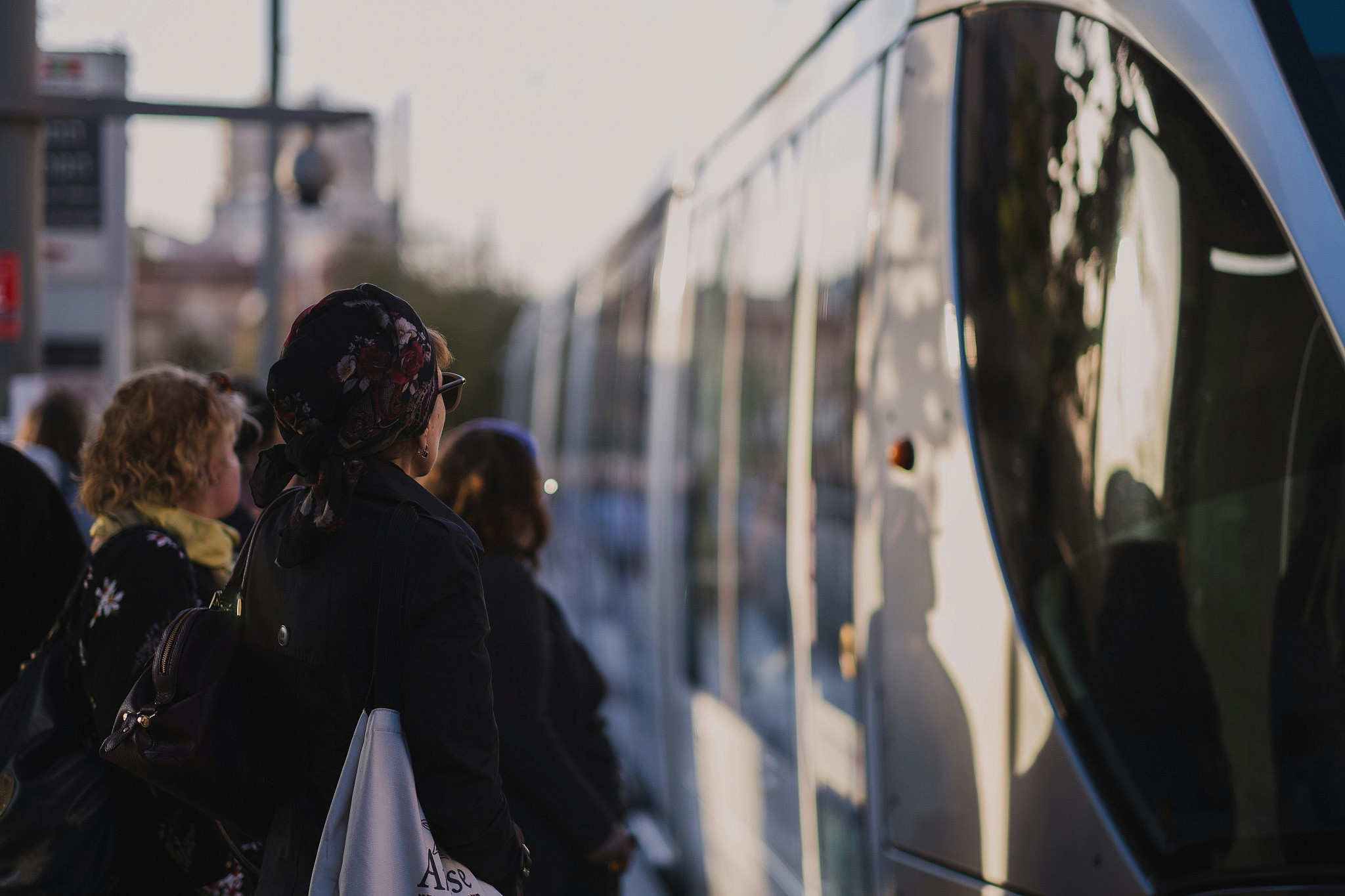
Waiting for the light rail in Jerusalem — strangers sharing space, journeys, and expectations of dignity (Levi Meir Clancy of Unsplash).
From Tel Aviv buses to the New York subway, we must ask: do our shared spaces reflect our shared values?
One morning on the A train in Manhattan, my daughter and I sat side by side. She was dressed in a jumper and tights, holding her siddur, and humming a tune from Shabbos. Opposite us, a disheveled man slouched with his trousers half-fallen, blasting sexually explicit lyrics from a speaker balanced on his knee. He rocked and shouted along, oblivious to the children nearby. It was 8:00 AM.
Another day in Tel Aviv, I boarded an Egged bus as a group of young Orthodox daughters in uniform climbed on behind me, their navy skirts swishing with each step, rucksacks slung over shoulders. They whispered to one another in low voices, their modest blouses and cardigans marking them as schoolgirls on their way to class. A shirtless man stumbled aboard, trailing cigarette smoke and a Bluetooth speaker pounding techno beats layered with expletives. The driver said nothing. The girls averted their eyes, clutching their satchels a little tighter.
In both cities, I have watched public transport transform into a stage — and our children, the unwilling audience.
Shared Spaces, Shattered Norms
Public transport is not private. It is shared space, woven into the rhythms of civic life. We ride alongside strangers — schoolchildren, pensioners, tourists, religious families. And yet, the standards of behavior once assumed as basic — decency, quiet, respect — have eroded. What passes for normal now would once have drawn rebuke.
This is not a call for censorship, nor a nostalgic plea for 1950s etiquette. It is a mother’s cry — and an educator’s alarm — for a return to shared norms that protect the dignity of all riders, especially the young.
Children are watching. On buses and subways, they see public groping, lewd dancing, obscene lyrics, vulgar speech, and confrontations that verge on the violent. They are exposed before they have the tools to comprehend. Some adults shrug and say, “They will see worse on TikTok.” That is precisely the problem: it is desensitization, the gradual dulling of outrage, and the normalization of deviance, when behaviors once seen as shocking become accepted as part of daily life. We have stopped distinguishing between the private and the public, between optional consumption and forced exposure.
Herein lies a truth that transcends ideology. Religious parents and secular parents alike want their children to travel in safety and dignity. The arguments that divide us in other arenas need not divide us here. Respectful behavior in shared spaces is not a religious demand nor a secular concession — it is simply a civic good.
Even more jarring is the comparison with cities we would not expect. In Kyiv, even amidst the trauma of war, trains run with a quiet dignity. Mothers with prams are offered seats without hesitation. Schoolchildren ride in relative calm, surrounded by adults who lower their voices rather than raise them. Announcements are clear and measured, never drowned out by thudding speakers. In Moscow too, whatever one may think of politics, public transit still operates with a baseline of decorum. Loud music is rare, and a pregnant woman or grandmother will rarely be left standing. Amidst hardship and austerity, there remains a shared instinct that public space ought to protect women, children, and the elderly.
That Tel Aviv and New York — global capitals of modernity — cannot maintain the same level of courtesy speaks volumes. Freedom and vibrancy are no excuse for abandoning respect.
Noise as a Weapon
What unsettles me most is not simply the content but the sheer loudness. On the subway, the volume itself is often a weapon. Amidst the blare of basslines and shouted lyrics, one cannot tell if a confrontation is harmless bravado or the prelude to violence. Noise cloaks intent. A mother clutching her daughter’s hand feels her heart race, scanning faces for cues of danger, calculating whether to move carriages.
This is a profoundly gendered experience. Amongst the riders, women are the ones who must gauge — constantly, silently — whether raised voices will turn into raised fists, whether crude lyrics will escalate into crude touch. Noise is not just sound; it is dominance. Thus, the so-called freedom of the noisiest becomes the captivity of the quietest.
And children see it all. My daughter asks why the man must shout so close, why no one intervenes, why adults avert their eyes. What lesson are we teaching her? That the world belongs to the loudest? That women must shrink whilst men sprawl? That the ones who impose their chaos are celebrated as “colorful,” whilst the ones who wince are scorned as “uptight”?
A society attentive to the female perspective would recognize that public noise is not harmless exuberance but often a cloak for intimidation. It is not only a matter of annoyance. Women know too well that amidst the loudness, real violence can erupt. Reports of women being groped, assaulted, or even raped on the subway are no longer rare headlines but recurring ones. The cacophony creates both cover and excuse, making it harder for victims to call for help and easier for bystanders to dismiss what they do not clearly see or hear.
In Israel, this unease carries another layer. Tel Aviv’s buses and Jerusalem’s light rail have been the sites of stabbings and bombings; more recently, the faces of kidnapped hostages stare at us from bus stops and carriage walls. The ride to school or work is thus never only about convenience. It is shadowed by memory and by fear. For women, the indecency of noise and the indecency of violence merge into one: a stripping away of dignity, a reminder of vulnerability that should never be normalised in a Jewish state.
Freedom Without Boundaries
Religious women, modest dressers, and quiet passengers often have no choice but to sit and endure. There is a gendered dynamic: the ones performing usually enjoy social license; the ones affected are dismissed as prudish or repressed. When a man dances shirtless in the aisle, he is considered harmless. When a woman looks away, she is accused of being intolerant.
In New York, the Metropolitan Transportation Authority has rules against performances and loud audio, but enforcement is rare. Police often ignore noise complaints or harassment unless a crime occurs. In Tel Aviv, buses lack even those basic codes; the culture leans toward laissez-faire. The result is the same: children commuting through a world of noise, chaos, and adult themes they did not ask to see.
Both cities pride themselves on vibrancy, freedom, and creativity. But freedom without boundaries can become coercive. When shared space is overtaken by the loudest, boldest, or crudest behavior, others are silenced.
Restoring Standards
We need to restore standards. Transit authorities should establish quiet cars during morning and afternoon school runs. Amplified sound should be banned without headphones. Posters in stations and on buses should articulate expectations for decency, not just safety. Drivers and conductors should be empowered to enforce basic rules, with mechanisms for passengers to report violations.
Cities might consider “child protection zones” — similar to anti-smoking buffers — around school routes and hours. These measures would not end vibrancy; they would channel it into spaces where it is chosen rather than imposed.
This is not about nostalgia for stricter times; it is about mothers being able to ride in peace with their children. It is about teenage girls traveling to school without being forced to practice premature resilience. It is about recognizing that civility is not weakness but strength.
A Jewish Lens
Jewish tradition teaches the value of tznius — often thought of as modesty, but also understood as dignity, restraint, and sacred privacy. Tznius is not limited to clothing; it governs speech, posture, and presence. It is about recognizing that others have a right not to be intruded upon.
For women, this value resonates deeply. To dress with dignity is to walk with the quiet wish that others will not intrude. To pray softly on the train is to hope the surrounding atmosphere will not shatter that stillness. To shepherd a child amidst the bustle is to long for restraint from those around.
Modesty is not repression. It is reverence. Reverence for the human need for quiet, for the child’s right to innocence, for the mother’s desire to nurture without fear.
Religious and secular Jews often misunderstand one another when it comes to questions of modesty and freedom. One side may hear only demands for restriction, while the other may see only indifference to values. But here, in the shared space of buses and trains, there is no need for ideological battles. We can bridge cultural divides simply by respecting one another — lowering the volume, curbing indecency, and remembering that children and fellow passengers deserve dignity.
The Road Ahead
Let us not wait until our daughters stop taking the bus, or our sons learn to normalise discomfort. Let us not tell children to just “look away” while doing nothing to shield them.
Between Tel Aviv and New York, I still believe we can build cities that sing — without shouting over our children. Public transport should carry us forward, not drag us down into chaos. Amidst the morning rush and the evening crush, let there be decency. Let there be quiet. And let there be dignity enough for mothers and daughters alike to ride in peace.
In Israel, this task carries a deeper weight. Public transport remains one of the few places where religious and secular, Jewish and Arab, young and old, settler and city-dweller all ride together. If we cannot cultivate respect here, where will we? If we can, it will be proof that amidst division and terror, klal Yisroel yet knows how to live with strength and honour in its Land — all of it. The roads, the buses, the light rail: they are ours, and they should reflect our people’s dignity.
As the prophet Micah taught: “What does the Almighty require of you? To act justly, to love mercy, and to walk humbly with Hashem” (Micah 6:8). Justice, mercy, and humility are not lofty ideals; they are everyday practices. Even on the bus. Even on the subway. And above all, in the Land of Israel, they are our charge.
Related Topics
Related Posts