The views expressed herein are solely mine.
Puerto Ricans Can Be President. Still No Vote
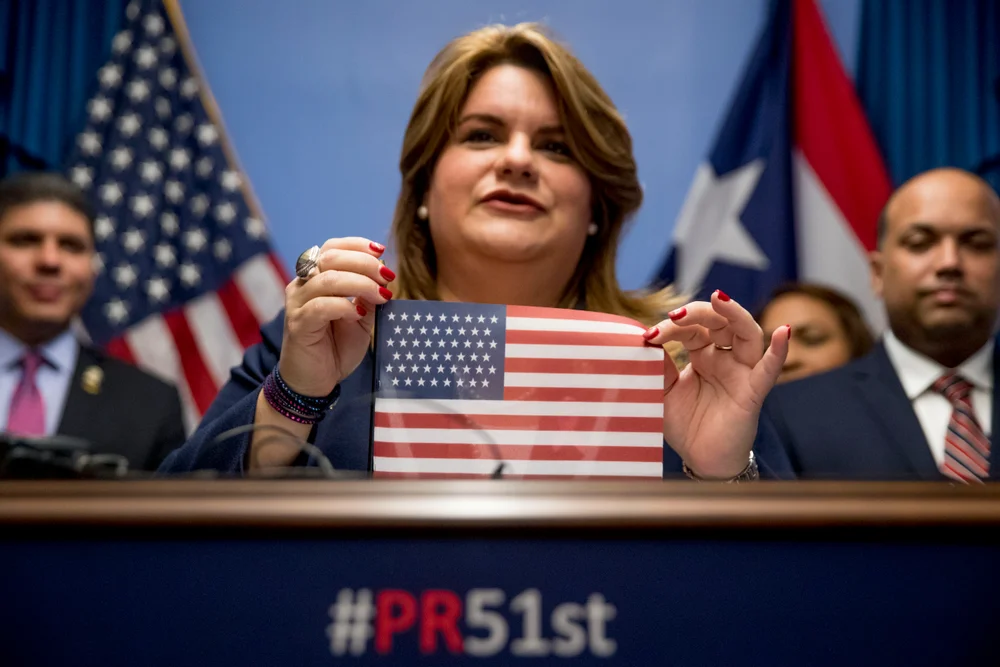
Resident Commissioner Jenniffer González-Colón, who represents Puerto Rico as a nonvoting member of Congress, holds up an American flag with 51 stars as she speaks about Puerto Rico statehood on Oct. 29, 2019, on Capitol Hill. Via Associated Press.
A person born in Puerto Rico can run for president of the United States.
This should not be a recurring national puzzle. It should be basic civics.
The United States Constitution sets only three requirements: the president must be a natural-born citizen, at least 35 years old, and a resident within the United States for 14 years. Puerto Rico does not fall outside that framework. It falls within it.
The decisive fact is simple: people born in Puerto Rico are US citizens at birth under federal law. Not later. Not by naturalization. At birth. Once that is clear, most of the fake mystery disappears.
Yes, the Insular Cases cast a long shadow. They ruled the ugly doctrine that territories could belong to the United States without being treated as fully part of it for every constitutional purpose. That doctrine was rotten when it was made and looks worse with age. But it did not make Puerto Rico foreign, nor did it erase the legal reality that Congress granted US citizenship at birth to people born there.
Puerto Rico should not be lazily folded into one generic “territories problem.” Not all territories stand in the same legal position. American Samoa is the clearest contrast: people born there are generally US nationals (to allow them to have full rights over land there), not US citizens, at birth. Puerto Rico is not that case.
The historical record points the same way. Barry Goldwater ran for president after being born in the Arizona Territory. John McCain’s candidacy prompted a Senate resolution affirming that someone born in the Panama Canal Zone could qualify as a natural-born citizen. Those precedents do not settle every territorial question by themselves. But they make one point clear: birth outside the fifty states has never automatically disqualified a candidate.
Thus, the answer is straightforward. If you are born in Puerto Rico, you are a US citizen at birth. If you are 35 and have lived within the United States for 14 years, the constitutional case for presidential eligibility is strong.
Which is why the real confusion is usually not legal. It is cultural. Too many mainland Americans still hear “Puerto Rico” and attach an asterisk to the citizenship that comes with it. They call that constitutional seriousness. More often, it is just the old instinct to treat some Americans as more American than others.
That is not the reflex of a confident republic.
A serious country does not play games with the meaning of its own citizenship. It does not ask Puerto Ricans to carry American passports, serve under the American flag, fight in American wars, and then turn evasive when the presidency enters the conversation.
A country that trusts Puerto Ricans to defend the republic should have no trouble admitting they can lead it. This is about constitutional literacy. Birth in Puerto Rico is not a barrier. American ignorance is.
Former Governor of Puerto Rico Luis Fortuño was once discussed in Republican circles as possible vice-presidential material. Current Governor Jenniffer González-Colón served in Congress as Resident Commissioner and has deep national Republican ties. Under the same constitutional logic, both belong in any serious eligibility conversation, even under Puerto Rico’s current territorial status.
That is the real absurdity: Puerto Ricans on the island can yield a constitutionally eligible presidential candidate, yet still cannot vote for the office itself.
This is not a loophole. It is not an island quirk. It is the American system working exactly as designed. And once that fact is faced, the deeper fraud becomes harder to hide.
Puerto Rico’s “Estado Libre Asociado” is not sovereignty. It is just the name of the island’s local government and its insular constitution. In reality, Puerto Rico remains a territory under the United States Constitutional Territorial Clause, subject to Congress’s plenary power and excluded from full national suffrage. That is not prudence. It is disenfranchisement dressed up as legal language.
And that failure is not only democratic. It is strategic. Puerto Rico sits at the hinge of the Caribbean and the southern approach to the United States at a time of cartel warfare, Chinese penetration, maritime insecurity, and renewed missile-defense planning. Washington should stop treating the island as a constitutional footnote and start treating it as what it is: American ground, American citizens, and a critical asset in any serious ‘Shield of the Americas’ strategy.
A republic willing to accept a Puerto Rican president should stop pretending Puerto Rico itself is an afterthought. Period.
Related Topics
Related Posts