
From memory to meaning to action
Featured Post
Was Grandpa Boris Holocaust-y enough?
He thought nobody would want to hear his survival story, which featured black-market smuggling and daring escapes. I'm afraid he was right
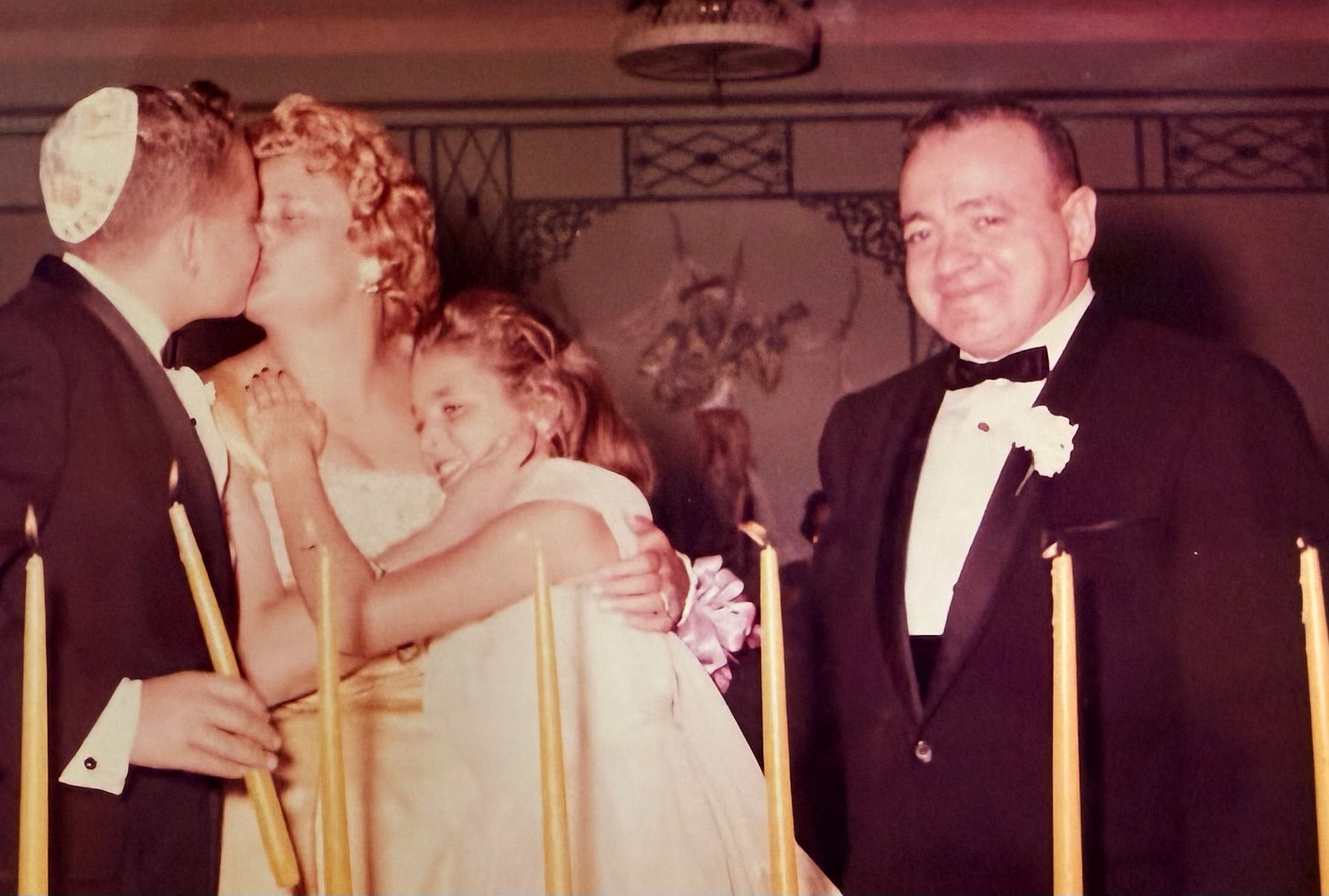
Boris Got the Last Laugh: Boris Silberberg smiles as his wife Rose kisses their son at his bar mitzvah while their daughter wraps her arms around Rose. After surviving the Holocaust, Boris and Rose built a family that now spans five generations.
“I’m so disappointed with the Holocaust survivor story I just heard. I want my kid to hear from a survivor who was in the camps. Can you make sure there is a survivor who was in the camps when we visit the Holocaust Memorial?”
The parent had just attended a survivor presentation and was deciding whether to attend another. She wanted her child to hear the stories many grandchildren of survivors grew up hearing, like the Schindler’s List type stories and the heartbreaking stories of ghettos and camps. I understood exactly what she meant.
My Grandma Rose survived the ghetto and the camps. Her stories included experimentation, sadism, and horrors that never fully loosened their grip on the people who lived through them.
Then there was my Grandpa Boris.
Boris Silberberg loved telling stories. Whenever he saw me, a smile spread across his face. “Hi, Gitaleh!” he would call out before pulling me into a hug. When the moment struck, he would lower his voice and describe an account from his past, as if trusting me with his secret. They always felt like tall tales, not because they weren’t true, but because they never followed a clean sequence and the scenarios seemed almost impossible to survive.
One story in particular he often told was about his time on a crowded train travelling somewhere between Poland and Bucharest. He had survived through 1945, the end of World War II, and lost almost everything. On the train, across from him, sat twin boys, eight or nine years old, disheveled and looking at each other nervously. A friendly 31-year-old Boris tried to start a conversation and understand who they were.
He spoke in Polish.
Nothing.
Yiddish.
Nothing.
German.
Nothing.
Boris knew seven languages and moved through them one by one, searching for a way to connect, but the boys did not respond. His next move? He took out a piece of bread and held it out. Their eyes widened. They looked at each other, deciding if he was safe. Then one of the boys took the bread, and only then, barely audible, mumbled a single word. “Dziękuję.” Thank you. The boys looked at each other, then back at Boris. Only then did they begin to talk.
As the boys warmed up to Boris, they explained that their parents had been taken to Auschwitz when they were four and a half. A Catholic neighbor had hidden them in exchange for everything their parents owned. When the war ended, they ran away. Scared and alone, they were trying to get to Israel. Boris chuckled to himself and described what he told them. He smiled and leaned closer to me. “I told the boys, ‘I am going to Israel too.'”
Then he paused for effect. “And then I adopted them.” He chuckled. “They used to call me uncle.” And just like that, they became family. He took them under his wing and cared for them until a surviving aunt found them years later. As if realizing for the first time, while shaking his head in nostalgic astonishment and disbelief, he said in a mix of Yiddish and broken English, “The kinder (children), oh the kinder, they vas just kids.”
For years, I’ve told my grandmother’s story. I’ve told it in schools and while guiding tours using careful language to fit what people expected a Holocaust story to be. I’ve told myself that I would get around to Boris’s full story eventually, but that wasn’t exactly true. His story did not fit the traditional template of a survivor story. He was not in Auschwitz, nor in a concentration camp. He survived in motion: smuggling people and goods, crossing borders, escaping danger, and eventually being arrested and sent to Siberia. When he told these stories, we laughed at his resourcefulness. His survival sounded less like tragedy and more like a series of impossible escapes.
Perhaps that’s the reason why I underestimated the importance of his story for so long. Even though I know his family was nearly wiped out, he didn’t dwell on those parts. The way he told his stories was joyful, adventurous and always had happy endings. All survivors are true heroes, but often their stories make them also sound like victims, especially the ones that focus on life in the camps. Boris was a victim of the times but was always the hero of the story.
I was accustomed to associating the Holocaust with death and labor camps, so when I was asked to focus on one grandparent’s Holocaust story, I almost always defaulted to my grandmother’s. Her experiences in the ghettos and camps felt like what people expected a Holocaust story to be. Boris’s stories were different. They were filled with narrow escapes, schemes, lucky breaks, and even laughter. I was giving more weight to my grandmother’s stories. Many of the survivors who escaped, hid, or fled often felt their experiences occupied a different place in the Holocaust narrative than those who survived camps.
I see this emphasis on camp stories even now. Recently, I was giving a tour and moderated a survivor talk. The survivor had been a child in Budapest, confined to a Jewish star house, a marked building where Jews were forced to live. He spoke in detail about his childhood, his fear and his confinement.
Afterward, when the participants were reflecting, one of them mentioned his mother was involved with documenting Holocaust stories and said almost dismissively, “I don’t usually hear Holocaust stories like that. I usually hear about the camps.” Then reluctantly shrugged. “But I guess these stories are also important.” What he said was honest, but it made me uncomfortable because the way he said it felt, perhaps unintentionally, minimizing. I did not want the survivor standing in front of him to hear that his story was somehow viewed as less important because it wasn’t a “camp story.” I have heard that particular survivor say he did not always tell his story and he had kept it hidden for many years.
Boris described his father being humiliated by Nazis, and even with tears in his eyes, he still managed to smile as he spoke about the father he loved. Despite everything Boris had witnessed, he remained remarkably playful. One of my favorite stories of his was about a customer at his bakery who regularly complained about his unreasonable mother-in-law. My grandfather would always answer, “Oh yeah, my mother-in-law is terrible too!” One day the customer confronted him. “I found out your wife was the only survivor in her family. Why did you complain about your mother-in-law?” Boris laughed. “Why should you have all the fun?”
Boris smuggled people across borders, dug tunnels in the snow, and hid diamonds and gold in a dirty handkerchief to pass inspections. He starved and ate potato peels that made him deathly ill and rebuilt his life again and again and again. He described so much of the cruelty and senseless killing he witnessed on the streets and in the ghettos. Yet, despite all that he witnessed, he was joyous.
Years after liberation, Boris built a life in New York. He owned a bakery, raised a family, and had grandchildren and great-grandchildren. He told his Holocaust stories often, and he would sprinkle in his funny Yiddish expressions. Boris gently encouraged my grandmother to share her stories with me: “Nu Rushka, tell her.” His words prompted my grandmother to open up to me when I was eight years old. And he made a big deal to say, “You need to ask your Grandma to tell you the stories!” He definitely thought of himself as a survivor, but not in the same way he thought of his wife. And I just went along with what he was saying and interviewed my Grandmother and continued to talk about it with her throughout my life.
Boris did not want to be interviewed for the USC Shoah Foundation like his wife Rose. It was partly because after the war he escaped from an Italian prison where he had been jailed for black market activity selling coffee, chocolates, and cigarettes and was afraid of being sent back! But mostly it was because he did not think his story was as important as stories from the camps. I was not the only person who underestimated Boris’s Holocaust story. Boris did too. He ultimately agreed to hire a private film company to document his it.
When my daughter was born, we named her Bailey Rose. I handed Boris the birth announcement and he paused. “I had a sister named Beyla,” he said. “She was my favorite sister.” He had never mentioned her before. Not in family conversations. Not in the filmed testimony we recorded. Not even in passing. For years, I worried that Boris’s story wasn’t Holocaust-y enough to share. Now I wonder how many people like Beyla disappear when we decide which survivor stories are worth hearing.
Related Topics