
Historic Preservation Lawyer
Purim 1908 and the Birth of Jewish Self-Defense
Is History Repeating Itself?
It has become apparent that Purim is not a good time to start a war with Israel.
Purim teaches us to stand tall and not be afraid. It is the story of how the Jewish people stood up to tyranny. It is a story that has been repeated again and again over the years and to the present day. Sometimes we were victorious, like in the story of Esther and Mordechai, and sometimes we were not.
Here is one relatively obscure example:
Purim 1908 in Neve Shalom
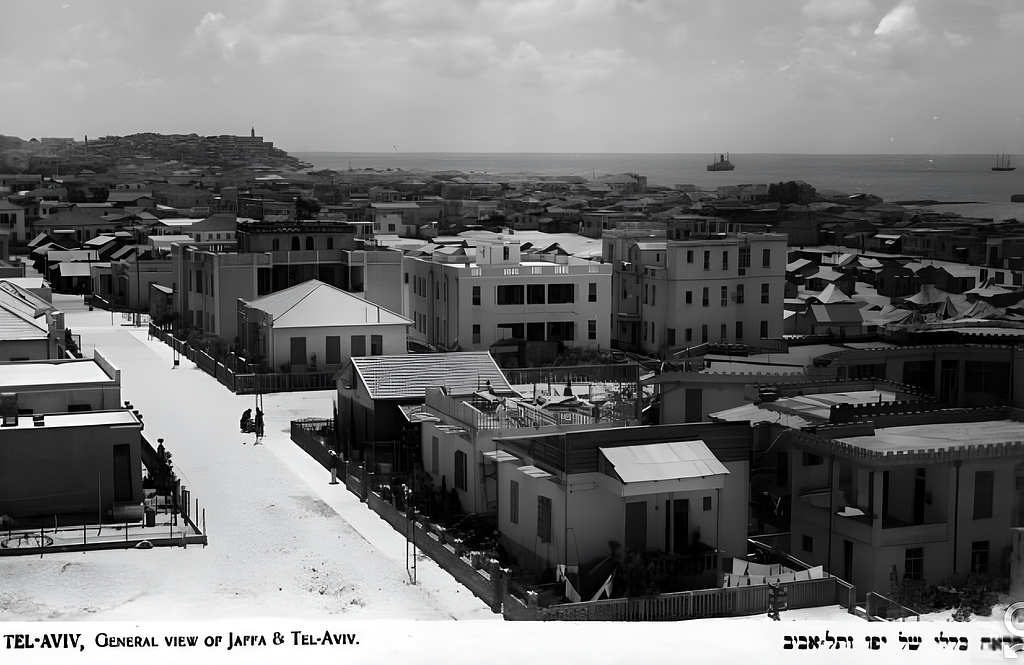
The neighborhood of Neve Shalom was built by Zerach Baronet in 1890. Today it is part of Neve Zedek, a neighborhood north of the old city of Jaffa. The area of Neve Zedek, with all its small neighborhoods, was thriving with Jewish religious and cultural institutions, and with a population that included intellectuals and businessmen.
However, on Purim of 1908, a violent antisemitic event took place there which came to be known as “the Purim events of 1908”, similar to the “events of 1920”, the “events of 1921” and the “events of 1929”. These events usually consisted of Jews being attacked by their Arab neighbors.
Until 1908, Purim celebrations had been held in secret to avoid upsetting the local Arab population, a problem Jews worldwide are facing again today.
Following the immigration of Yemenite Jews to the area, their custom of taking to the streets for Purim celebrations gradually spread to Ashkenazi Jews, and that same year the city’s first masquerade ball was held in a Jewish library in the town. In addition to the ball, the Zionist organizations “Poaley Zion” and “Hapoel Hatza’ir” also celebrated Purim in different locations, one in the hotel of Haim Baruch and one in the hotel of Elkana Spector, both located in Neve Shalom.
Following warnings of a planned attack during the holiday, a number of Hapoel Hatza’ir and Poaley Zion members were placed on guard at the Spector and Haim Baruch hotels, armed with clubs and daggers.
The Attack and Escalation
On the eve of the holiday, a Muslim man attacked and wounded a Jewish woman who had been walking in Neve Shalom with her husband. The husband, who tried to protect his wife, was badly beaten.
The hotel guards went out after the perpetrator and mortally wounded him. In the meantime, an Arab crowd of about one hundred people had gathered in one of the cafés nearby and was preparing to attack the city’s Jews. This news was passed on to Avraham Krinitzi, who was one of the leaders of the defenders and later became the mayor of Ramat Gan. Accompanied by seven young men, Krinitzi burst into the café, where a fight began.
During the commotion, one of the Jewish men grabbed Krinitzi’s knife and seriously wounded one of the Arabs with it. The crowd fled through the windows and back entrances and called the police. In the meantime, young Jews mobilized to defend the neighborhood. Meir Dizengoff and Dr. Haim Hissin, who lived in the Neve Shalom neighborhood at the time, tried to intervene and calm the situation, but without success.
Police Intervention and Violence
Following the Arab’s injury in the coffee shop, Turkish police and soldiers were called from the “Sarayya” (the government building), located a few hundred meters away.
The owners of the hotels were Russian citizens and therefore under the auspices of the Russian consul. The police, accompanied by the representative of the Russian consul, referred to as the “Haman” of that time, and the representative of the “Ka’imkam” (the Ottoman district governor and another “Haman” of the time), entered the hotels and arrested seven Jews, including a boy under the age of fifteen, whom local Arabs beat to their heart’s content in front of everyone.
When the “Jewish” attacker was not found among the prisoners, they returned a second time and broke into the Haim Baruch Hotel to search again. When this Jewish attacker was still not found in the building, the representative of the “Ka’imkam” reportedly allowed his soldiers to do as they pleased in the hotel.
The soldiers, accompanied by an agitated Arab crowd, blew up the menorah in the hall and wounded fourteen guests, three of them with gunshots, including an old man who had immigrated to Israel that day, and the rest with clubs and sticks. The women and children were not harmed.
By this time, the Jews who were at the Purim Ball at the library poured into the street to defend their Jewish brothers.
Aftermath and International Response
The wounded were eventually taken to the hospital, including the wounded Arab, and soldiers were stationed in the streets to escort the ball guests back to their homes safely. The Russian envoy demanded that an investigation be conducted and that those who had harmed his subjects be punished.
Telegrams and messengers were sent by the city’s Jews to Constantinople and Europe in response to the incident. The police claimed in their defense that they had not shot at the Jews but were actually protecting them, and that the rioters were about twenty Arabs who had accompanied them. They explained the break-in to the hotel by saying that they had been informed that the Arab murderer was hiding there, and that the law supported them in this matter.
The result of the above was the intervention of the King Achashverosh of the day, in the form of the Ottoman Governor in Jerusalem and the Ottoman government in Constantinople, who initiated steps to bring about peace between the Jews and their Arab neighbors. This was brought about due to the unwillingness of the Jews to be bullied and pushed around by their Arab neighbors. They defended themselves and spoke for themselves, and the authorities recognized this.
A Turning Point
However, many consider these events a turning point in Arab-Jewish relations in Jaffa in particular, and in Arab-Zionist relations in the country in general, as the first violent incident since the attack on Petah Tikva in 1886. Since the events of 1908, we can see a rapid deterioration of Arab-Jewish relations that culminated in the attack on Tel Chai in 1920, which also took place right before Purim, the events of 1921 in Jaffa, the events of 1929 in Jerusalem and Hebron, and the Arab Revolt during the years 1936 to 1939.
Lessons Through the British Mandate and Beyond
With all the events that took place during the British Mandate era, the Jews depended on the British government to protect them, but that protection did not come. The events of Purim 1908, which took place during the Ottoman period, a time of lawlessness, showed that when Jews defended themselves, they were able to prevail. It was only when the Jews of Palestine realized they must not depend on the British for protection, but rather needed to defend themselves, that we saw the birth of real Jewish fighting forces in the “Haganah”, the Irgun, and the Lehi, which later became part of the IDF.
Today
Today we are witnessing a sharp rise in antisemitism all over the world. It seems to me that Jews cannot rely on their local governments to protect them and need to rely only on themselves for their protection.
Related Topics
Related Posts