
Award-winning feminist author, anthropologist, educator, coach, publisher, and activist
Pushed Out and Pushing Back: Everyday Sexism
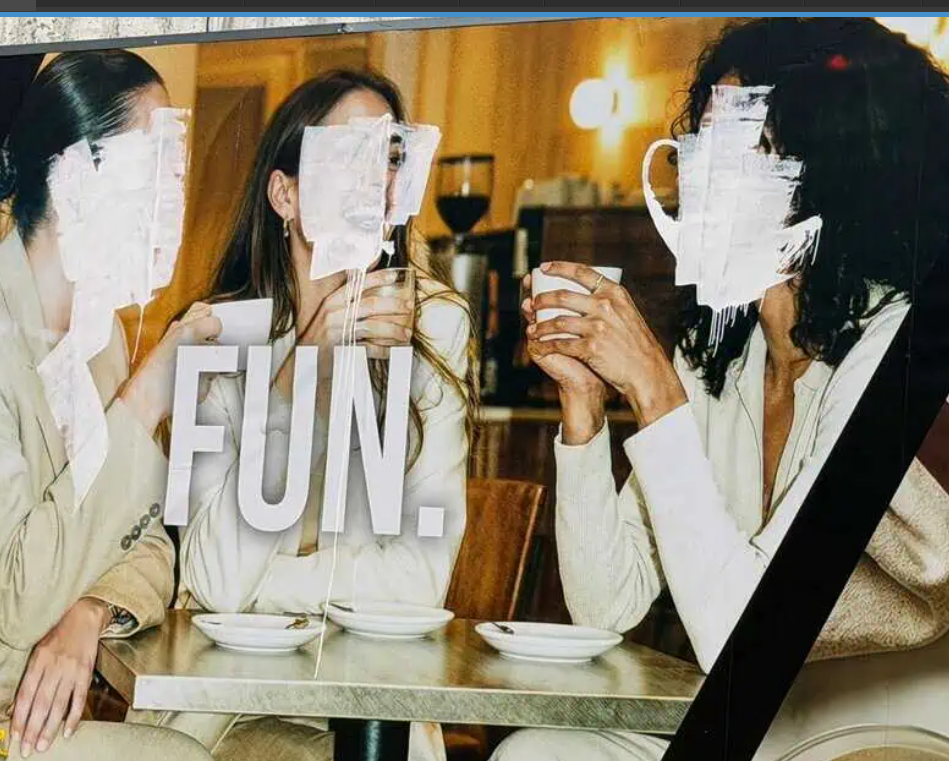
FUN: Women's faces were painted over on a poster in Kiryat Ono
Snippets from recent life in Israel:
- In Kiryat Ono, a billboard featuring women was vandalized shortly after it was installed. Black markings were drawn over the women’s faces, obscuring their features while leaving the rest of the image intact. The posters remained in public view.
FUN: Women’s faces were painted over on a poster in Kiryat Ono - A group of soldiers who just completed combat training found themselves locked out of their facility on their base, and had to break in through a window to reach their destination. Why? Because they were women, and the ultra-Orthodox soldiers on the base didn’t want them to enter.
- A group of young women who had just been released from compulsory army duty shared a rite of passage social media clip in which they tore up their army identifications – and were court-martialed and fined 1200 NIS each for dressing “immodestly”. During the proceedings, they were told, “Look how you’re dressed,” and asked, “What if a religious soldier saw you like this?”, demonstrating that the issue was not discipline, but control over women’s bodies.
- A group of women combat intelligence soldiers are regularly denied sleeping quarters at certain bases with large numbers of religious soldiers after late-night operations.
- At the Jerusalem marathon, a sweltering day of Middle East heat, male soldiers were allowed to race in shorts. Women soldiers were forced to wear long pants, an explicit and unjustified gender distinction.
- In Gaza, female soldiers were barred from entering a structure where male soldiers were present and were forced to operate outside in a high-risk area, despite the safer option being available. The religious soldiers who kept the women out said that women’s presence was “not respectful.” These decisions placed women at greater physical risk. The men were clearly heeding the instructions of their rabbis – not just haredi but also religious Zionist rabbis – who have been increasingly ordering religious men to refuse to serve alongside women.
I have some questions.
“Not respectful” – to whom???
Whose demands are prioritized over others?
Whose lives matter and whose don’t?
Whose voices matter and whose don’t?
There is such a fundamental inequality embedded in all of these events.
In each case, men matter and women simply don’t. Men get to decide how they want their world to look – women-free, as it were – while women have no say in how their worlds should look, or whether they are even allowed to be in it. Men demand that other human beings disappear from their landscape and that their demands be heeded – while the human beings who are forced to disappear have no say at all.
The culture enables misogyny
Even though each of these developments took place in a different context, with different actors and different justifications, they are not isolated incidents. Rather, they are part of a growing pattern in which women in Israel are being restricted, excluded, or pushed aside—often in the name of religious accommodation. As Attorney Racheli Sonego of the Israel Women’s Network explains, “This is no longer a series of isolated incidents. What we are seeing is a troubling pattern of exclusion and a gradual erosion of women’s status in the public space.” Indeed, research by the Israel Democracy Institute and others have documented a steady expansion of gender segregation in Israeli public life, particularly in areas such as higher education, public events, and municipal services.
This normalization is taking place in direct tension with Israeli law. The Supreme Court has repeatedly ruled that gender segregation in public space is unlawful, and that the army must allow women into all positions. Yet legal scholars and advocacy organizations have noted a widening gap between formal legal protections and their implementation, with authorities often failing to intervene when violations occur. Despite repeated court rulings affirming that gender segregation in public space is illegal, enforcement remains inconsistent, allowing these practices to persist and expand.
In fact, while women across Israel were having these experiences, the Knesset advanced proposals that would expand the ability of public institutions to separate men and women under the framework of religious accommodation. These practices are becoming routine, and are now bolstered by the legal system which seems to have thrown women under the bus in order to appease religious men.
Policy analysts warned that such measures could broaden gender-based exclusion in state settings, including institutions that have traditionally operated on the basis of equal participation.
The Knesset is “accommodating” religious men
There is a direct connection between what is happening on the street and what is happening in the Knesset. It’s where cultural norms and institutional policy feed into each other. When women’s images are removed from public space without any accountability, it sends the message to lawmakers that pushing women aside is socially acceptable. And when the government legalizes these actions, it sends the message to people on the ground that it’s legitimate and legal to remove women. It’s a chicken-egg form of everyday sexism. Or religious misogyny on a loop.
That said, the current moment is unprecedented in just how much the formal institutions of government are encouraging misogyny as policy.
A lot of this has to do with religion and its increasing role in radicalizing the government. Today, demands for religious “accommodation” are increasingly translated into policy, even when they come at the expense of established equality norms. In the military, new laws to allow soldiers to refuse service alongside women—and the growing institutionalization of gender-segregated frameworks— have made it legal to exclude women from what was once a shared civic space.
In the public sphere, weak enforcement of court rulings against gender segregation, along with repeated acts of erasing women from billboards and community spaces, signals a broader tolerance for exclusion. The most far-reaching and troubling development, however, lies in the recently passed Law to Expand the Rabbinical Courts, which would expand the jurisdiction of rabbinical courts into civil domains. These moves would shift authority over key aspects of personal and family life away from democratic legal frameworks and into religious systems that have historically limited women’s rights in matters of divorce, custody, and economic independence.
We cannot let the misogyny go unchallenged
The good news is that these developments are being challenged. The Israel Women’s Network is leading the appeal against the Law to Expand the Rabbinical Courts. Similarly, civil society organizations are documenting cases and pursuing legal action, journalists are reporting on incidents that might previously have gone unexamined, and public debate is intensifying. These responses play a critical role in interrupting the process of normalizing misogyny in the name of religion.
The current moment is not defined by a single policy or sector but by a broader question about the structure of public life. The issue is whether equality remains the baseline, even when contested, or whether it is becoming conditional, applied selectively and increasingly subordinated to other priorities. The answer will emerge not from one decision but from the accumulation of many—policy choices, institutional responses, and public reactions.
As Attorney Sonego noted, the central challenge is recognizing the pattern while it is still reversible. “Once exclusion becomes normalized, it is far more difficult to undo. The question is not whether these developments are connected, but whether they are understood as such in time to change their course.”
As Tal Hochman, CEO of the Israel Women’s Network, put it: “Women are not asking for new rights. These rights already exist in law. The question is whether the system will enforce them—or allow them to erode in practice. What we are seeing now is the test.”
Related Topics
Related Posts