The views expressed herein are solely mine.
Qatar’s Emir Flies Under Israeli Protection
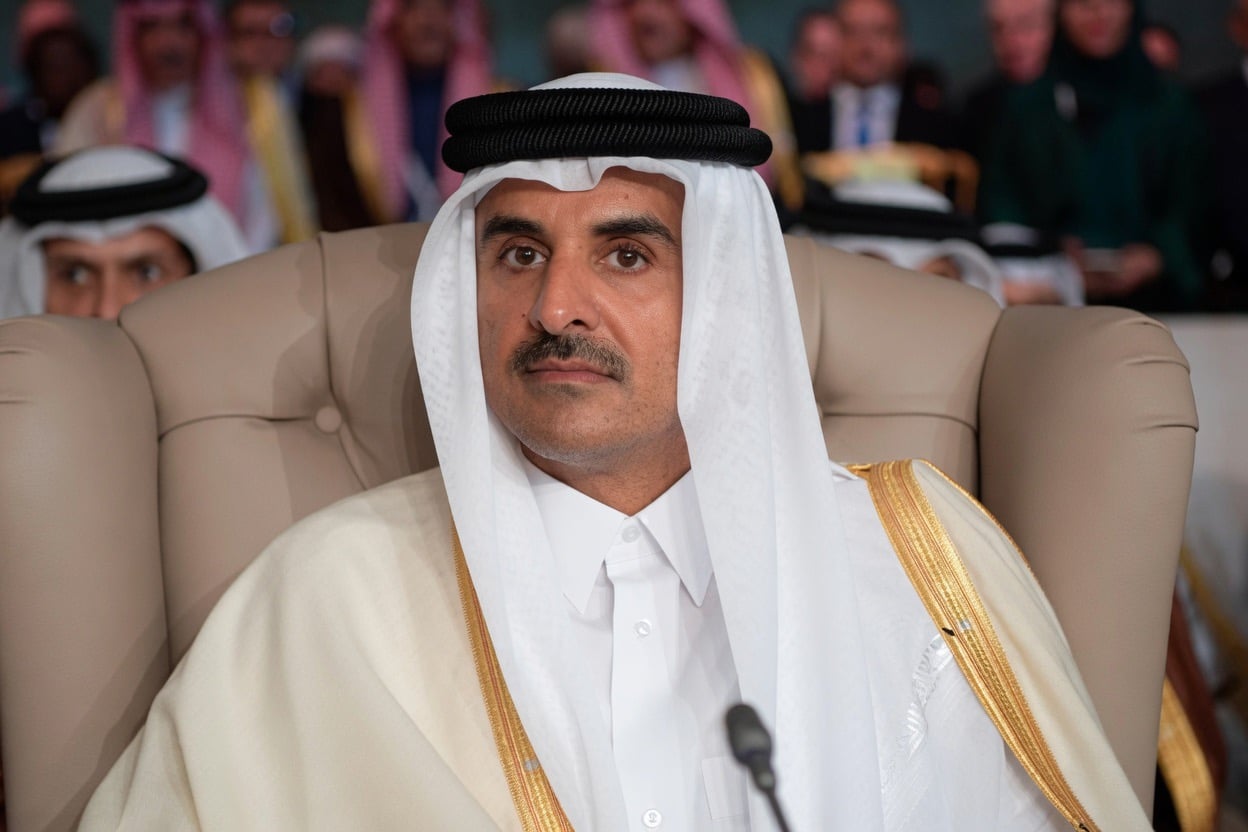
Qatar's Emir Sheik Tamim bin Hamad Al Thani attended the opening of the 30th Arab Summit in Tunis, Tunisia, on March 31, 2019. (Fethi Belaid / AP).
Israeli companies are shielding Qatar’s ruling family from missile attacks even as Doha hosts Hamas leaders. That contradiction is not merely ironic; it exposes a strategic opening Jerusalem has underused.
Three aircraft in Qatar’s royal fleet reportedly carry Elbit’s C-MUSIC laser-defense system against shoulder-fired missiles. One reportedly carried Emir Tamim bin Hamad Al Thani to Tehran in 2025. Israeli firms also won an estimated $150 million to $250 million in subcontracts tied to Qatar’s 2017 F-15QA acquisition, including 160 JHMCS helmet-mounted cueing systems and night-vision equipment. Saudi Arabia received 462 comparable systems for its F-15SA fleet.
Israel’s defense exports reached a record $19.2 billion in 2025, nearly 30 percent above the previous year. Missile, rocket, and air-defense systems made up the largest share. Certainly, such exports do more than produce revenue. They build technical dependence, operational familiarity, and, when managed deliberately, strategic leverage that diplomacy alone has failed to deliver.
Qatar makes the point plainly. Doha has sheltered Hamas’s political leadership for years. Qatari cash assistance to Gaza, often framed as humanitarian support, has helped sustain Hamas’s terror-governing structure. Yet members of the ruling family travel on aircraft protected by Israeli technology designed to defeat missile threats.
That contradiction does not give Israel automatic influence. Equipment installed years ago has limited value on its own. However, leverage rests on continuing control over maintenance, spare parts, software support, upgrades, technical access, export licenses, and follow-on contracts.
Today, technological dependence becomes political influence only when the supplier can shape future support. Because these capabilities reached Qatar through American defense channels, Jerusalem must coordinate closely with Washington and U.S. prime contractors rather than assume it can act independently.
The Jewish state should treat commercial ties of this kind as channels of influence, not awkward footnotes in regional security strategy.
First, future Israeli-origin support and upgrades for Qatari platforms should be conditioned, jointly with the United States, on verifiable action against Hamas. The objective should be measurable conduct, not public humiliation or impossible demands for immediate alignment. The goal should be simply denying sanctuary to Hamas officials involved in terrorism, cutting financial channels that sustain Hamas rule, ending state-backed platforms that glorify the group, and yielding results over time.
Second, Israel should deepen discreet security cooperation with Saudi Arabia. Riyadh faces Iranian missile and drone threats directly. Existing technological links can support sustained work on integrated air and missile defense, counter-drone operations, intelligence coordination, and defense-industrial resilience. Habits of cooperation built now can survive political delays and make eventual normalization more achievable when conditions permit.
Third, Israel should recognize a basic strategic truth: formal diplomacy is not the only route to influence. Quiet technological, economic, and security connections could create the conditions for access and shared interests where embassies cannot operate. Jerusalem must cultivate such links deliberately and patiently, without pretending that every sale automatically yields a political partnership.
Finally, strict end-use monitoring must remain non-negotiable. Systems supplied through intermediaries or foreign contracts must be protected from diversion, reverse engineering, and access by Iran or its proxies.
Israel’s defense industry has already opened doors that conventional diplomacy could not. The task now is to convert technological dependence into usable leverage and ensure commercial relationships serve Israel’s core security interests rather than remain isolated transactions.
Dependence without conditions is merely commerce. Dependence with conditions, monitoring, and a clear and smart geopolitical purpose can become a durable, quiet instrument of deterrence and stability for the region.
Related Topics
Related Posts