PoliSci Student | Op-Ed Writer and Columnist | Opinion Journalist
Rabbi Marcus Melchior
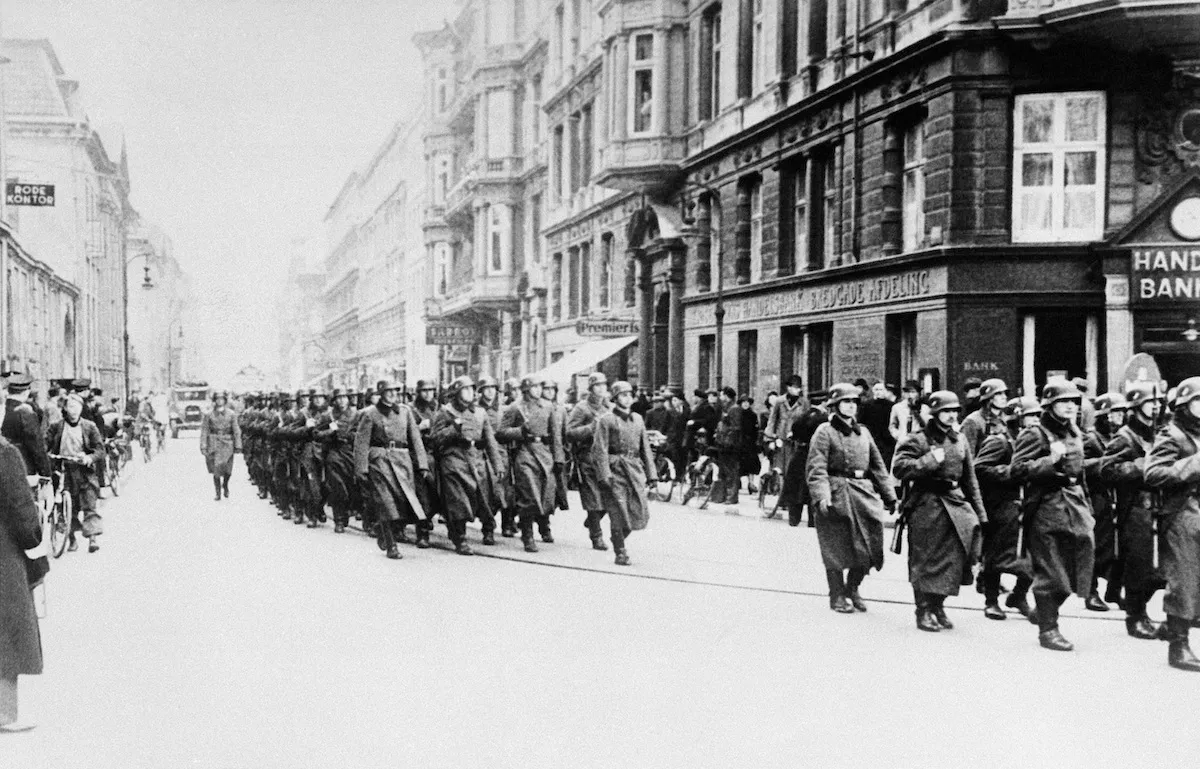
Copenhagen, Denmark on April 20, 1940, Image by AP (PD)
Bearing someone’s name is not just a nominal gesture: it is often a commitment to history and to a legacy that precedes us. In my case, I bear the name of Marcus Melchior, a Danish rabbi, a key figure of spiritual and moral resistance during one of the darkest periods of the 20th century. His life not only moves me: it challenges me.
Melchior was more than just a leader in the community. He became an architect of salvation and a voice of courage in 1943, when Nazi occupation made it nearly impossible for Danish Jews to survive. During Rosh Hashana (1943), Melchior made a decision that went against the liturgy to save lives: he canceled his services, he submitted to the persecution, and he informed his community that the Nazis were planning an impending raid on the Jewish community in Denmark. Everyone should hide or run, he said. Supported by information obtained from a German diplomat who disclosed the plan, the warning set up an unparalleled chain of civil solidarity. In just a few days, thousands of refugees were transported by water to Sweden, which was neutral, with the assistance of fishermen, neighbors, students, priests, and officials. It was risk, organization, and moral and political clarity—not a miracle.
About 7,000 jews crossed the Øresund in small boats, and approximately 95% of the roughly 7,800 Jews in Denmark managed to escape. Numbers matter because they leave little room for propaganda. The majority survived and returned after the war, while about 500 were sent to Theresienstadt. One of the most remarkable instances of citizen rescue in the face of a violent state is still the “Danish Case.” Melchior was not a hero by himself. He was a community-building leader. He fled to Sweden with his family and served as a rabbi for the Danish refugees until the war’s end. Back home, he took over as Chief Rabbi of Denmark in 1947 and maintained a contemporary, cohesive Jewish enterprise that was institutionally dialogical, personally orthodox, and focused on bridging rather than dividing religious currents. It’s a straightforward but important lesson: the ongoing task of repairing the social fabric follows the remarkable gesture.
He left behind a public and family legacy as well. His great-grandson Yair (Jair) Melchior is currently the Chief Rabbi of Copenhagen; his grandson Michael Melchior is a rabbi and politician in Israel; and his son Bent Melchior would go on to become the Chief Rabbi of Denmark. While they embody institutions, biographies do not replace them. Legacy ceases to be merely a commemorative act and transforms into civic culture when a community acknowledges and replicates leaderships of service rather than spectacle.
What does Melchior tell us now, far from Copenhagen and from 1943?
Timely clarity saves lives. When being courteous could have been fatal, Melchior decided to speak. In addition to the lie, the tactical ambiguity that has been ingrained is the enemy of truth. Someone who recognizes danger before it gets convenient is a leader.
Civil heroism is not a single impulse; it is a public policy. The “fleet” of fisherman that transported thousands to Sweden was not a magical phenomenon; rather, it was arranged port by port, neighborhood by neighborhood, with common expenses and networks.
Religion can be a lever for life and freedom. Theology was the moral catalyst for action, not a justification for avoidance. Melchior’s resolute homily invoked the first commandment—”choose life”—rather than ritualism.
The Melchior model is not nostalgia, it is a standard. It demands of us three things we often avoid: to say the unspeakable, to organize without permission, and to sustain what has been built when the media spotlight is gone.
There is no epic without logistics, no community without leaders willing to risk their own skin, no memory without institutions to guard it.
Carrying this name is both a burden and a privilege. It is a reminder that history does not end; it echoes. And when those echoes reach us, we must decide whether to turn away or to answer back. Rabbi Marcus Melchior answered with courage. I can only hope to answer with the same clarity. Not all of us can be him. But all of us can be part of the fleet. And that — organized, concrete, sustained — changes history.
Related Topics
Related Posts