The Alhambra: a Story Shared, a Story Untold
Between Paradise and Ruin
Water runs through narrow channels and gathers in pools. Cypress and orange trees rise above clipped hedges. Beyond the walls, the Sierra Nevada mountains frame Granada in the distance. The gardens give way to gates, courtyards, and palace chambers.
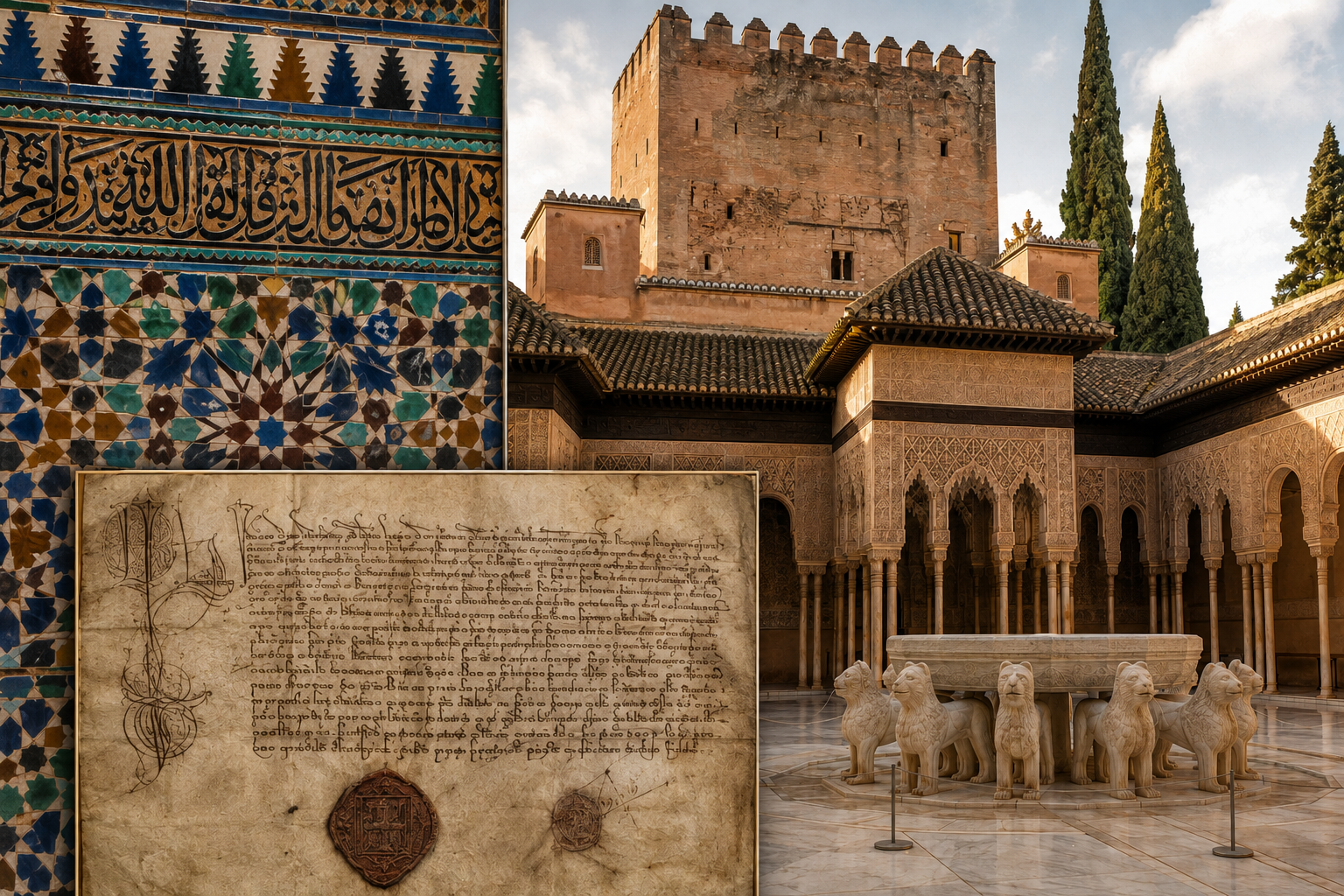
The name Alhambra—“the red fortress” in Arabic—recalls its rugged earthen walls. They reveal little of what lies inside: patterns carved in plaster, Arabic calligraphy, painted tiles, cedar ceilings, and courtyards filled with light and water. That is part of the wonder—fortress on the outside; within, the genius of designers who sought to capture a vision of paradise on earth.
Washington Irving captured that tension:
“Perhaps there never was a monument more characteristic of an age and people than the Alhambra; a rugged fortress without, a voluptuous palace within; war frowning from its battlements; poetry breathing throughout the fairy architecture of its halls.”
What connects the nineteenth-century American writer who gave us the Headless Horseman to a Muslim palace in Granada—and from there to synagogues in Budapest, Berlin, Cincinnati, New York, and Denver?
Irving arrived in Granada in 1829. Already famous for Rip Van Winkle and The Legend of Sleepy Hollow, he was one of the best-known writers in the Atlantic world, the Steven Spielberg of his day.
The Alhambra he encountered was not yet an international destination. Soldiers, squatters, widows, and children lived in its chambers. Towers stood and fountains stirred, but abandonment, war, earthquakes, and neglect had begun to take their toll.
Irving moved in and listened to the stories of the people living there. Tales of the Alhambra, published in 1832, brought together history, legend, and local lore. His fame, storytelling, and eye for atmosphere helped revive international interest in the Alhambra.
Nineteenth-century Romantics were drawn to ruined castles and fallen kingdoms. Spain was European and Christian, yet centuries of Muslim rule placed it partly outside the way Europe imagined itself. Here, a traveler could encounter an imagined Orient without leaving Europe.
The Alhambra had been the seat of the Nasrids, rulers of the last Islamic kingdom in Iberia. After the Christian conquest of 1492, it became a royal Spanish residence. Monarchs added chapels, emblems, and the Renaissance palace of Charles V. Later, the court moved away.
Today, the halls are repaired, the gardens cultivated, and the fountains restored. Visitors follow timed and regulated routes, as at so many international heritage sites. Yet Irving’s Alhambra has not disappeared. The place still draws us toward the atmosphere and the life that once surrounded it.
A significant part of Granada’s life was its Jewish community—a presence submerged beneath the centuries and largely forgotten. We have the privilege of helping to revive its memory.
The Pomegranate of the Jews
Near the western end of the Alhambra stands the Alcazaba, the fortified section of the complex. At its outer edge rises the Torre de la Vela, a broad, square watchtower crowned by a bell and flags. From its rooftop, Granada spreads out below.
If one looks south from this vantage point, the Realejo—Granada’s medieval judería, the Spanish term for a Jewish quarter—lies at the foot of the hill. The Alhambra itself rises along the ridge of Sabika Hill. On this same hill stood a palace associated with the eleventh-century Jewish vizier and communal leader Shmuel HaNagid. Its exact location has been lost. Perhaps some trace of it still waits beneath the Nasrid Alhambra for us to uncover.
Granada was home to one of medieval Iberia’s most important Jewish populations. Jewish life was not confined to court officials or celebrated poets. Families built homes, traded, practiced medicine, maintained synagogues, studied sacred texts, and took part in the life of the city.
Jewish Granada was a major hub tied to Jewish communities across Iberia, North Africa, and the Mediterranean. Letters, religious questions, books, and poems traveled between centers of learning. Financial support reached academies in Kairouan and Babylonia, while teachers, merchants, refugees, and students carried ideas from one Jewish community to another.
Granada came to be remembered as “The Pomegranate of the Jews,” an image that captures the richness and variety of its Jewish life. Jews were a colorful and dynamic presence at the heart of the city.
Granada grew as a recognized center of Hebrew poetry, Talmudic learning, medicine, and translation. The eleventh-century poet and philosopher Moses ibn Ezra was born into one of its distinguished families. His contemporary Judah Halevi joined its circles of poetry and learning. In the following century, Granada-born Judah ibn Tibbon translated works of philosophy, ethics, and Hebrew grammar from Judeo-Arabic into Hebrew, making the intellectual inheritance of Muslim Spain available to Jewish communities in Christian Europe.
Shmuel HaNagid stands out in this world. He was a Talmudic scholar, Hebrew poet, leader of Andalusian Jewry, and patron of Jewish learning and creativity. His influence within Jewish life reached well beyond Granada.
His political and military career was no less remarkable. After the Caliphate of Córdoba collapsed in the early eleventh century, Muslim Iberia fragmented into smaller kingdoms. Granada became the center of the Zirids, a Berber Muslim dynasty. At their court, Shmuel HaNagid rose to become a minister, diplomat—and commander of a Muslim army.
His career exemplifies the unusual historical relationships between Jewish elites and Muslim ruling houses in medieval Iberia.
His military role upends expectations. After the Jewish revolts against Rome and the destruction of the Second Temple, Jewish sovereignty and organized military power largely disappeared from Jewish life. Jews continued to serve in armies, but the enduring image of the Diaspora Jew was not a commander riding at the head of his troops.
For much of the last two decades of his life, Shmuel HaNagid led Granada’s armies into battle. He exercised authority and carried responsibility for soldiers, strategy, victory, and defeat.
He also wrote about war in Hebrew—not from the safety of a library or court, but as someone who knew both its exhilaration and its price:
War at the outset is like a beautiful maid
With whom everyone wishes to flirt.
At the end it is like a despised hag…
(Translated by Leon J. Weinberger)
These lines could surely be understood by any contemporary Israeli soldier. Shmuel HaNagid knew both the anticipation of battle and the suffering in its wake. His poetry brought together Hebrew literary imagery and his own lived experience on the battlefield.
A Jewish scholar and poet leading the armies of a Muslim kingdom unsettles familiar descriptions of medieval Jewish life and the later stereotype of Jews living apart from politics, sovereignty, and military force.
After his death, his son Yosef inherited much of his father’s influence at court but lacked his political judgment. Resentment and political conflict grew. In 1066, Yosef was assassinated, and the violence turned against Granada’s Jewish population. Later accounts estimate that 4,000 Jews were murdered, although the precise number cannot be verified.
The massacre devastated Jewish Granada but did not end its story. Jews returned and rebuilt. Later Muslim dynasties imposed new restrictions, and under the Almohads in the twelfth century many Jews were forced either to convert or flee. Jewish life continued in Granada until the expulsion of 1492.
This is why convivencia—the term often used to describe coexistence among Muslims, Christians, and Jews—requires qualification. Historians continue to debate its extent, character, and duration. The possibilities for cultural exchange and Jewish achievement rose and fell like the tides, while legal inequality, political vulnerability, prejudice, and violence never disappeared.
Jewish life in Muslim Granada was neither an uncomplicated Golden Age nor an uninterrupted story of persecution. Its achievements and its vulnerability were both real.
The Edict Unmentioned?
To return to the Alhambra after tracing this Jewish history is to see the palace differently. Its courtyards and inscriptions speak powerfully of Muslim Granada and Christian conquest, but they say almost nothing about the Jewish lives shaped, elevated, and finally uprooted in its shadow.
At the heart of the Nasrid palace lies the Court of the Lions. A marble fountain supported by twelve carved lions stands at its center, surrounded by a forest of slender columns. Some have sought to connect the fountain to the earlier palace of Shmuel HaNagid and his son Yosef. The suggestion is enticing, but it may owe more to wishful thinking than to historical evidence.
From the Court of the Lions, I pass through the palace chambers into the Court of the Myrtles. A long reflecting pool stretches toward the massive Comares Tower. I cross its shaded northern portico, pass through an antechamber, and enter the vast throne room.
This was the throne room at the heart of the Comares Palace, the core of the official state complex known in Arabic as Qaṣr al-Sultan—the Sultan’s Palace. The sultan sat beneath a wooden ceiling evoking the seven heavens of Islamic tradition, surrounded by inscriptions praising God and proclaiming Nasrid authority.
After the Christian conquest, the throne room of the Nasrid sultans became a chamber of the Spanish Crown. The linguistic change reflected new political realities in Iberia.
Here, in January 1492, the last Nasrid ruler, Muhammad XII—known in the West as Boabdil—surrendered Granada to Isabella of Castile and Ferdinand of Aragon. The last Muslim kingdom in Iberia had come to an end.
American schoolchildren know that Ferdinand and Isabella sent Christopher Columbus across the Atlantic: “In fourteen hundred and ninety-two, Columbus sailed the ocean blue.” But that year the Spanish monarchy also set out to define political unity through religious uniformity.
On March 31, less than three months after the conquest, Isabella and Ferdinand issued from the Alhambra a decree forcing their kingdoms’ Jews to convert or go into exile.
The Alhambra Decree gave Jews four months to depart. Some converted, by conviction or necessity. Others left for North Africa, Italy, Portugal, the Ottoman Empire, and beyond.
Homes and property were abandoned, confiscated, or looted. Livelihoods, institutions, and centuries of Jewish life were uprooted.
The seat of Muslim Granada had become the home of a Christian monarchy determined to impose religious and territorial unity, regardless of the price. The Alhambra is also a story of how the glories of empire are often built at a price paid by minorities, the marginalized, and those cast as the other.
The Alhambra’s vast halls are covered in words: Qur’anic verses, poems, royal titles, and blessings. Yet no display, exhibit, or sign marks the Edict of Expulsion and its consequences.
The omission is striking because the Alhambra is one of the world’s great monuments to historical memory. Its Muslim past has been recovered, restored, and placed at the center of the visitor experience. Its Jewish connections—some speculative, others documented—remain outside the account the site gives of itself.
Granada has other sites that preserve and share the city’s Jewish history. Yet that history must also be represented at the Alhambra—the epicenter of the 1492 expulsion and the one place nearly every traveler to Granada will visit.
There is room on the grounds of the Alhambra for Jewish Granada. I encourage its curators and custodians to reach out to the Israel Museum in Jerusalem or ANU–Museum of the Jewish People in Tel Aviv to create an exhibit that shares the Jewish experience in Granada—its pinnacles of creativity and influence, and the violence and expulsion that brought about its destruction. Such an exhibit could place the Edict within the larger context of medieval Jewish life in Granada and Andalusia.
The exhibit would not need to turn the Alhambra into a Jewish site. It would allow the Alhambra, Granada, and Spain to acknowledge a shared history that currently remains unmentioned on the grounds of the Red Palace.
In the absence of a dedicated place at the Alhambra to tell the Jewish story, my presence—and the presence of other Jewish travelers—matters. We stand on the site, share that story, and remember what has been left untold. That act of remembering is our resistance.
Building for a New Golden Age
Spain expelled its Jews in 1492. Three and a half centuries later, Jews across Europe and the United States began drawing upon the forms of medieval Spain as they built their synagogues. The place that had witnessed Jewish exclusion became, indirectly and unexpectedly, a source for Jewish architectural confidence.
As a child growing up in Nantasket, a small town near Boston with an even smaller Jewish community, I attended a seaside synagogue built in a Neo-Byzantine style. Its architecture suggested to me that our Jewish story also belonged to places far away and times long ago. Only later did I understand that the building of my childhood belonged to a larger Jewish search for an architectural language and a public sense of belonging.
That search took many forms. For many nineteenth-century European and American Jews, it led toward medieval Spain. They recovered its Hebrew poetry, philosophy, and religious thought while asking what that past might make possible in their own time. For some, the answer was the Neo-Moorish synagogue.
Heinrich Graetz’s History of the Jews, published beginning in 1853, helped shape the modern idea of Muslim Spain as a Jewish Golden Age. Graetz and other German-speaking Jews asked whether emancipation could allow them to participate in European society without abandoning who they were.
Medieval Spain offered a precedent. Recovering Sepharad—the Hebrew name for Spain and the Jewish civilization that flourished there—was also a statement about the future.
This raised a practical question: What should the grand synagogues being built by Jewish congregations look like?
Gothic architecture belonged to the church. Classical design spoke the language of the state. Medieval Jewish Europe had left few monumental synagogues that could serve as models.
The Alhambra offered another path.
Moorish Revival was a popular architectural style. Up-and-coming Jewish elites in Europe and America sought to keep up with fashion while making a unique statement about Jewish emancipation and public identity. They wanted synagogues that belonged on the modern city street and stood proudly as recognizable Jewish buildings.
The Great Synagogue on Dohány Street in Pest, built between 1854 and 1859, was one answer. Its three thousand seats, twin towers, striped brickwork, horseshoe arches, and richly colored interior gave the hope for a Golden Age physical form.
The style moved quickly. Berlin’s New Synagogue opened in 1866 beneath a gilded dome. That year, Cincinnati’s Plum Street Temple—today known as Isaac M. Wise Temple, honoring a founder of American Reform Judaism—brought the vision to America, its interior filled with sacred texts, light, warmth, and color.
New York’s Central Synagogue, completed in 1872, adapted the Dohány design for an American setting. By 1899, Temple Emanuel’s Pearl Street building in Denver had carried Moorish and Eastern Islamic forms to a young city near the American frontier.
Many Jews who prayed in these synagogues were not descended from Spanish Jewry. They were Ashkenazim from Central and Eastern Europe or German Jewish immigrants to the United States. Yet they claimed Sepharad as part of their inheritance.
These buildings stood prominently on city streets, declaring that Jewish life would no longer remain confined to hidden prayer rooms or marginal neighborhoods. Their congregations intended to take their place in civic life.
The paradox is clear. A palace associated with the decree that expelled Spain’s Jews became an inspiration for synagogues across the Western world. The Jewish story had nearly disappeared from the way Granada and the Alhambra were remembered. Yet the forms of the Alhambra reappeared in Jewish houses of worship from Budapest to Cincinnati.
Jews took an architecture from a place that had erased them and made it part of the construction of their future.
Taking the Alhambra with Us
The idea of a Jewish Golden Age has not disappeared. In March 2024, Franklin Foer published an essay in The Atlantic titled “The Golden Age of American Jews Is Ending.” The title itself shows the idea’s continuing force.
Jews still turn to medieval Muslim Spain when describing periods of security, creativity, participation, and confidence. Yet a Golden Age is less a description of a perfect past than a way of asking questions about the present. When can Jews participate fully in the societies around them without abandoning who they are? How do we live with our neighbors and stand for our rights in the face of prejudice and exclusion?
For me, this is why Jewish Granada still matters: it is a place where history becomes our-story. Muslim Spain’s Jewish poets, scholars, ministers, and soldiers show how fully Jews could participate in the life around them. The massacre of 1066 and the expulsion of 1492 remind us how fragile that life could be.
The Jews who built Neo-Moorish synagogues in nineteenth-century Europe and America claimed the Alhambra as a memory and used it to imagine what Jewish life might become. They asked whether a new Golden Age could be built—and gave that hope physical form.
As I leave the Alhambra, the sound of water recedes behind me. The Jewish story is difficult to see in its courtyards and exhibitions, but it survives in poems, scholarship, dispersed communities, and synagogues built to resemble the palace from which an edict of expulsion was issued.
We take the Alhambra with us because its questions remain ours. On which foundations do we stand? What memories and stories underpin our commitments? What allows Jewish life to flourish—and what part will each of us play in building and sustaining it?
–
Hit Follow at the top of the page to keep up-to-date with my blog and with this ongoing series on Jewish experiential travel. Stay tuned.