London based entrepreneur, cybersecurity analyst doing a PhD in AI
Rafael Nadal and Inner Stability
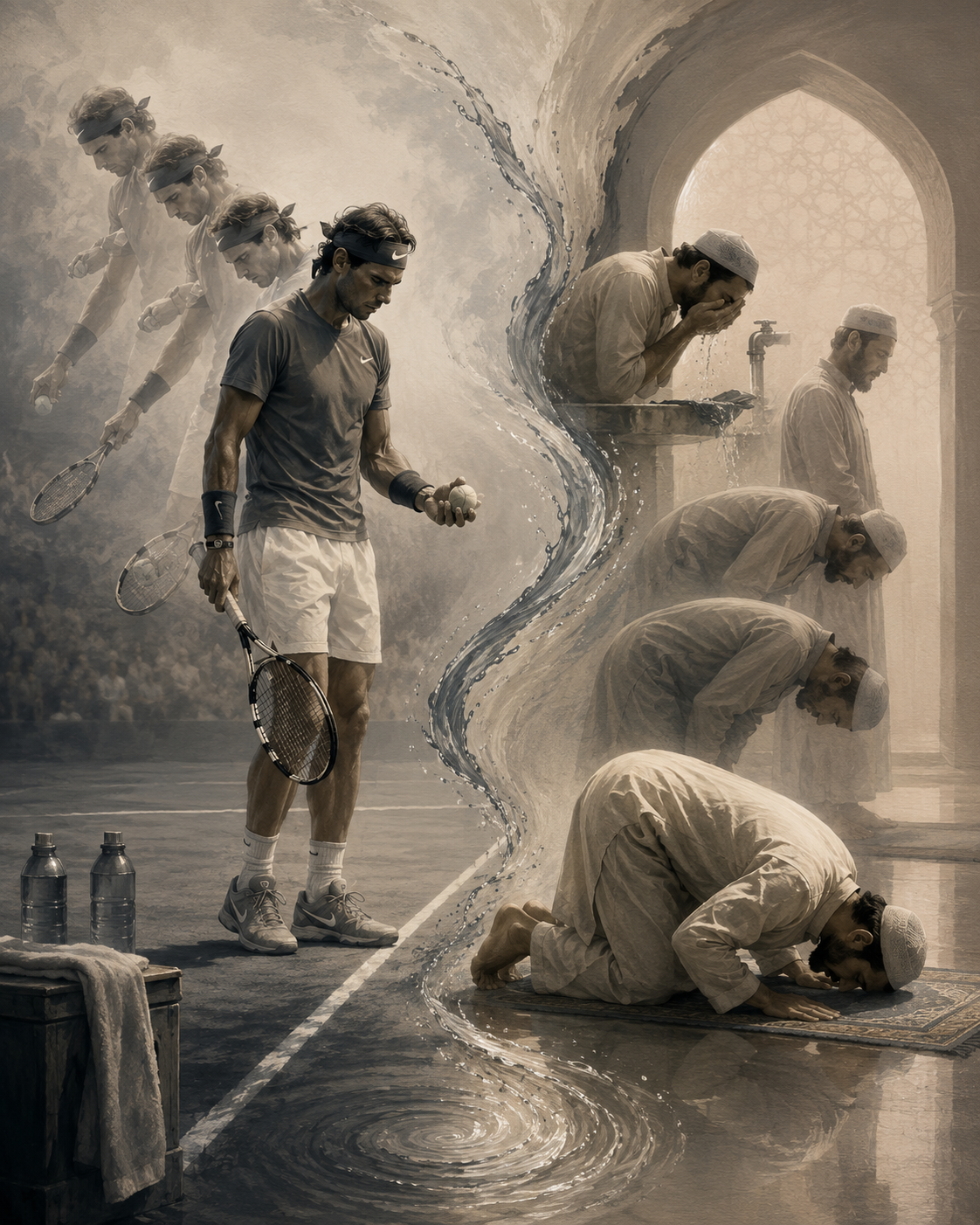
Ritual, Rhythm, and the Mind: Nadal, the Five Prayers, and the Architecture of Inner Stability
There is a moment before every Rafael Nadal serve that feels almost liturgical.
He adjusts his shorts.
Touches his nose.
Pulls his shirt.
Taps his left shoulder, then his right.
Bounces the ball—exactly, repeatedly, insistently.
Steps back. Steps forward.
Looks down. Breathes.
Then begins again.
This extends between games when he rests to the placement of his water bottles. Precise in order. He drinks from one of them and then the other one in order. The order never changes.
To the casual viewer, it can look like superstition.
But to the trained eye of psychology, neuroscience, and religious psychology, it is something deeper:
Ritual as Regulation – The Mind Does Not Like Chaos
Human cognition is not built for constant novelty. The brain is a prediction machine, constantly trying to reduce uncertainty and stabilise attention.
Neuroscience shows that repeated, structured actions reduce cognitive load by shifting behaviour from the prefrontal cortex (effortful control) into the basal ganglia (automatic habit systems). Once a sequence is learned, it becomes embodied predictability—a way of conserving mental energy under pressure.
This is why rituals appear in every high-performance domain:
- athletes before execution
- surgeons before operation
- musicians before performance
- soldiers before engagement
Ritual is not irrational.
It is neurocognitive stabilisation under stress.
Nadal’s routines are not random quirks. They are a way of forcing the nervous system into a known state before uncertainty begins.
And religion, across civilizations, discovered this long before neuroscience named it.
The Five Daily Prayers: A Different Kind of Consistency
Islam structures the day not around productivity, but around interruption.
Five times a day, everything pauses:
- work
- conversation
- consumption
- distraction
And the body is brought into a sequence of repeated actions:
standing, bowing, prostrating, sitting.
This is not merely “worship” in the abstract sense.
It is ritualised embodiment.
The same movements.
The same order.
The same orientation.
The same water before it.
Across traditions, water appears as the threshold of sacred action:
- Islam: wudu (ablution) before prayer
- Judaism: mikveh immersion and ritual washing
- Hinduism: purification in rivers like the Ganges
- Christianity: baptism as symbolic cleansing and rebirth
Different theologies. Same intuition:
before the mind turns toward the transcendent, the body must be reset.
Why Water?
From a psychological perspective, water is one of the most powerful sensory reset signals available to the human nervous system.
Cold or cool water on the skin:
- activates the parasympathetic nervous system
- reduces sympathetic arousal (stress response)
- increases vagal tone (calming regulation)
- creates a perceptual “boundary moment” between states
In simple terms: water tells the brain something has changed.
You are not the same person you were a moment ago.
This is why washing rituals are so universal. They are not arbitrary symbolism—they are neurobiological transitions.
The body learns:
“I am leaving one mental state and entering another.”
Nadal and the Sacredness of Repetition
What makes Nadal fascinating is not that he has rituals.
It is that he never abandons them under pressure.
In fact, the higher the stakes, the more rigid the ritual becomes.
This is counterintuitive in modern thinking, where we assume flexibility equals strength.
But in cognitive terms, Nadal is doing something very sophisticated:
he is reducing decision fatigue at the exact moment decision pressure peaks.
By locking in a fixed pre-serve sequence, he removes variability from the most volatile moment in tennis.
The ritual becomes an anchor.
And anchors are what prevent drift when the system is under load.
Religion as Cognitive Architecture
If we step back, something striking appears:
religion is not only belief—it is structured repetition designed to stabilise consciousness.
The five daily prayers do at a civilisational scale what Nadal’s routine does at an athletic scale:
- they interrupt chaos
- they reset attention
- they reorient intention
- they re-establish identity
In psychological terms, they function as:
- attentional reset points
- emotional regulation cycles
- identity reinforcement loops
In neuroscientific terms, they create:
- predictable dopamine cycles (anticipation → action → relief)
- reduced cognitive entropy
- strengthened habit circuits tied to meaning rather than impulse
In other words:
ritual is how meaning becomes embodied.
The Power of Continuity
One of the most underappreciated effects of ritual is continuity of self.
Modern life fragments attention:
- notifications
- feeds
- switching tasks
- constant context collapse
The self becomes discontinuous—many micro-identities across a day.
Ritual restores continuity.
Nadal is the same Nadal before every serve.
The praying person is the same person across five daily returns.
This continuity has measurable psychological effects:
- reduced anxiety
- increased emotional stability
- improved impulse control
- stronger sense of identity coherence
Because the mind trusts what repeats.
The Hidden Function of Ritual: Control of Time
Ritual does something even deeper than stabilise behaviour:
it restructures time itself.
Without ritual, time is linear and chaotic—one long stream of events.
With ritual, time becomes segmented:
- before and after prayer
- before and after serve routine
- before and after purification
This segmentation reduces existential overwhelm.
The brain no longer experiences life as an unbroken flood, but as manageable intervals.
This is why religious traditions rarely leave time unstructured.
Time without structure becomes psychologically heavy.
The Paradox: Freedom Through Constraint
At first glance, ritual looks like restriction.
But cognitively, it produces the opposite effect:
freedom from internal noise.
Nadal is not less free because of his rituals.
He is more free to execute under pressure.
The praying person is not less free because of structured worship.
They are more free from emotional volatility, distraction, and fragmentation.
This is the paradox that both sport psychology and religious tradition converge on:
constraint reduces chaos, and reduced chaos increases agency.
The Deeper Question
If ritual stabilises the mind, and water resets the nervous system, and repetition builds identity continuity—then a question emerges:
What happens when a society removes ritual entirely?
We may not become freer.
We may simply become less anchored.
More reactive.
More fragmented.
More dependent on external stimulation to regulate internal states.
In that sense, the ancient practices were not merely spiritual obligations.
They were psychological technologies of stability.
Conclusion: The Human Need for Return
Nadal returns to his ritual before every serve.
The worshipper returns to prayer five times a day.
Both are doing something the modern world increasingly forgets:
they are refusing to let life become one continuous, unbroken drift.
Instead, they carve it into returns.
And perhaps that is the deepest insight shared across sport, neuroscience, and religion:
the mind does not find peace in constant motion, but in repeated return to centre.
Ritual is not the enemy of freedom.
It is one of the oldest methods humanity discovered for protecting the mind from itself.
Related Topics