
"These fragments I have shored against my ruins"
Raoul Wallenberg: How a British Propaganda Film Became a Model for Rescue
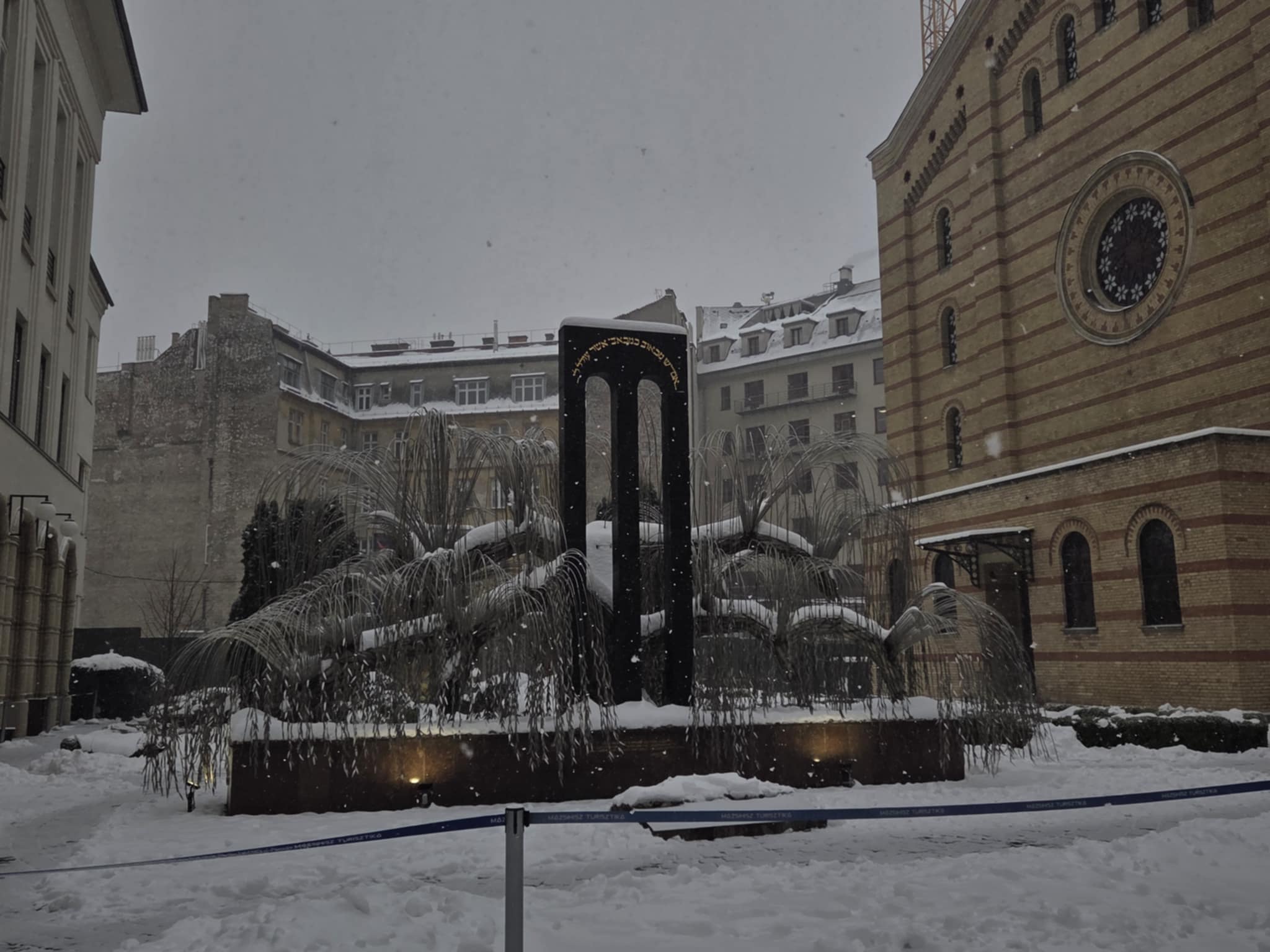
The Raoul Wallenberg Holocaust Memorial Park in the rear courtyard of the Dohány Street Synagogue (Photo courtesy of Inez Korontos-Porath)
When Pimpernel Smith reached Sweden in late 1943, the Swedish Film Censorship Board banned it from public screening, wary that its openly anti‑Nazi stance might jeopardise the fragile, carefully maintained neutrality of the country.
The only people who saw it were those invited to private showings at the British embassy. At one of these screenings, Raoul Wallenberg sat beside his half‑sister, Nina Lagergren, watching Leslie Howard’s archaeologist smuggle prisoners out of Nazi camps. Afterwards, she recalled, he turned to her and said: “That is something I would like to do.” Whether this was the exact phrasing or the family’s later distillation is impossible to know, but what endures is the version they chose to keep: a clandestine film, a banned narrative of rescue, and a young man recognising in its fiction a role he might one day inhabit.
For Raoul Wallenberg in 1943, this was not a generalised drama of oppression. The identity of those being hunted, transported, and erased was already painfully specific, even if the language of extermination had not yet fully crystallised. Neutrality did not imply ignorance; it required a careful management of what could be publicly acknowledged and what had to be privately understood.
The anecdote is only the surface; the conditions behind it are more revealing. Pimpernel Smith was never meant to be entertainment; it was a British wartime instrument, crafted to slip a certain moral posture into the minds of those watching from the safety of neutrality. Its fantasy was simple: that an ordinary, slightly eccentric man could outwit a totalitarian system through ingenuity and nerve. Most viewers would have recognised it as wishful thinking. But propaganda does not need to be universally persuasive; it needs only to find the few who are already receptive, the ones who recognise themselves — or the selves they might become — in the fiction. Wallenberg, watching a banned film in a diplomatic back room, was precisely such a viewer; for him, it would not have read as fiction but as instruction. The story offered him not information but a working model, a way of imagining effective action at a moment when Europe was running out of it.
Leslie Howard was not merely the face of Pimpernel Smith; he was its architect; actor, producer, and director of a film that treated rescue as both performance and obligation. Born to a Hungarian Jewish father but known to the world as the embodiment of English restraint, Howard understood better than most how identities can be constructed, performed, inhabited, and deployed. During the war he turned that understanding into a form of resistance, using cinema to model a kind of individual agency that reality seemed to have foreclosed. His archaeologist‑rescuer was not a superhero but a man who relied on wit, disguise, and the manipulation of appearances; tools Howard himself had mastered. That the film later became entangled with the circumstances of his own death only sharpened its aura: a fictional rescuer played by a man who, in the end, was treated as a threat serious enough to eliminate.
By the time Wallenberg saw Pimpernel Smith, he was not an impressionable youth but a man with a specific geography already inscribed in him. He had travelled to Budapest several times in the early 1940s, long before the German occupation, and had watched the city’s atmosphere tighten around its Jewish population. The unease he absorbed there was not abstract: it was written into anti‑Jewish laws, professional exclusions, and the daily choreography of who could move freely and who could not. When he sat in that embassy screening room, he was not encountering the idea of rescue in the abstract; he was seeing a fictional version of a landscape he already knew intimately. The film did not plant a new desire so much as give shape to an existing apprehension; a usable model for action at a moment when Budapest was sliding towards catastrophe. When he returned there in August 1944, after the occupation, he stepped into a role that was already half‑imagined: the man who uses documents, performance, and audacity to create temporary margins of safety in a system designed to eliminate them.
Wallenberg’s work in Budapest lasted barely six months. On 17 January 1945, as the Red Army entered the city, he was taken into Soviet custody and vanished. The man who had spent the last months of his life manufacturing documents, identities, and safe passage for others was denied all three himself. Whether he died quickly in Lubyanka or survived for years in the labyrinth of Soviet prisons remains unresolved, but the essential fact is clear: his disappearance was the price of the role he had chosen to inhabit. The same qualities that allowed him to improvise pockets of survival under the Nazis — audacity, independence, an unorthodox command of authority — made him intolerable to the Soviets. If Pimpernel Smith offered him a model for action, history offered him no corresponding script for survival.
The stories we tell about figures like Wallenberg and Howard tend to harden into moral parables: the rescuer who vanished, the actor‑propagandist who died for the work he created. But myth has its own gravitational pull, and it rarely aligns neatly with the lived texture of a life. Wallenberg did not walk into Budapest as a pre‑formed hero, and Howard did not set out to become a martyr. Yet both men were absorbed into narratives that outlived them, narratives that simplify even as they commemorate. The danger is not that these stories are untrue, but that they become too complete; too polished to accommodate the uncertainty, improvisation, and fear that shaped their actions. Myth offers coherence where history offers only fragments. It gives us beginnings and endings, causes and consequences, when the reality is that both men stepped into roles whose costs they could not fully foresee.
Even eighty‑two years after his disappearance, for Jews, the unresolved fate of Wallenberg carries a particular weight. A rescuer without a grave joins a longer history of lives that cannot be ritually or narratively concluded, names suspended between testimony and absence. To acknowledge this is not to diminish him. It is to return to him the dignity of complexity, and to recognise that the stories we build around him say as much about our own need for moral clarity as they do about the man himself.
It is tempting to imagine influence as a straight line: a film is made, a man sees it, a life is changed. But the reality is more fragile, more contingent. Pimpernel Smith was conceived in wartime Britain as a piece of cultural resistance, a story designed to stiffen morale and model a form of individual agency that official policy could not always enact. That it travelled across borders, slipped past censors, and found its way into a private screening room in Stockholm was already improbable. That one of the people watching it had spent the previous years travelling to Budapest, observing the tightening noose around its Jewish population, was another coincidence layered on top. And that this same man would later be sent back into that city, after the German occupation, with a mandate so vague it required him to invent his own methods — that is where the chain becomes almost too delicate to trace.
Yet this is how influence often works: not through grand declarations but through the quiet recognition of a usable narrative. A film made for British audiences becomes a private catalyst for a Swedish diplomat; a fictional archaeologist’s improvised rescues become a template for real interventions on the streets of Budapest. None of this was inevitable. It depended on timing, temperament, prior knowledge, and the willingness of one viewer to treat a piece of propaganda not as fantasy but as instruction. The chain holds not because it is neat, but because it is human — a reminder that stories move unpredictably through the world, and that sometimes they lodge in the mind of exactly the person history will later call upon.
Related Topics
Related Posts