
London based entrepreneur, cybersecurity analyst doing a PhD in AI
Rational Fear – Revisiting the Nash Equilibrium.
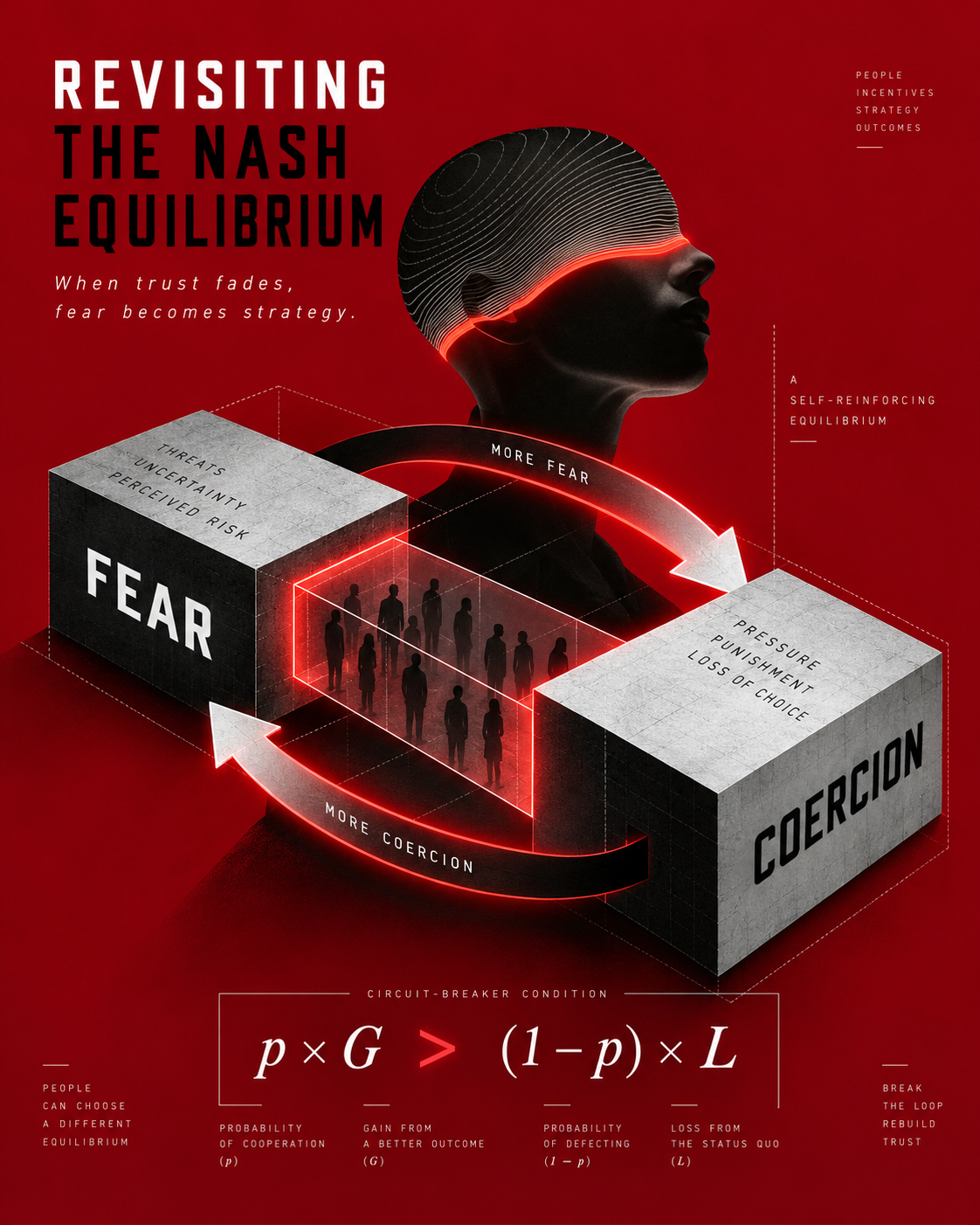
The mathematics of cooperation we need when we reach a political stalemate to prevent civilian distress and damaging the economy.
Revisiting the Nash Equilibrium: How to Cut the Circuit of Fear
When trust disappears, fear becomes the currency of power. But what happens when everyone acts rationally to protect themselves, yet everyone becomes less secure? Game theory may offer an elegant way out.
The Paradox of Rational Fear
Imagine two neighbours who have stopped trusting one another.
The first installs a security camera. The second interprets it as surveillance and erects a higher fence. The first, now suspicious, installs another camera. The second hires private security. Soon, both houses resemble fortresses.
Neither necessarily intended to threaten the other. Each believed they were acting defensively.
Yet the neighbourhood has become less pleasant, more expensive and considerably more frightening.
Now multiply this situation by millions of people, add governments, armies, historical grievances, terrorism, disputed territory and the possibility of catastrophic violence.
We arrive at one of the most important questions in political science:
How can individually rational decisions produce collectively irrational outcomes?
More importantly, how do we escape when neither side trusts the other enough to move first?
This is where we must revisit the mathematics of John Nash.
1. Nash Equilibrium: When Nobody Wants to Move
In 1950, the mathematician John Nash developed a concept that transformed economics, political science and strategic decision-making.
A Nash equilibrium describes a situation in which no participant can improve their outcome by changing their strategy alone, assuming everyone else continues with theirs.
The critical word is alone.
Consider two rival states. Both would benefit from reducing hostilities, reopening trade and allowing ordinary life to resume.
However, each fears that reducing its defensive posture while the other maintains its capabilities could leave it exposed.
Therefore, both maintain their positions.
Neither has sufficient confidence to change independently.
The resulting equilibrium can be stable without being desirable.
Nash did not establish that conflict was inevitable, nor that every interaction was zero-sum. His mathematics applies to cooperative-looking outcomes as well as destructive ones.
The problem is that a stable equilibrium does not automatically represent a morally good or socially efficient equilibrium.
A society can become trapped in an arrangement that nobody particularly likes, simply because nobody believes they can safely leave it.
This is the political tragedy of lost trust.
2. The Zero-Sum Illusion
A zero-sum game is one in which one player’s gain exactly equals another player’s loss.
If one player gains five points, the other loses five. Together, their gains and losses add up to zero.
Certain strategic conflicts contain zero-sum elements: the immediate control of a particular territory, for example, cannot always be simultaneously held by two competing authorities.
But prolonged violent conflict is frequently worse than zero-sum.
It becomes negative-sum.
Two parties may destroy resources, institutions, infrastructure and opportunities that neither can recover through victory alone.
Consider a hypothetical community:
Before hostilities, two populations each enjoyed 100 units of economic and social welfare.
After years of insecurity, both have lost schools, businesses, infrastructure, investment, medical capacity and the ordinary confidence required for economic activity.
One population now has 70 units. The other has 40.
One may have achieved a relative strategic advantage. Yet the combined welfare has fallen from 200 to 110.
This is not simply redistribution.
It is destruction.
And the greatest costs are often carried by people who never made the strategic decisions.
An Israeli parent planning a child’s journey to school and a Palestinian parent trying to secure medical treatment for a child may face very different circumstances and dangers. Yet both confront the fundamental loss of predictability that violence imposes on civilian life.
Recognising this shared vulnerability does not imply equal responsibility for particular acts, erase distinctions between armed groups and civilians, or remove the obligation to establish facts and accountability.
It establishes a simpler proposition:
Human security must be included when calculating the costs of conflict.
3. How Fear Becomes a Self-Reinforcing Circuit
Political scientist Robert Jervis explored a related phenomenon in his landmark 1978 paper, Cooperation Under the Security Dilemma.
The security dilemma occurs when steps taken by one actor to increase its security make another actor feel less secure.
That second actor responds.
The first interprets that response as confirmation of the original threat.
The circuit begins to feed itself.
Fear → Defensive escalation → Perceived threat → Counter-escalation → More fear
This does not explain every war. Some actors deliberately pursue aggression, domination or violence. Others face genuine threats that cannot be resolved through reassuring language.
But the security dilemma explains why even actors primarily seeking protection can become trapped in mutually damaging behaviour.
The most dangerous feature of this circuit is its effect on interpretation.
A concession becomes evidence of weakness. A defensive measure becomes preparation for attack. A peace proposal becomes a suspected deception.
When confidence collapses, coercion can begin to look like the only language the other side understands.
Fear may produce immediate compliance. It can sometimes deter genuine aggression. But it cannot, by itself, create legitimacy, reconciliation or dependable long-term cooperation.
And eventually, the coercion intended to produce security may become one of the mechanisms perpetuating insecurity.
4. The Civilian Cost of the Fear Economy
The destructive circuit extends far beyond military strategy.
Fear changes how society functions.
Parents change school arrangements. Businesses delay investment. Doctors leave unstable communities. Public institutions become harder to operate. Neighbours become suspicious of one another. Political debate becomes increasingly polarised.
Even an absence of immediate violence does not necessarily restore normality.
The World Health Organization estimates that approximately 22% of people exposed to war or conflict during the preceding decade experience one of several mental health conditions, including depression, anxiety and post-traumatic stress disorder.
The consequences compound over time.
A child who misses school today may face diminished opportunities tomorrow. A business that closes may never reopen. A family that relocates may never return.
Every round of fear therefore creates costs beyond the original confrontation.
We might call this the civilian fear tax: the additional burden imposed on daily life by persistent insecurity.
It includes lost working days, disrupted education, psychological distress, weakened institutions and opportunities that never materialise.
A strategy that appears successful on a military dashboard may be disastrous on a civilian balance sheet.
5. Some New Mathematics: The Circuit-Breaker Inequality
Can we express the problem mathematically and identify a possible escape?
Consider a simplified two-player game drawn from the established assurance game, also called the stag hunt.
Each participant has two choices:
Restraint: cooperate through a mutually verifiable agreement.
Hardening: adopt a coercive or confrontational posture to minimise perceived exposure.
For illustration, assign the following hypothetical payoffs:
| Player A / Player B | B chooses restraint | B chooses hardening |
|---|---|---|
| A chooses restraint | +4, +4 | −3, +2 |
| A chooses hardening | +2, −3 | 0, 0 |
The first number represents A’s outcome; the second represents B’s.
These are illustrative units, not measurements of any actual conflict.
Notice something remarkable.
When both exercise restraint, each receives four points. Neither benefits from changing alone, because hardening would reduce their payoff to two.
Therefore, mutual restraint is a Nash equilibrium.
But when both harden, each receives zero. If either unilaterally changes to restraint, that participant risks falling to negative three.
Therefore, mutual hardening is also a Nash equilibrium.
The same game has two stable outcomes: one productive and one destructive.
What determines which one prevails?
A crucial factor is the participants’ beliefs about the other’s likely behaviour.
Now define three variables:
- p = the probability, as perceived by one player, that the other will reciprocate restraint.
- G = the additional benefit of restraint when the other reciprocates, compared with hardening.
- L = the additional loss from exercising restraint when the other hardens, compared with hardening oneself.
The decision rule becomes:
p × G > (1 − p) × L
Expected gain from cooperation > Expected loss from unreciprocated cooperation
Call this the Circuit-Breaker Inequality.
This is a proposed policy interpretation of a standard expected-payoff comparison, not a newly discovered mathematical theorem. Its usefulness is that it identifies two distinct ways to escape a fear-based equilibrium.
One can increase the probability of reciprocal cooperation.
Or one can reduce the danger of cooperating without reciprocity.
The second possibility is particularly important.
The surprising result: Trust need not come first
Using our illustrative payoffs:
G = 4 − 2 = 2.
L = 0 − (−3) = 3.
The condition for cooperation becomes:
2p > 3(1 − p)
Solving gives:
p > 0.60
In this example, a participant must believe there is more than a 60% probability of reciprocity before restraint becomes their preferred strategy.
Suppose trust is only 40%.
The participant rationally chooses hardening.
Now imagine a carefully designed agreement that reduces the potential loss from unreciprocated restraint from three points to one.
Perhaps there are independent monitors, early-warning mechanisms, reliable guarantees or small commitments that can be reversed safely.
The equation changes:
2p > 1(1 − p)
Therefore:
p > 0.33
Suddenly, the same participant who previously required more than 60% confidence needs only more than 33%.
At 40% confidence, limited cooperation becomes rational.
Nothing miraculous has happened.
The participants have not forgotten their grievances. They have not suddenly become friends. Their historical disagreements remain.
We changed the cost of taking the first cooperative step.
That is the central insight.
We often approach peace by asking people to trust one another.
Mathematically, another approach is available:
Make limited cooperation sufficiently safe that it becomes rational even when trust remains low.
The figures are illustrative, and real-world conflicts involve many actors, unequal power, uncertain information and obligations that cannot be reduced to utility scores. Nevertheless, the principle supplies a useful framework for designing practical interventions.
6. How Do We Actually Cut the Circuit?
If fear is self-reinforcing, good intentions alone are insufficient.
We need mechanisms that interrupt the feedback.
First: Replace assumptions with verification
Suspicion becomes particularly dangerous when information is incomplete.
The United States and Soviet Union understood this after the Cuban Missile Crisis. In June 1963, they agreed to establish a direct communications link to reduce the risk of catastrophic miscalculation.
They did not suddenly trust each other.
They reduced the danger of misunderstanding.
Contemporary arrangements can employ independent monitors, agreed incident-reporting systems and reliable channels for rapid clarification.
The objective is not to eliminate disagreement.
It is to prevent every unexplained action from automatically becoming evidence of hostile intent.
Second: Begin with small, verifiable agreements
Large political settlements may be impossible when trust is near zero.
Smaller agreements can be more manageable.
These might involve coordinated medical evacuations, restoration of essential infrastructure, recovery of human remains, family reunification or appropriately monitored humanitarian arrangements.
The International Committee of the Red Cross has extensive experience facilitating such operations through neutral engagement.
Critically, protecting civilians and allowing humanitarian assistance are not optional rewards for political cooperation. They are governed by existing legal obligations.
Small agreements should strengthen those obligations, never replace them.
Successful implementation can produce evidence that cooperation is possible without requiring premature confidence in a comprehensive settlement.
Third: Reduce the penalty for taking the first step
This is the mathematical heart of the proposal.
Where possible, design arrangements so that neither side must accept unlimited exposure simply to demonstrate goodwill.
Actions can be phased, monitored and structured with clear responsibilities, credible safeguards and procedures for responding to breaches.
The United Nations guidance on ceasefire mediation emphasises credible monitoring and verification arrangements.
The objective is to reduce the loss variable, L.
A peace process that depends entirely on trusting an adversary may fail.
One that establishes independently verifiable conditions has a stronger practical foundation.
Fourth: Separate legitimate security from intimidation
Security and coercion are not identical.
Defending civilians against actual attacks is a legitimate necessity. Threatening civilians to create political compliance is not.
Agreements must distinguish defensive capabilities from offensive preparations wherever technically possible.
Transparency, reliable communication, geographically defined arrangements and appropriate safeguards can help reduce misinterpretation.
The aim is not to demand vulnerability from those facing real danger.
It is to prevent unnecessary escalation from being mistaken for effective security.
Fifth: Measure civilian normality as an outcome
Traditional negotiations often focus on territory, military positions and political commitments.
These are important, but insufficient.
We should also measure whether ordinary life is becoming more predictable.
Are children attending school consistently? Can ambulances move safely? Are hospitals functioning? Can businesses reopen? Are families being reunited? Do people feel sufficiently secure to plan their futures?
Civilian welfare cannot replace military or legal assessments, but it should be an explicit measure of whether security policies are working.
The objective is not simply fewer confrontations.
It is the restoration of functioning society.
Sixth: Make accountability compatible with cooperation
Trust cannot be rebuilt by demanding collective amnesia.
Violations must be documented. Victims require recognition and remedies. Hostage-taking, attacks on civilians and other unlawful conduct cannot be excused as negotiating tactics.
Nor should accountability be applied selectively.
A durable settlement requires mechanisms that protect civilians, address legitimate grievances and establish consequences for violations.
Reconciliation without justice can become another form of coercion.
Justice without any pathway to coexistence can leave societies permanently trapped in confrontation.
Both must be considered.
7. The Ultimate Objective: Change the Game, Not Just the Players
The deepest lesson of Nash equilibrium is not that human beings are selfish or that cooperation is impossible.
It is that incentives and expectations matter.
Sometimes individuals behave destructively because the surrounding structure makes every alternative appear dangerously uncertain.
Replacing one leader with another may not be enough if both inherit the same incentives.
A peace agreement may fail if its participants still believe that unilateral restraint carries intolerable risk.
A ceasefire may remain fragile if neither side can distinguish genuine compliance from strategic preparation.
The challenge is therefore institutional as much as psychological.
Design systems in which restraint can be verified, violations have consequences, civilian rights are protected and the benefits of peaceful coexistence are tangible.
These changes do not guarantee peace. They can, however, make an alternative equilibrium more attainable.
And Finally, The Mathematics of Courage
We frequently imagine peace as a triumph of goodwill over fear.
But there is another possibility.
Peace can also emerge from the intelligent design of institutions that allow limited cooperation despite fear.
That distinction matters enormously in societies where trust has been shattered by violence.
The mathematics offers a modest but powerful proposition:
Cooperation becomes viable when its expected benefits exceed the risks of acting without reciprocity.
We can influence that balance by improving verification, strengthening safeguards, protecting civilians, designing limited commitments and enforcing accountability.
Instead of repeatedly demanding that the other side abandon its fear, we can begin by reducing the dangers that sustain it.
The true challenge is not merely escaping one destructive Nash equilibrium.
It is constructing conditions under which a better equilibrium becomes self-sustaining.
A society is not genuinely secure because its adversaries are frightened.
It becomes secure when its people can function without being governed by fear.
And perhaps that is the most important circuit we must learn to break.
Not the circuit of defence, but the circuit in which one person’s search for safety continuously becomes another person’s reason to be afraid.
Footnote:
L is the unreciprocated-restraint penalty or “sucker penalty”: the extra loss from showing restraint while the other side hardens. In the example, if B hardens, A gets 0 by hardening but −3 by restraining, so L = 3. It is not the total cost of conflict; it is the added danger of moving first.The rule is: restrain only when the expected gain beats the expected risk,
pG > (1−p)L. Rearranged, the threshold is p > L / (G + L). With G = 2 and L = 3, restraint requires more than 3/5, or 60%, confidence. If monitors, phased steps, reversibility or guarantees reduce L to 1, the threshold falls to 1/3. Then even 40% confidence is enough for a limited first step.The payoff figures and thresholds are illustrative, not empirical estimates. The rule
p > L/(G+L) assumes risk-neutral expected payoffs in a simplified two-player interaction; loss aversion, repeated play, spoilers, domestic audiences and asymmetric exposure can raise the effective threshold or change the strategies available.Legal protections for civilians and humanitarian access are binding norms under international humanitarian law, but their practical effect depends on compliance, monitoring and enforcement. The model therefore indicates a design principle—make limited cooperation safer before trust returns—rather than proving that any particular agreement will hold.
The practical point is simple:
Lowering the cost of being betrayed can make cooperation rational before trust returns. The more exposed side still faces the larger
L and needs stronger safeguards.A note on provenance :
Please refer to my ORCID ID for any papers emanating from this article which need referencing. https://orcid.org/0009-0003-0067-3715
Related Topics
Related Posts