
Rebecca: Kindness with Determination
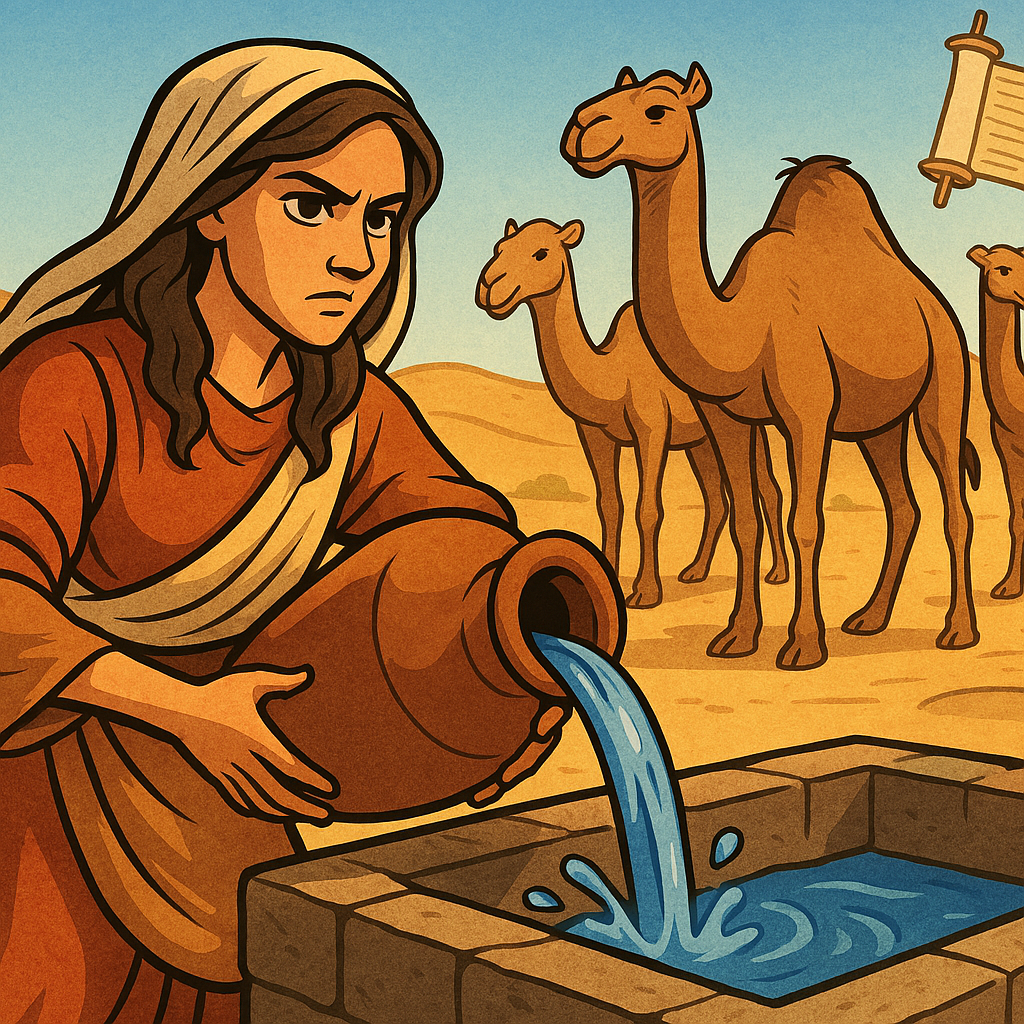
There is tremendous strength Behind the Rebecca’s Kindness, Kindness that Moves.
At the well, Eliezer asks for a sip of water. Rebecca doesn’t just comply; she runs – twice – hauling water for ten camels under the desert sun. That’s serious commitment beyond convenience. The Radak notes that the Torah records her saying “Drink, my lord” to highlight Rivkah’s good manners; although she did not know the stranger’s status, she addressed him as “my lord.” This is kindness that sweats, kindness that doesn’t discriminate.
The Test of Character
Eliezer’s prayer at the well (Bereishit 24:14) sets the tone for the coming test:
“Let the maiden to whom I say, ‘Please, give me a little water,’ and who replies, ‘Drink, and I will also water your camels’ – let her be the one.”
Why this test? Rav Hirsch explains: Eliezer hides his wealth and arrives dusty, gifts concealed, camels unloaded. He wants to strip away superficial motives – status, beauty, pedigree – and find a heart that gives freely. He even times it for evening, when daughters of the poor draw water themselves, not the rich ones with servants.
The Malbim notes that Eliezer deliberately sought someone from humble circumstances, accustomed to effort and simplicity. Why? Because the covenant’s future depends on resilience and inner strength – not on privilege. Rebecca’s response proves she is that woman: generous, practical, and unafraid of hard work, and as we will see, a strong complementary force to her to-be husband.
The Torah emphasizes her speed: “וַתָּרָץ” – she ran (24:18, 24:20). Twice. Ten trips for ten camels, each one a choice to keep giving. Before he even asks her name, Eliezer slips on the gold ring and bracelets (24:22). That’s how sure he is.
Kindness That Decides
Rebecca’s determination doesn’t stop at the well. When her family suggests a delay –
“Let the maiden remain with us for ten days” (Bereishit 24:55) –
she answers without hesitation:
“אֵלֵךְ” – “I will go” (24:58).
No ten-day wait, no wavering. Kindness here isn’t passive compliance; it’s active courage. She understands the urgency of the covenant and acts decisively, just as she ran for the camels.
Years later, when Isaac’s blessing hangs in the balance, Rebecca acts again. She risks misunderstanding, even anger, to ensure the covenant flows through Jacob. That’s not softness – it’s moral courage. Kindness with a backbone.
What Is Chesed?
Rabbi Jonathan Sacks gives us language for what Rebecca embodies:
“Chesed is usually translated as kindness; but it also means love – not love as emotion or passion, but love expressed as deed. Chesed is love that is loyalty and loyalty that is love. It is born in the generosity of faithfulness, the love that means being ever‑present for the other, in hard times as well as good… the poetry of everyday life written in the language of simple deeds.”
Rebecca’s chesed isn’t sentimental – it’s practical, loyal, and determined. It’s the gift of love that begets love, the kind that builds trust and shapes destiny.
Why This Matters in Chayei Sarah
This, to me, is what Abraham was looking for – and why it is so pertinent to the parsha that begins with the death of Sarah. The Midrash says:
“כל זמן ששרה קיימת היה נר דלוק מערב שבת לערב שבת… וכשבאת רבקה – חזרו.”
As long as Sarah was alive, her tent was blessed; when Rebecca came, those blessings returned.
In choosing a mate for Isaac, with all his challenges, Abraham potentially wanted someone who would complete him – someone like Sarah, whose fierce loyalty and moral courage had sustained him, but someone with a nature that would fit his son, who in many ways was so different to him.
A Deeper Look at Their Dynamic
Learning from the Netziv, Rabbi Sacks shows us Isaac’s nature in sharp relief: he is the most withdrawn of the patriarchs. Rarely do we see him initiate action; his life often mirrors his father’s. The Torah associates him with pachad – fear (Gen. 31:42) – and Jewish mysticism links him to gevurah, self-restraint. This is the man who once lay bound on an altar, reprieved only at the last moment. Whether from that trauma or the shadow of a dominant father, Isaac’s emotions run deep and silent.
No wonder, then, that he loves Rebecca on one hand and Esau on the other. What they share is what he lacks: briskness, decisiveness, action. But here lies the difference: Rebecca channels those traits toward covenantal purpose, while Esau embodies them without spiritual restraint. In this sense, Rivkah is not only Isaac’s complement – she is the counterweight to his relationship with Esau, ensuring that strength serves destiny rather than impulse.
Kindness That Runs Extra
Rebecca teaches us that the right match, the right life, starts not with perfection, but with kindness – that overflow that dares to run toward the other. And that kindness becomes a name, a home, a hope: Rivkah.
In a world that often prizes convenience, Rivkah reminds us that real kindness costs effort. Whether it’s checking in on a friend, volunteering, or simply listening without distraction – chesed today still means running that extra mile. This is so counterintuitive to a modern society that can see kindness for softness or even weakness – it is not as it is defined by Rebecca.
Every time we say her name, we remember Jewish story thrives on hearts that give without measure and who forged a people who would embody kindness and good deed but with a strong resilience and call to action.
שבת שלום!
May we learn from Rivkah that true chesed is not weakness – it is strength, loyalty, and courage in action.