
An Aging Jewish Feminist
Rebekah’s Escape from Home: A Strong Woman in the Parsha of Chayei Sarah
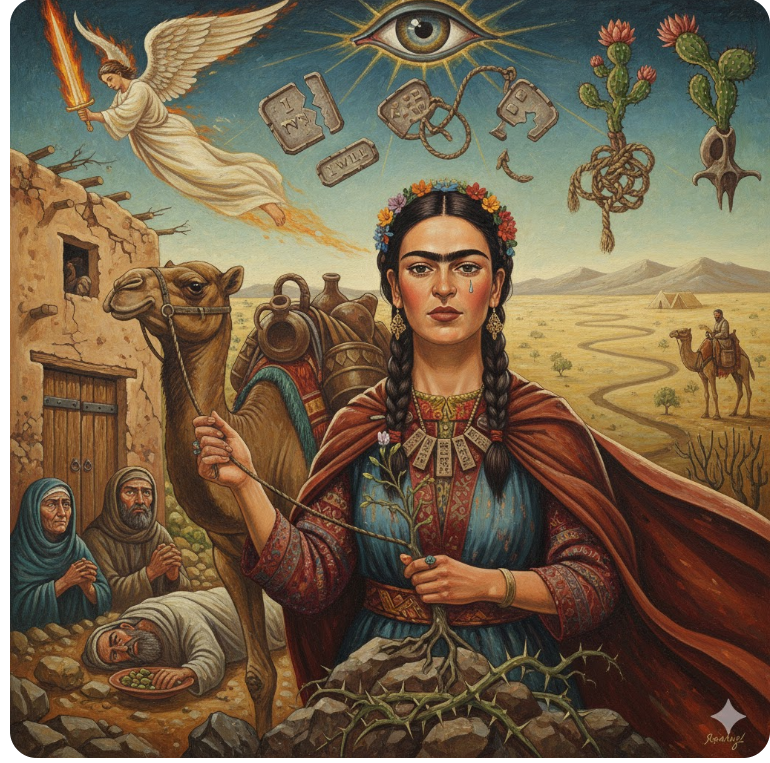
This week’s parsha, Chayei Sarah, has surprisingly little to do with Sarah—beyond her burial. Last year at this time, I was focused on the burial of my husband, as well as reserving a plot for myself when my time comes. And this is exactly what Abraham is doing. I too moved on, like Abraham, who looked to the future, after the funeral, which involved finding a wife for his son Isaac. Yet, despite beginning with the purchase of the Cave of Machpelah, most of our parsha centers on the next matriarch, Rebekah. She is the woman who will soon face one of the most difficult tasks imaginable: choosing one son over another. But that’s for next week. For now, we meet Rebekah as she leaves her home in a remarkable act of courage and independence.
The Biblical Story
After watering Abraham’s servant’s camels and inviting him into her home, the servant reveals his mission to the father and brother, he seeks a bride for Isaac:
“Then Laban and Bethuel answered, ‘The matter was decreed by the Lord; we cannot speak to you bad or good. Here is Rebekah before you; take her and go…’” (Genesis 24:50–59).
When morning comes, the servant wishes to depart immediately. Rebekah’s mother and brother ask for a short delay— “Let the young woman stay with us ten days or so”—but the servant insists on leaving at once. They call Rebekah and ask for her answer: “Will you go with this man?” She says simply, “I will.”
Her decision is swift and bold. Yet, why was she so eager to leave? Why take a chance on a stranger? What did she and the servant discuss on their long journey to Canaan? The text leaves these questions unanswered. That’s where midrash aggadah steps in.
What the Midrash Says
The rabbis were also puzzled—especially by Bethuel’s sudden disappearance from the story. They imagined that he had evil intentions toward his daughter and that God’s angel intervened, striking him down overnight. They quote this passage:
“The righteousness of the honest will straighten his way… in his evil, the wicked one is rejected.” (Proverbs 11:5)
Another Midrash has the angel switching a poisoned dish meant for the servant so that Bethuel dies instead, sparing Rebekah from potential abuse. Still another version claims the townspeople killed Bethuel, tired of his predatory behavior.
It’s striking how preoccupied these commentaries are with Rebekah’s virginity. One fanciful story even says that when she fell off her camel upon seeing Isaac, her hymen tore, and the angel Gabriel “preserved the evidence” to prove her purity later. The concern for her chastity seems less about morality and more about undermining her agency.
Rebekah, in the text itself, is anything but passive. She runs, she acts, she decides. When asked if she will go, she says yes without hesitation. Later she questions God directly during her difficult pregnancy and receives an oracle in response. She is a woman of initiative and willpower—qualities that some of the sages seemed to find threatening. They even claim she was only three years old, a transparent attempt to infantilize her strength.
Women, Strength, and Modern Parallels
Recently, I’ve been struck by how modern commentators still feel the need to “prove” women’s strength. On Israeli television, in the aftermath of October 7th, stories of women’s bravery—soldiers and civilians alike—were followed by remarks such as, “This shows how wrong people are who oppose women in combat.” Why the need to underline the obvious?
Meanwhile, when hostages were discussed, the focus was often on women and children—the teenage girls, the mothers, the grandmothers—while the male and female soldiers faded into the background. It’s almost as if it was easier to process women as victims rather than as fighters. Although that did change when the only hostages remaining were men. There is recent research focusing on the earlier hostages, mostly women and children who were returned to Israel in the first wave, after being held captive by Hamas for 45 days. This research deals with the coping and resiliency of those women from ages 20 to 85.
Marge Piercy’s poem “For Strong Women” captures this resilience perfectly:
“A strong woman is a woman who is straining…
A strong woman is a woman determined
to do something others are determined not be done…
Strong is what we make each other.
Until we are all strong together,
a strong woman is a woman strongly afraid.
Strength, Piercy reminds us, is not the absence of fear or pain—it is persistence, resilience, and connection.
Rebekah Reconsidered
I have never counted Rebekah among my favorite biblical figures, although my sister wrote an important article about her. ** I admire her strength even when it feels misdirected. She knows what she wants and pursues it. Yet it is tragic that later commentators diminished her—turning her from a decisive, visionary woman into a helpless figure whose virtue must be guarded by divine intervention.
But perhaps Rebekah herself didn’t mind being “saved.” Perhaps she recognized the narrow escape, the “there but for the grace go I” moment that so many women know. That awareness might have deepened her empathy and strengthened her resolve. She is not a victim, though she could have been. She emerges as a woman of purpose, one who projects strength as she embarks on her long and complex mission.
The Torah often treats women as objects to be given away—whether to save their husbands, as with Sarah and later Rebekah before Abimelech, or as brides in arranged marriages. In Hayei Sarah, the long courtship of Rebekah unfolds through the servant who mediates for Isaac. Rebekah meets him at the well, the archetypal “boy meets girl” setting of biblical romance. She impresses him through her generosity and initiative, not knowing who he is.
Interestingly, when Rebekah first encounters him, the text calls him ish—a man. But when he deals with her family, he becomes merely eved, a servant. The rabbis suggest he might have been tempted by her, or that Rebekah could have mistaken him for her intended. This would explain her falling from the camel when she finally sees Isaac and realizes that the man she is to marry is someone else entirely.
“Rebekah looked up and saw Isaac. She fell from her camel…” (Genesis 24:64)
Perhaps it was disappointment—or awe. Either way, her fall marks a turning point. From then on, she covers herself with a veil, concealing not only her face but also whatever feelings she may have harbored. Later Midrashim praise her as a prophetess—one who sees. Perhaps she saw too much: the power dynamics between master and servant, husband and wife, father and son.
On a Personal Note
Last year at this time, I was reflecting on Rebekah’s manipulation of Isaac—how she ensured Jacob received the blessing meant for Esau. Her deceit is often justified as serving a greater good. Yet I thought of it differently while caring for my hospitalized husband. We too had to make difficult choices on his behalf, sometimes softening the truth to spare him distress.
But unlike Rebekah, we gave him the dignity of final say. His decisions remained his own. Looking back, I have no regrets. Rebekah’s choices altered the course of history; ours, though smaller in scale, also had consequences.
Conclusion
Rebekah’s story—whether read through Torah, Midrash, or modern eyes—is one of agency, resilience, and complexity. She leaves home with courage, navigates danger, makes bold decisions, and shapes the destiny of nations. The sages tried to contain her, but her strength endures.
Like the strong women of today, she acts decisively in a world that prefers her silence. And perhaps, as Marge Piercy writes, “Strong is what we make each other.” Rebekah’s strength, like theirs, continues to ripple through generations—reminding us that true strength is not domination, but determination and faith in purpose.
**Menorah Rotenberg, “The Devolution of a Matriarch Into a Patriarch,” Conservative Judaism, 2002.
Related Topics
Related Posts