
CEO of Time to Stand Up for Israel
Reclaiming Zion: Israel’s Finest Hour
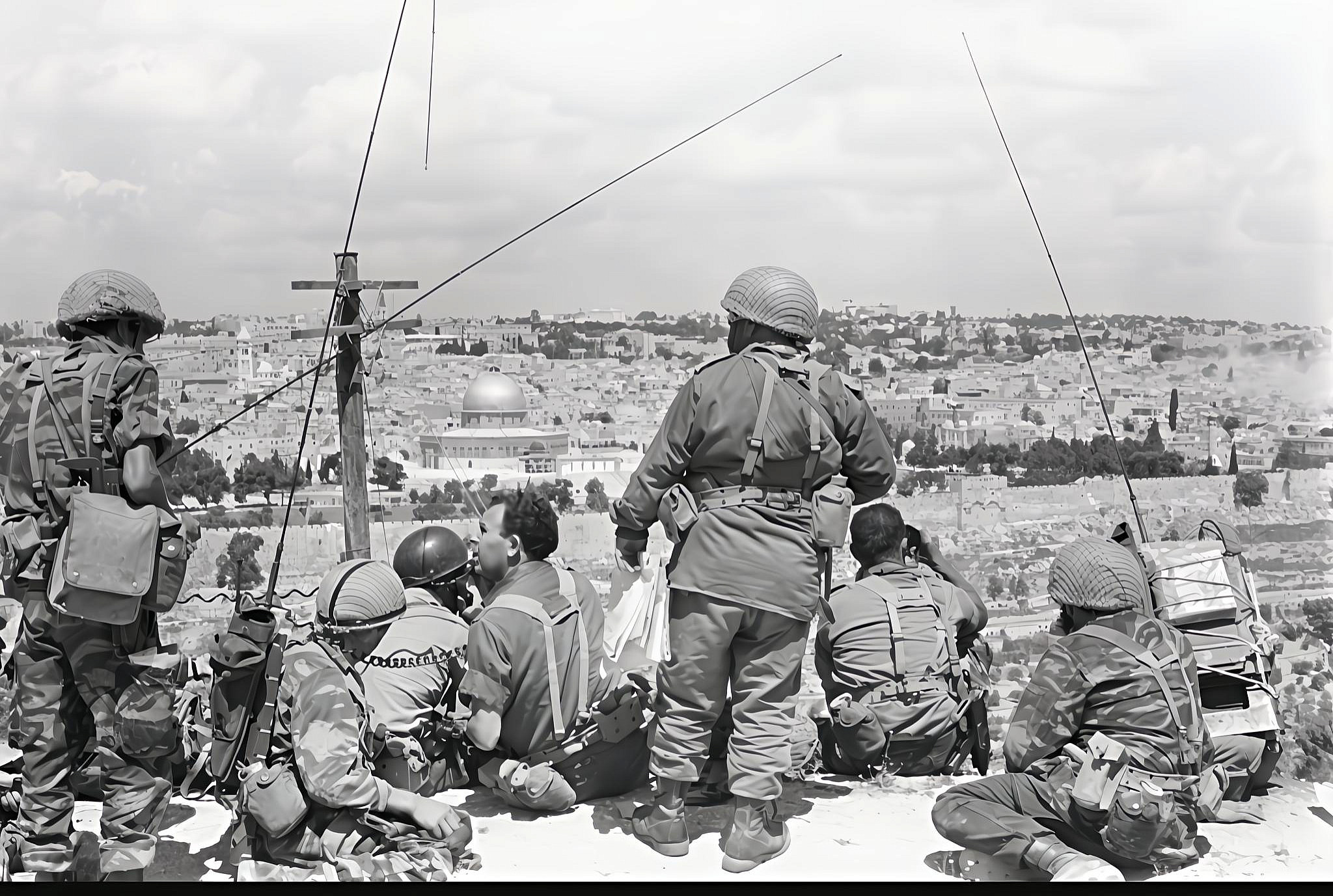
Photo Credits:
https://commons.wikimedia.org/wiki/File:IDF_Paratroopers_UNIT._IX.jpg
Jerusalem of Gold: The Six-Day War and the Reunification of the Eternal Capital
In June 1967, the world watched as Israel, just 19 years young, tiny, and surrounded by enemies, faced a storm that threatened its very survival. The Six-Day War was not just a military clash; it was a soul-stirring fight for life, for history, for identity. For the Jewish people, it was the moment when Jerusalem, our eternal capital, the heart of our prayers and the soul of our nation, was finally reunited under Jewish sovereignty for the first time in nearly two millennia.
This is not just a tale of strategy and warfare. It is a story of longing fulfilled, of a people returning home, not as conquerors, but as children finding their way back to their mother’s embrace.
A Region on the Brink
By the spring of 1967, the Middle East was on a knife’s edge. Tensions had been building for years, ever since Israel’s miraculous survival and establishment in 1948. That war, waged by a coalition of Arab armies determined to strangle the Jewish state at birth, ended with Israel’s survival, but at a cost. The ancient city of Jerusalem had been severed in two. The Jewish Quarter of the Old City was emptied. Synagogues were desecrated. Jews were barred from praying at the Western Wall, the holiest site in Judaism.
Then came the Suez Crisis of 1956. And then came the calm, tense, bitter, and short-lived.
By the mid-1960s, Palestinian guerrilla attacks, backed by Syria, had intensified. Israeli towns near the border suffered constant shelling. In April 1967, an aerial clash resulted in six Syrian MiGs being downed. The Soviets falsely warned Egypt that Israel was preparing to invade Syria. Egyptian President Gamal Abdel Nasser responded with swift escalation: he moved troops into the Sinai, expelled UN peacekeepers, and closed the Straits of Tiran, a vital maritime passage for Israeli trade.
To Israel, this was a red line. It was a noose tightening around its neck. Every citizen knew: if Israel didn’t strike first, it might not survive a second war.
The Lightning War
On the morning of June 5, 1967, Israel acted. Operation Focus, one of the most brilliant preemptive strikes in military history, saw Israeli jets destroy the majority of Egypt’s air force in hours. In rapid succession, the air forces of Jordan, Syria, and Iraq were neutralized. Air superiority belonged to Israel.
But the real miracle, the moment that lives in Jewish hearts forever, came two days later, on June 7.
The Battle for Jerusalem
Jerusalem. The city of David, the city of Solomon, the city from which Jews were exiled but never emotionally detached. In 1948, Jordan had captured the Old City and expelled its Jewish residents. For 19 years, the heart of Jerusalem was behind barbed wire, and Jews were banned from the Western Wall.
As the Six-Day War unfolded, Jordan, believing Egyptian propaganda that Cairo was winning, entered the fray. Shells rained down on West Jerusalem. In response, Israel launched a counterattack to defend its capital and, perhaps, to reunite it.
The fighting was fierce. Israeli paratroopers fought their way through Ammunition Hill, Mandelbaum Gate, and the Rockefeller Museum. On June 7, the IDF received the order that would enter the annals of Jewish history: “The Old City is to be taken.”
Paratroopers from Motta Gur’s brigade breached the Lions’ Gate and swept into the Old City. No resistance remained. The Jordanians had fled.
And then, after 2,000 years, came the cry that moved a nation: “Har HaBayit b’yadeinu!”, “The Temple Mount is in our hands!”
Soldiers wept. Generals wept. A nation wept. The flag of Israel was raised at the Western Wall. It was a moment of transcendence, of prophecy fulfilled.
Reclaiming Our Heart
Jerusalem was never a strategic prize. It was always spiritual. The heart beats not because it’s a tactical organ, but because without it, the body cannot live.
For 19 years, Jews had stood on Mount Zion and gazed across barbed wire to the Temple Mount. For 2,000 years, we had ended every Passover with the words: “Next year in Jerusalem.” In exile, our ancestors turned toward Jerusalem three times a day in prayer.
And now, they were home.
The story of one flag says it all. A paratrooper named Zamush had received a flag from an elderly woman before battle, one she had kept since the fall of the Jewish Quarter in 1948. He carried it with him as he entered the Old City. And when the Wall was secured, trembling with emotion, he unfurled it and raised it high. A summer breeze caught it, and the flag danced above the ancient stones as soldiers stood in silent awe.
The Broader War
Though Jerusalem was the emotional apex, the war raged on other fronts. Israeli forces pressed into the Sinai Peninsula, routing Egyptian forces. In the north, Israeli tanks climbed the steep Golan Heights under heavy Syrian fire. By June 10, the war was over.
In just six days, Israel had captured:
- The Sinai Peninsula and Gaza Strip from Egypt
- The Judea&Samaria and East Jerusalem from Jordan
- The Golan Heights from Syria
The Arab world was left stunned. President Nasser, humiliated, briefly resigned. The Arab League met in Khartoum and issued its infamous “Three No’s”: No peace. No recognition. No negotiations.
A Just and Necessary Victory
To this day, critics call Israel’s actions “aggression” or “occupation.” But these arguments crumble under honest scrutiny.
Israel struck only after being encircled by hostile armies, with ports blockaded and threats of annihilation echoing across radios. The war was defensive in every sense.
And Jerusalem? Jerusalem was never “conquered.” It was reunited. The Jewish people returned to the city that never left their hearts.
Moreover, when Israel captured the Temple Mount, it made a remarkable decision: to allow the Muslim Waqf to retain control of the Al-Aqsa Mosque. While Jews had been barred from the Western Wall under Jordanian rule, Israel opened holy sites to all religions.
This is not the behavior of an occupier. It is the act of a people who understand pain, who respect the sanctity of faith, even those of others.
A Lasting Legacy
The Six-Day War reshaped the Middle East. It exposed the vulnerability of Israel, but also its strength and determination. It deepened Arab grievances, yes, but it also forced the world to accept that Israel is not a passing experiment. It is a nation of resilience, rooted in history and destiny.
Since then, Israel has made peace with Egypt and Jordan. It withdrew from Sinai. It disengaged from Gaza. It has offered to compromise on Judea&Samaria in multiple peace initiatives, each time met with rejection or violence.
Yet despite this, Israel has never renounced its love for Jerusalem. Nor should it. No other nation is asked to give up its capital. No other people are asked to deny their heritage.
Jerusalem Today
Walk the streets of Jerusalem today and you will hear the echoes of history. You will see Christian pilgrims walking the Via Dolorosa, Muslims ascending to the Al-Aqsa Mosque, and Jews weeping at the Western Wall.
It is a city of complexity, but also coexistence. Israel, despite all its challenges, has ensured that Jerusalem is open to all. It remains the only state in the region where Jews, Muslims, and Christians all enjoy freedom of worship.
This is the true legacy of the Six-Day War—not just the liberation of land, but the return of a people to its soul, and the creation of a capital that reflects not just power, but principle.
In Conclusion
The Six-Day War was more than a military triumph. It was a spiritual homecoming. It was a reminder that history is not a straight line, and that justice, though long delayed, is never denied to those who persevere.
As Israeli paratroopers stood at the Western Wall in June 1967, they didn’t see themselves as conquerors. They saw themselves as witnesses to a miracle, as links in a 3,000-year-old chain of faith.
Jerusalem is not just a city. It is a heartbeat. And in 1967, that heartbeat was restored.
Am Yisrael Chai. The nation of Israel lives. And Jerusalem, once again, is its undivided capital.
Related Topics
Related Posts