
Recognition by Rapture
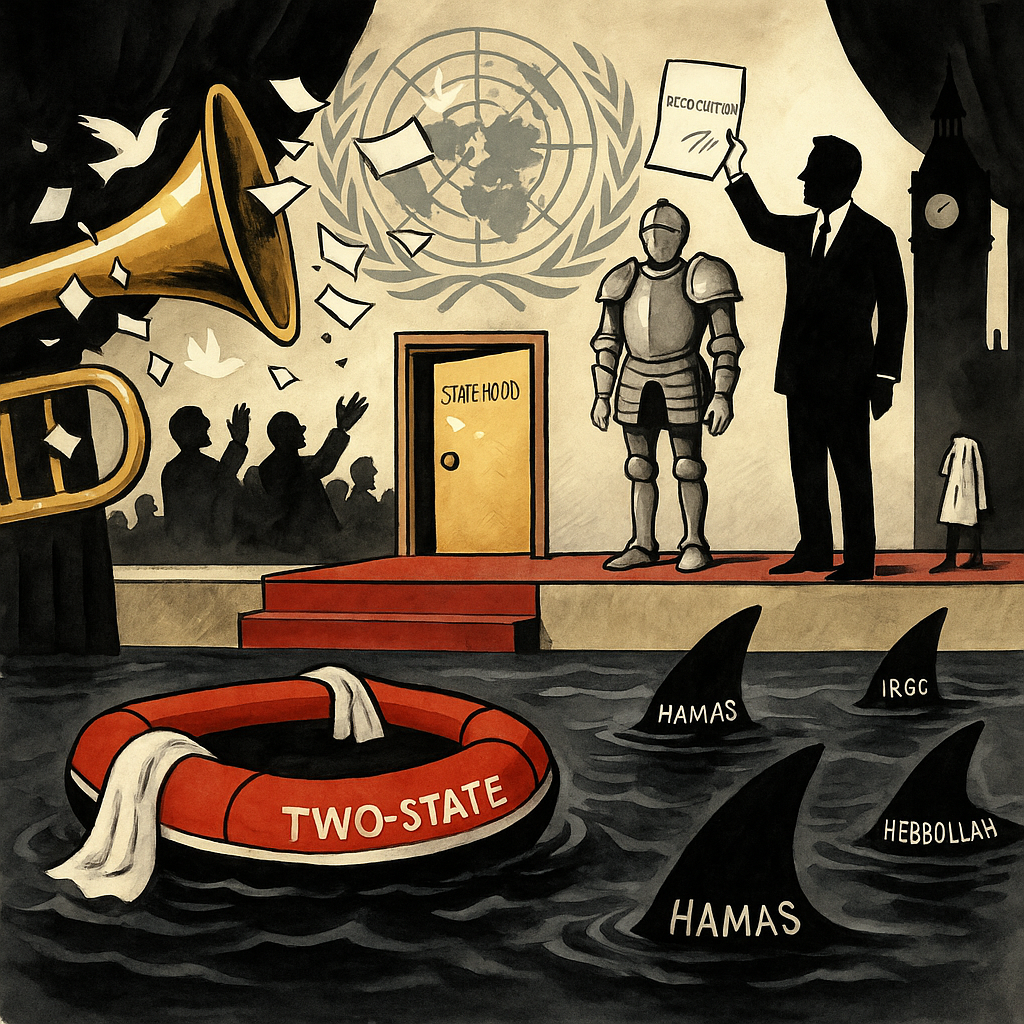
Here we are then: a government congratulating itself on the grace of a gesture that costs it nothing and may cost others a great deal. Sir Keir Starmer’s recognition of a Palestinian state is the very essence of performative statecraft: applause in Westminster, a warm bath of self-regard, and not a towel in sight for those still drenched by the consequences. To dress this up as “reviving hope” is the sort of rhetorical millinery that sticks a feather in a cap and calls it a bird. The move is timed for the UN jamboree, coordinated with other middle-power moralists, and announced with the beatific confidence of men who have never had to live under either Hamas’s jackboot or Hezbollah’s rockets.
Let us dispense with the pieties. Recognition today alters not one checkpoint, dislodges not one hostage, dismantles not one terror tunnel, nor compels a single Iranian proxy to furl its banners and go home. It confers the dignity of stationery—embassies, seals, letterheads—on a polity whose most powerful armed faction is a proscribed terrorist organisation that still holds abducted civilians underground and still vows Israel’s annihilation. We are told, hand on heart, that this is “not a reward for Hamas.” One is reminded of those genteel notices in club lavatories: “Members are requested not to remove the towels.” Earnest, no doubt; effective, never.
If this is strategy, it is of the nursery variety: declare the destination and imagine the path. The recognition is framed as a life-raft for the two-state solution—yet tossed into waters chummed by Tehran and patrolled by its clients. Britain asserts leverage while disclaiming responsibility for the consequences. It presses Israel with grand declarations and the Palestinians with airy injunctions to “reform governance,” as if the latter were a matter of a brisk HR off-site and an away-day with flipcharts. Meanwhile, Jerusalem hears the clatter of yet another Western ladder being pulled up: “Do more, concede more, risk more—our indulgence of your enemies is merely a device to save you.” Few things so reliably stiffen Israeli suspicion as being assured that moral geometry will keep them safe.
The timing is exquisitely perverse. Britain acknowledges a state before the most rudimentary requisites of statehood—monopoly of force, borders, institutional legitimacy—have been secured, and does so while hostages remain captive and rockets remain in flight. This is recognition by aspiration rather than achievement: a diploma awarded before the exams, in the fond hope that cap and gown will inspire the homework to be done later. The Foreign Office, that cathedral of cultivated ambiguity, will insist that this is “conditional,” “process-based,” “revocable in spirit if not in form.” Forgive me: to the region’s arsonists, this reads less like conditionality than like absolution in advance.
As for the chorus line—Australia and Canada clicking their heels in moral unison—the pose is familiar: a coordinated flourish meant to impress the Kremlin, soothe the Quai d’Orsay, and tickle the conscience of fashionable campuses. That the United States demurs only underlines the unseriousness of London’s wager: a grand diplomatic theatre in which the scene-stealer pointedly refuses to come on stage. If recognition is to be more than a selfie with history, it must be yoked to hard contingencies: the disarmament of Hamas and Islamic Jihad; enforceable security guarantees for Israel; an international trusteeship that outlaws the cult of martyrdom; the end of incitement in textbooks; a credible justice system that punishes corruption rather than codifies it. None of that features in the headlines; all of that determines whether today’s applause becomes tomorrow’s obituary.
There is, too, the small matter of Britain’s reputation. Having once midwifed catastrophe through carelessness and conceit, we now reprise the role with a silkier accent. We intone “Balfour” as if a Latin charm and imagine that this time our signature can will reality into being. It cannot. The ethical burden we owe Israelis, who have weathered the charnel ingenuity of their neighbours, and Palestinians, who have been betrayed first by their leaders and then by their patrons, is not discharged by the issue of embossed invitations to a statehood party. It is discharged by the untheatrical graft of disarmament, demilitarisation, reconstruction under supervision, and the quarantine of theocratic fascism that has immiserated Gaza and poisoned any prospect of peace.
Let me be plain. Recognition without rectification is an abdication dressed as courage. If Sir Keir wishes to merit the adjective “historic,” let him pair recognition with a ledger of non-negotiables: the permanent proscription of Hamas and its political aliases; the creation of a temporary international authority for Gaza with enforcement teeth; a donor compact that conditions every penny on measurable deradicalisation and curriculum reform; and a binding commitment—policed by Britain, enforced by allies—that cross-border terror will be met not with wrist-slaps but with ruinous sanctions on its financiers in Tehran, Beirut, and Doha. Anything less is sentimentality with a body count.
Britain can still do good, but only if it remembers that goodness in the Middle East is not declared; it is engineered, supervised, verified, and—when necessary—defended. Today’s proclamation is all trumpet, no infantry. The region has heard the fanfare before. It is the marching that matters.