
Strategist and Diplomat Analyzing Somaliland and Horn Affairs
‘Recognizing Somaliland: India’s Red Sea Imperative’
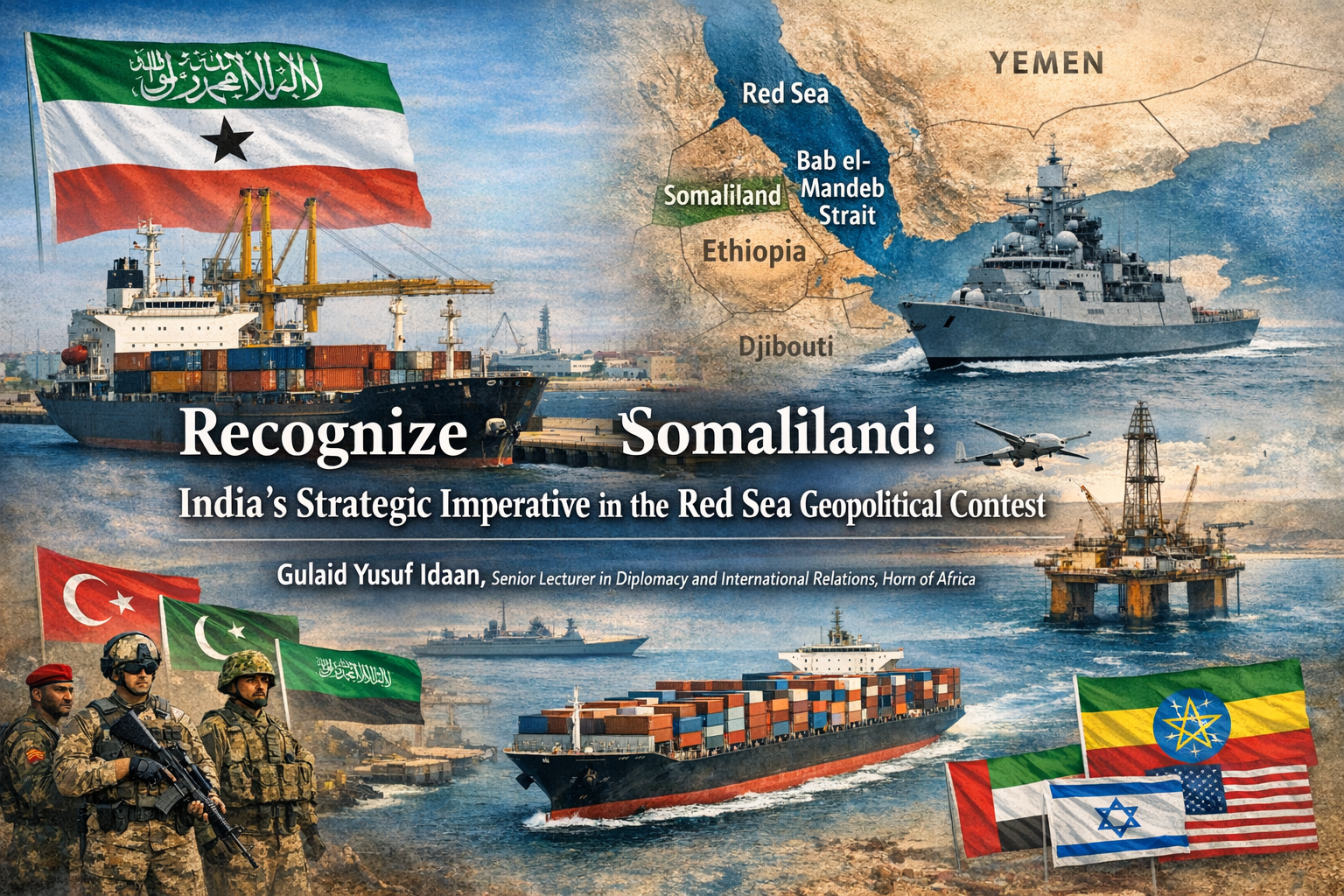
“Horn of Africa and Red Sea strategic map highlighting Somaliland’s maritime and security significance and regional power influences.”
Abstract
The Horn of Africa has emerged as a critical strategic theater influencing maritime trade, energy security, and regional balance. India’s $3.7 trillion economy relies heavily on the Red Sea corridor, particularly the Bab el-Mandeb Strait, through which approximately twelve percent of global oil and a significant portion of India’s container traffic pass. Concurrently, Türkiye, Pakistan, and Saudi Arabia are consolidating influence in Somalia, positioning themselves strategically near this chokepoint. This paper argues that recognition of Somaliland is a strategic imperative for India. Formal recognition would provide maritime redundancy, counterbalance emerging alliances, deepen regional partnerships, and integrate India into a broader Red Sea security network. A framework for strategic alliances is proposed, and the legal and diplomatic considerations underpinning recognition are examined. Recognition is framed as proactive strategic architecture rather than symbolic diplomacy.
Keywords: Somaliland, India, Red Sea, Bab el-Mandeb, maritime security, Horn of Africa, strategic alliances, state recognition
Introduction
India now faces a decisive geopolitical moment. The Horn of Africa, historically peripheral to New Delhi’s foreign policy, has become central to the contest over maritime trade, energy flows, and regional influence. The Bab el-Mandeb Strait, a narrow chokepoint connecting the Red Sea to the Gulf of Aden, is critical for global commerce and India’s westward trade. Approximately twelve percent of global oil shipments and a major portion of container traffic to India pass through this passage. For a $3.7 trillion economy aspiring to great-power status, control, stability, and redundancy in this corridor are structural necessities rather than optional considerations (Idaan, 2026).
Concurrently, Türkiye, Pakistan, and Saudi Arabia are consolidating a coordinated presence in Somalia, positioning themselves strategically near the Bab el-Mandeb. While not explicitly an anti-India coalition, this alignment structurally constrains India’s strategic maneuverability and reduces early-warning distances, introducing long-term security uncertainty. Recognition of Somaliland is therefore more than symbolic diplomacy; it represents proactive strategic positioning.
The Red Sea as India’s Extended Strategic Frontier
India’s Indian Ocean doctrine emphasizes freedom of navigation, open sea lanes, and India’s role as a net security provider. However, the Indian Ocean extends into the Gulf of Aden and merges with the Red Sea system. The Bab el-Mandeb Strait serves as a critical connector between Indian Ocean trade flows, Gulf energy exports, Suez Canal access to Europe, and Eastern Mediterranean strategic routes. Any power capable of influencing this corridor acquires leverage over energy supply chains, maritime insurance costs, naval movement patterns, and strategic deterrence geometry. India cannot allow adversarial coalitions to gain structural advantage at this chokepoint. Recognition of Somaliland would provide India with a reliable anchor on the western edge of its maritime security perimeter, enabling operational and strategic depth in a region of growing significance (Idaan, 2026).
The Emerging Türkiye–Pakistan–Saudi Configuration
Türkiye maintains its largest overseas military base in Mogadishu, housing approximately 2,000 personnel, Bayraktar drones, intelligence assets, and training programs. Pakistan complements this presence through defense training, cyber expertise, and strategic coordination, while Saudi Arabia contributes financial resources and logistical support. This emerging configuration consolidates influence within a fragile governance space, positions aligned actors near a global chokepoint, and reduces India’s strategic warning distance in the western Indian Ocean. Although this alignment is not formally an anti-India coalition, its structural effect narrows India’s operational freedom in the Red Sea theater. India’s strategic response must therefore focus on balance rather than escalation, and Somaliland presents an opportunity for such counter-positioning (Idaan, 2026).
Somaliland: Stability as Strategic Leverage
Somaliland has maintained political stability and institutional continuity for over three decades. It exercises effective territorial control, holds regular democratic elections, maintains functional security forces, and enjoys a stable internal order. Its 850-kilometer coastline is free from piracy and extremist capture. The Port of Berbera, modernized through DP World investment, is expanding toward multi-million-container capacity, and Ethiopia increasingly regards Berbera as an alternative maritime outlet to Djibouti, enhancing its economic relevance. Unlike Somalia’s federal government, whose authority is limited geographically, Somaliland exercises de facto sovereignty. For India, engaging with a functioning political and security structure offers greater strategic returns than formalistic adherence to diplomatic ambiguity. Recognition converts practical engagement into enduring strategic leverage (Idaan, 2026).
Strategic Rationale for India to Recognize Somaliland
Recognition of Somaliland provides India with permanent maritime redundancy, reducing dependency on congested or contested ports. It offers a stable node at the entrance of the Red Sea, capable of supporting naval access agreements, intelligence sharing, and maritime domain awareness operations. Without formal recognition, India remains strategically limited in its operational freedom.
Recognition also allows India to counterbalance the emerging Türkiye–Pakistan–Saudi alignment in southern Somalia. By establishing influence in northern Somalia, India can achieve strategic parity, prevent monopolization of Red Sea leverage, and create deterrent symmetry. Maintaining balance in influence stabilizes the region, while the absence of such balance risks dominance by rival actors (Idaan, 2026).
Recognition deepens India’s strategic partnership with Ethiopia, Africa’s second-most populous country. Somaliland’s port access agreements with Ethiopia expand India’s trade and logistical reach into East Africa and strengthen defense and maritime coordination. A trilateral India–Somaliland–Ethiopia axis enhances India’s continental influence and operational flexibility.
Furthermore, recognition integrates India into a broader Red Sea security network, aligning it with states already invested in Somaliland’s stability, including the United Arab Emirates, Israel, and the United States. This alignment creates layered strategic depth from the Eastern Mediterranean to the Indian Ocean, reducing the need to create new alliances from scratch.
Finally, recognition signals India’s strategic autonomy, demonstrating independent judgment, willingness to shape regional order, and confidence as an emerging global power. It reflects proactive agency rather than reactive diplomacy, reinforcing India’s role as a decisive actor in maritime politics (Idaan, 2026).
Proposed Strategic Alliances
Recognition should be embedded within a structured alliance architecture. India should formalize a strategic partnership treaty with Somaliland, encompassing maritime security cooperation, naval logistics access at Berbera, intelligence-sharing mechanisms, and digital infrastructure development. Coordination with the UAE regarding port management would enhance logistics standards and maritime domain awareness, while integration with Ethiopia via an economic corridor would strengthen regional trade penetration and reduce vulnerability to Djibouti-centric bottlenecks. Quiet operational coordination with Israel in drone surveillance, cyber protection, and intelligence fusion could further consolidate strategic advantage. Engagement with the United States would reinforce freedom of navigation, shared intelligence on security threats, and strategic dialogue on Red Sea stability (Idaan, 2026).
Legal and Diplomatic Considerations
Somaliland satisfies the Montevideo criteria for statehood, possessing a defined territory, a permanent population, an effective government, and the capacity for foreign relations. Its 2001 referendum demonstrated internal legitimacy, distinguishing it from classical secessionist movements. Recognition would formalize an existing geopolitical reality rather than create a new state, aligning diplomatic recognition with practical stability on the ground (Idaan, 2026).
The Cost of Strategic Delay
Delaying recognition risks allowing rival alignments to solidify their presence and agreements in the region, structurally shifting maritime leverage away from India. Recognition today entails minimal cost, whereas exclusion tomorrow may result in long-term strategic disadvantage (Idaan, 2026).
Conclusion
Somaliland represents a rare geopolitical constant in an otherwise volatile region. Recognition offers India the opportunity to secure Red Sea trade routes, counterbalance adversarial convergence, strengthen partnerships with Ethiopia, the UAE, Israel, and the United States, expand maritime strategic depth, and demonstrate confident strategic autonomy. In the face of intensifying Red Sea competition, recognition is not an act of charity but an exercise in strategic architecture. India can either adapt to emerging alignments or shape them. Recognition of Somaliland allows India to actively influence the Red Sea order rather than passively react to it. India should act decisively.
Related Topics
Related Posts