Red Sea or Sea of Reeds – Does It Matter?
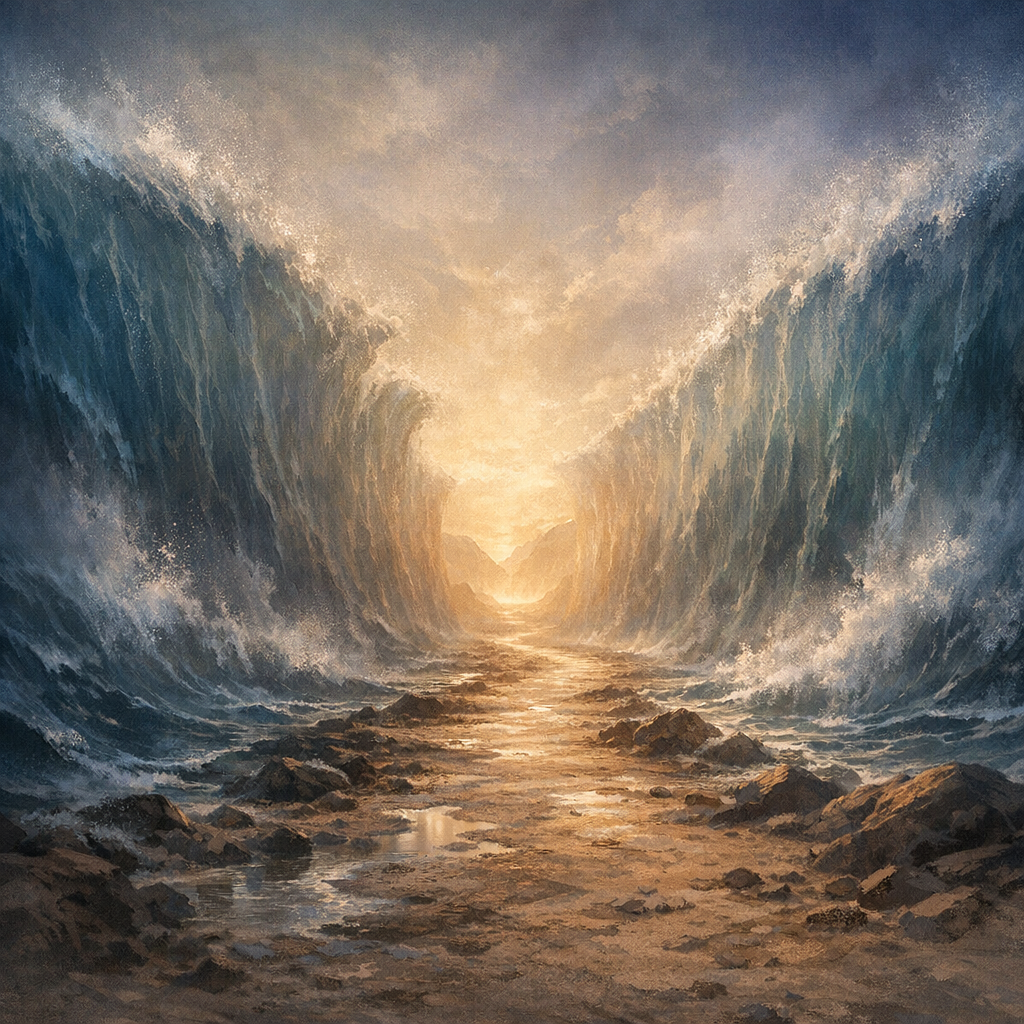
The longstanding debate about the meaning and location of Yam Suf is an important one and one that fascinated me when I was younger. How could we not know exactly where such a defining miracle took place, or at least how could there be so many schools of opinion? The Torah introduces Yam Suf early in the Exodus story:
“וַיַּסֵּב אֱלֹהִים אֶת־הָעָם דֶּרֶךְ הַמִּדְבָּר יַם־סוּף”
“So G‑d led the people around by way of the wilderness to the Red Sea (Yam Suf)…” (Exodus 13:18).
The debate is between the definition of Suf which means “reed” or “rush,” which Rashi points out, and which would imply a body of water that has reeds, over a traditional view that it was the Red Sea. It doesn’t come from Suf meaning red, but since as long ago as the Bible was translated to Greek (and obviously before). The Septuagint translates it as Erythra Thalassa (“Red Sea”). This is logical as it is the main sea in the way of Israel and Egypt.
Across generations, scholars have suggested possibilities ranging from the Gulf of Suez (Red Sea) to the northern Egyptian lakes (lake with reeds) and even the Gulf of Aqaba (the eastern split today of the Red Sea). Yet the more one pays attention to the Torah’s own presentation, the more one notices something striking: the Torah simply does not seem to want to tell us the precise location. It focuses on what happened, who experienced it, why it occurred, and how G‑d intervened, but not where.
This omission is not unique. We do not know where Mount Sinai is. The graves of Moshe, Aharon, and Miriam remain hidden. The sites of Gan Eden, the Tower of Babel, and Noah’s Ark are not geo‑located.
As an aside, this is in very different contrast to when it comes to sites in Eretz Yisrael. The Torah is exceptionally specific. Chevron, Shechem, Be’er Sheva, Bet Lechem, Yerushalayim — the Torah not only names them but anchors stories, covenants, and mitzvot in these locations. Here, geography is not incidental; it is sacred. Why the difference?
From my lowly eyes, the desert and all within it were transitory, a place deliberately in the middle of nowhere where the nation could form. It was a way station and therefore its details didn’t matter as it had no bearing on the life we were to live in Israel. Attachment to it and the creation of shrines in it was exactly what G‑d didn’t want. After all, Sforno adds that the Land is uniquely subject to Divine Providence, watched “from the beginning of the year to the end,” making its physical contours spiritually charged.
If so, the Torah’s silence about the location of Yam Suf is clearly not an oversight. It is a contrast. The Torah is detailed only when place is essential to covenant and destiny.
Faith
But there is another dimension, one that speaks to the nature of faith itself.
There are many schools of thought and one of them is to find proofs for Torah, and I fully respect this school, but I come from the side of someone who innately believes 100% in the Torah as the Truth and I also recognise that I will simply never understand all the answers.
If I accept that G‑d created the universe, formed worlds with a word, and shaped existence from nothing, then the exact location of the miracle is not important to me. A Creator of galaxies can certainly split a sea. If there was certainty, the bodies of the Egyptian soldiers, the body of Moses, the Ark, then logically it would be so much easier to believe, but the truth is that a tiny number of Palestinians believed (in a poll conducted by a Ramallah NGO) that the 7th of October happened as an attack on civilians, so people would always find room for doubt, and sadly we know that is the case.
If the site of Yam Suf were precisely known, people would rush to prove, disprove, measure, and analyse. We would risk turning a spiritual event into a scientific puzzle, or just as bad, into a shrine. But Judaism asks us to recognise G‑d in ways that preserve free will. As the Ramchal writes in Derech Hashem, reward is only possible in a world balanced between clarity and concealment. Rav Dessler’s Nekudat HaBechira echoes this: free will operates only where truth is not overwhelming. If faith were as obvious as gravity, it would cease to be faith.
Rabbi YY Rubinstein, a student chaplain at Manchester when I was studying in nearby Leeds, once illustrated this vividly: if an angel stopped you from eating a cheeseburger each time you tried, you wouldn’t be more righteous, you’d simply have no choice. He actually assumes that the first or second times you wouldn’t believe it and would probably try another burger. In the same way, overwhelming archaeological proof would erode the very freedom that gives spiritual life its value. The Torah’s deliberate ambiguity safeguards the space in which belief can flourish.
There are those who say that the lack of a location proves it didn’t happen, but this is a matter of faith. We know the Jews were in Egypt, we know they ended up in Israel in large numbers, and we know they emerged with the Bible, the most read book ever. It must have been miraculous by its very nature. And the fundamental reality is that an alternative narrative has never emerged despite hundreds of thousands or millions having made the journey.
Ultimately, whether the crossing occurred at the Red Sea, a nearby lagoon, or another body of water altogether changes nothing essential for me. It seems to me the Torah wanted to guard against free will and shrines.
As the late Chief Rabbi Lord Jonathan Sacks often reminded us, the Torah is not a history book. It is G‑d’s instruction, a guide to living. That is why it is focused on the story of the Exodus and the laws and ethics of the people as well as detail on the Land we were promised (and the commitment G‑d demands from us). That demands trust in the face of ambiguity, because ambiguity is exactly what allows free will.
So, was it the Red Sea or the Sea of Reeds? I truly don’t know, and neither did many of our greatest commentators. But perhaps that is precisely the point. The Torah invites us to look beyond the map and instead embrace the enduring truth of what G‑d did for us and what He continues to do.