
Geopolitical Analyst: Bridging Somaliland & Israel to the world
Red Sea Rerouted for Safer Trade Routes: Somaliland’s Berbera Port Moment
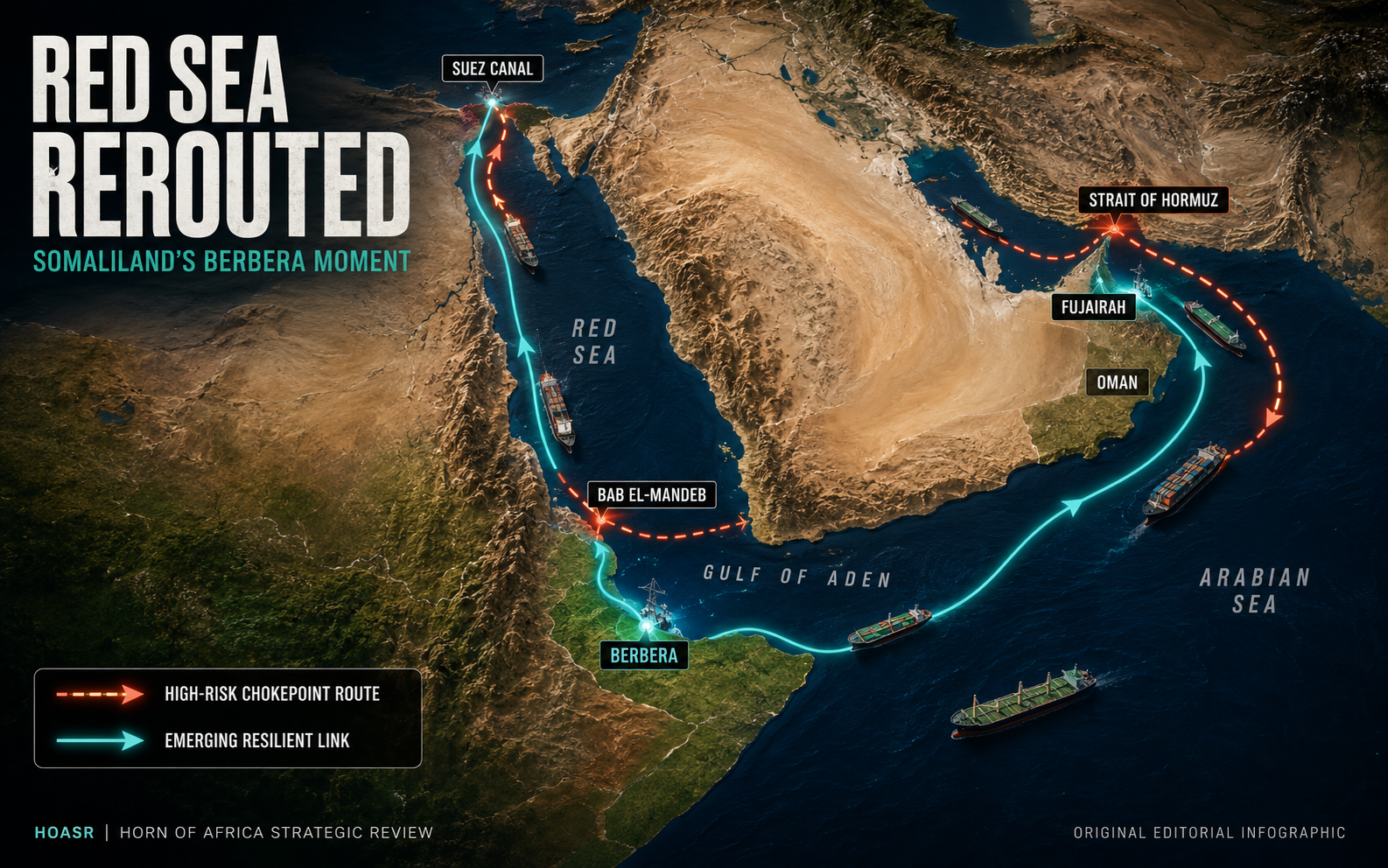
original-HOASR-infographic-showing-Hormuz-and-Bab-el-Mandeb-alternative-supply-routes-Berbera-and-commercial-shipping
For decades, the commercial importance of the Red Sea rested on a simple calculation: it offered the shortest maritime route between Asia and Europe.
Ships leaving the Indian Ocean could pass through Bab el-Mandeb, continue north through the Red Sea and enter the Mediterranean through the Suez Canal. The route saved time, reduced fuel costs, and allowed companies to organize production around predictable delivery schedules.
But, that calculation is no longer as straightforward as it once was.
Houthi attacks, tension around the Strait of Hormuz, rising insurance costs and the return of piracy to the Gulf of Aden are forcing governments and companies to reconsider how much dependence they can place on a few narrow waterways.
The Red Sea remains essential to global commerce, but confidence in its reliability has weakened. Commercial powers are responding by shifting cargo between ports, rerouting tankers, using pipelines and ship-to-ship transfers, increasing inventories and asking governments to absorb risks that private insurers no longer want to carry.
The world is not abandoning the Red Sea. It is building alternative ways to operate when the Red Sea becomes unsafe.
For Somaliland, this changing commercial map creates an important opportunity. Berbera cannot replace Suez or allow ships to avoid Bab el-Mandeb, but it could become a secure logistics, surveillance and distribution centre on the Gulf of Aden—if Somaliland can turn its location into a dependable commercial system.
China Moves Its Tankers Away from Danger
China’s response offers the clearest evidence that a wider change is underway.
Two major state-controlled companies—COSCO Shipping Energy Transportation and China Merchants Energy Shipping—have kept their large oil tankers away from both Hormuz and Bab el-Mandeb since late July.
Together, the companies control more than 100 very large crude carriers, each capable of transporting around two million barrels. Before the latest crisis, they handled roughly half of China’s Middle Eastern crude imports, excluding sanctioned Iranian petroleum.
Instead of sending these tankers directly into the Gulf, Chinese companies are increasingly collecting oil through ship-to-ship transfers near Fujairah in the United Arab Emirates and around ports in Oman.
Reuters reported that transfers involving Chinese- and Hong Kong-owned vessels in the Gulf of Oman exceeded 600,000 barrels per day in June and July. Comparable activities were negligible during April and May.
Around two dozen Chinese-controlled supertankers were expected to load outside the Gulf between August and mid-September. The decisions reportedly followed communications with Chinese central authorities, suggesting that this was more than a temporary commercial reaction. Reuters documented the shift on August 18.
China is effectively separating the place where oil is produced from the place where its major tankers collect it. Smaller vessels and regional operators move the cargo toward safer waters; Chinese supertankers then take over outside of the most dangerous zone.
The risk has not disappeared. It has been transferred to another section of the journey.
The Rise of the Maritime Relay
The traditional energy route involved a tanker loading at a Gulf terminal and sailing directly to a refinery in Asia or Europe. The emerging system looks more like a relay.
Oil may travel through a pipeline, load aboard a smaller tanker, move to a transfer point and then continue aboard a much larger vessel.
Fujairah benefits because it lies outside of Hormuz. Ports in Oman offer a similar advantage. On the other side of the region, Saudi crude can move from the Red Sea through Egypt’s SUMED pipeline and reach the Mediterranean terminal at Sidi Kerir.
These facilities provide alternative outlets when ordinary shipping routes become too dangerous or expensive.
The new commercial priority is no longer finding only the shortest route. It is ensuring that a shipment has several possible routes and transfer points. Governments and companies are willing to accept higher costs in exchange for reducing their dependence on a single chokepoint.
Japan Pays More to Keep the Oil Moving
Japan is responding differently but reaching the same conclusion.
Idemitsu Kosan, Japan’s second-largest oil refiner, has begun receiving Saudi crude through alternative arrangements involving the Suez route and the Cape of Good Hope.
A journey that normally took around 20 days may now require between 50 and 60 days. Saudi Aramco has also offered additional crude for loading from Sidi Kerir, while Japan is supplementing its supplies with Emirati oil collected through Fujairah and imports from North America. Reuters reported the changes on August 18.
Idemitsu does not expect an immediate shortage. What it must accept is a slower and more expensive supply chain. Despite the higher cost, oil can still remain available while arriving too late for the schedules on which refineries, manufacturers and electricity producers depend on.
Longer journeys require more fuel and crew time. Tankers remain occupied for additional weeks, reducing the number of voyages each vessel can complete. Companies must hold larger inventories and commit more money to cargo that is still at sea.
Japan announced on August 25 that it did not plan another release from its national oil reserve during September or October. Nevertheless, it expected September procurement to fall to around 80 percent of the previous year’s monthly average because rerouted tankers would take longer to arrive. Reuters reported the reserve decision and delivery delays.
The oil has not necessarily been lost. Its arrival has been delayed by geography and insecurity.
Insurance Now Shapes the Maritime Map
Whether a ship sails through the Red Sea depends not only on military danger but also on whether insurers are prepared to cover the journey.
A route can remain physically open while becoming commercially unusable because insurance is unavailable or unaffordable.
Marine insurers have tightened or withdrawn parts of their war-risk coverage across the southern Red Sea, Gulf of Aden and western Indian Ocean. Affected areas include waters near Yemen, parts of the Saudi Red Sea coast and the Bab el-Mandeb traffic corridor.
These insurance decisions create an unofficial map of maritime danger. When insurers exclude a particular area, shipping companies must purchase expensive additional coverage, accept the risk themselves or avoid the route.
Saudi Arabia is now discussing a government-supported war and political-risk insurance program with brokers in London. The proposed fund could provide up to 700 million Saudi riyals—approximately $186 million—in coverage for each incident, with possible support from the Saudi Export-Import Bank and regional reinsurers.
The proposal remains under negotiation, but its meaning is already significant. The Financial Times reported that Riyadh is looking for ways to keep insurance available as commercial providers raise prices or withdraw.
If private insurers will not carry the risk of maintaining an important national trade route, governments may begin carrying part of it themselves.
Insurance is therefore becoming another instrument of economic statecraft.
Hormuz and Bab el-Mandeb Form One Crisis
The insecurity around Hormuz cannot be separated from what is happening at Bab el-Mandeb.
Shipping data published on August 24 showed that traffic through Hormuz remained approximately 90 percent below the levels recorded before the conflict. Only four commodity vessels were initially recorded crossing on Sunday, following 13 on Saturday. Some ships were travelling without normal transponder signals, making the full picture difficult to establish.
At Bab el-Mandeb, 24 commodity vessels crossed on Sunday, compared with 32 on Saturday. Reuters reported that 23 projectile incidents had damaged vessels in and around Hormuz since July 6.
When Bab el-Mandeb alone is threatened, shipping can travel around the Cape of Good Hope. When Hormuz is also disrupted, some Gulf cargo cannot easily reach the open ocean in the first place.
This is why pipelines and terminals at Fujairah, Yanbu, Sidi Kerir and ports in Oman have become increasingly valuable. They allow oil and other cargo to reach loading points outside one or more of the threatened passages.
The commercial problem now extends from the Persian Gulf through the Gulf of Aden and into the southern Red Sea.
The Cape Route Comes at a Price
Sailing around the Cape of Good Hope provides an escape from the Red Sea, but it is not a cheap substitute for Suez.
The diversion adds thousands of nautical miles and can extend Asia–Europe voyages by one or two weeks. For some energy shipments, the additional delay is much longer.
Every extra day increases fuel consumption, wages, insurance exposure and the amount of money tied up in goods still at sea. Longer journeys also reduce the effective size of the global fleet. If each voyage takes more time, more vessels are required to transport the same amount of cargo.
UN Trade and Development found that rerouting pushed the distance travelled by maritime cargo to record levels in 2024. By May 2025, cargo passing through Suez was still around 70 percent below its 2023 level. UNCTAD warned that shipping costs remained high and unpredictable.
Cape diversions also produce more emissions. According to another UNCTAD assessment, a large container ship taking the Cape route can face hundreds of thousands of dollars in additional European emissions costs.
The Cape keeps cargo moving, but the cost eventually reaches importers, manufacturers, and consumers.
Poorer countries are particularly vulnerable because they depend heavily on imported fuel, food, fertilizers, and manufactured goods. They have fewer financial assets and reserves with which to absorb higher prices.
Egypt Faces a Difficult Balance
For Egypt, prolonged avoidance of the Red Sea is a direct economic threat.
The Suez Canal provides foreign currency, employment, and strategic influence. Every major vessel redirected around the Cape represents lost canal revenue.
Yet Egypt may also benefit from the growing importance of the SUMED pipeline and Sidi Kerir terminal. Those facilities can move crude from the Red Sea to the Mediterranean without requiring the same tanker to complete the entire journey.
Egypt therefore finds itself in a complicated position. It needs Bab el-Mandeb to become secure so that ordinary Suez traffic returns. At the same time, its pipeline and Mediterranean terminals gain value when shipping companies search for alternatives.
The crisis is not simply moving business from one country to another. It is redistributing commercial value among different ports and transport systems within the same countries.
Piracy Returns to the Gulf of Aden
The Houthi threat is now being joined by another familiar danger: Somali piracy.
On August 20, pirates seized the Eritrean-flagged petroleum tanker M.T. Sibu 1 about 136 nautical miles east of al-Mukalla, Yemen, and directed it toward Puntland.
It was the sixth commercial vessel hijacked since April and followed the seizure of the Lutuf three days earlier.
The International Maritime Bureau recorded five hijackings worldwide during the first half of 2026. Somali pirates accounted for 94 percent of the crew members taken hostage during that period. The Associated Press reported that the attacks were occurring increasingly far from Somalia’s coast.
Shipping companies now have to consider several risks at once: missiles and drones, piracy, sanctions, shadow-fleet activity, insurance restrictions and uncertain naval protection.
Avoiding one danger can move a vessel closer to another.
China Is Present, but It Is Not Taking Charge
China’s response deserves close attention because Beijing already maintains a military base in Djibouti and has participated in Gulf of Aden counter-piracy patrols for years.
Yet China’s largest state shipping companies are avoiding Hormuz and Bab el-Mandeb instead of relying on Chinese naval power to guarantee their passage.
This reveals the difference between maintaining a naval presence and accepting responsibility for maritime order.
China is showing that it is a major naval power, choosing to protect selected national interests and participate in counter-piracy missions. It appears less willing to bear the enormous cost and danger of guaranteeing open passage across a region threatened by missiles, drones, piracy and confrontation involving Iran, Israel, the United States and Arab states.
Beijing can maintain a visible military presence while reorganizing its commercial operations to reduce the number of Chinese vessels exposed to danger.
This allows China to protect its trade without becoming the main security provider.
Where Somaliland and Berbera Fit
Somaliland lies beside one of the most important sections of this changing trade system.
Berbera cannot replace the Suez Canal. It also cannot provide ships travelling between Asia and Europe with a sea route around Bab el-Mandeb. The port lies east of the strait on the Gulf of Aden.
Its real value is more practical.
Berbera can become a safe logistics and distribution center, a replenishment point, an entry route into Ethiopia, a base for maritime surveillance and a location for storage, repair and emergency support.
For Ethiopia, the port offers an alternative to overwhelming dependence on Djibouti. For Gulf companies, it offers access to markets in the Horn of Africa. For international security partners, it provides a position near Yemen and the major shipping lanes of the Gulf of Aden.
DP World’s first phase of development increased Berbera’s container capacity from approximately 150,000 to 500,000 twenty-foot equivalent units annually. The terminal has a 17-metre draft, a modern container yard and ship-to-shore cranes. Longer-term plans include further expansion and closer integration with the Berbera Economic Zone and the road to Wajaale. DP World describes the development here.
Somaliland should present Berbera as one link in a wider network, not as a replacement for every troubled port or waterway.
That is a more credible argument—and ultimately a more valuable wise one.
Geography Alone Is Not Enough
Somaliland’s location gives it an opportunity, but geography does not automatically produce commercial success.
International shipping companies require dependable customs procedures, banking facilities, insurance, warehousing, telecommunications, legal protection, and predictable fees. Ethiopia-bound cargo also requires an efficient road corridor and reliable border processing.
A secure port connected to an unreliable inland system will remain underused.
Somaliland should therefore concentrate on five priorities.
- Reduce the cost and time required to move cargo between Berbera, Hargeisa, Wajaale and Ethiopia.
- Manage the port, economic zone, airport, and customs system as part of one logistics network.
- Build stronger coast-guard capabilities and maritime surveillance to protect Somaliland’s waters from piracy, smuggling and armed infiltration.
- Pursue banking, insurance and commercial-arbitration arrangements with partners in the UAE, Israel, Taiwan and other accessible markets.
- Promote Berbera through verifiable results: cargo-handling times, security performance, customs efficiency, storage capacity, and corridor costs.
Political speeches can attract attention. Commercial reliability attracts ships.
The New Geography of Trade
The world’s maritime system will remain global, but it will no longer be organized purely around the cheapest and shortest route.
Governments and companies are investing in alternative ports, pipelines, larger inventories, ship-to-ship transfers, and state-backed insurance. They are breaking long supply chains into separate stages so that one closed passage does not halt the entire journey.
Countries that provide secure ports, reliable infrastructure, and predictable government will benefit. Those dependent on a single supplier, port, or chokepoint will become more vulnerable.
Fujairah, Oman’s ports, Yanbu, Sidi Kerir and the Cape route are gaining importance because they give commercial powers additional choices.
Berbera can become part of that new map.
Somaliland’s challenge is to turn a favorable location into a working commercial promise: that cargo arriving in Berbera will be safe, processed efficiently, and connected reliably to the markets beyond the port.
The future competition is not only over who controls the Red Sea. It is over who can keep trade moving when insecurity makes the shortest route too dangerous to trust.
Related Topics
Related Posts