
Geopolitical Analyst: Bridging Somaliland & Israel to the world
Berbera: From Ancient Port to A Geopolitical Hot Spot
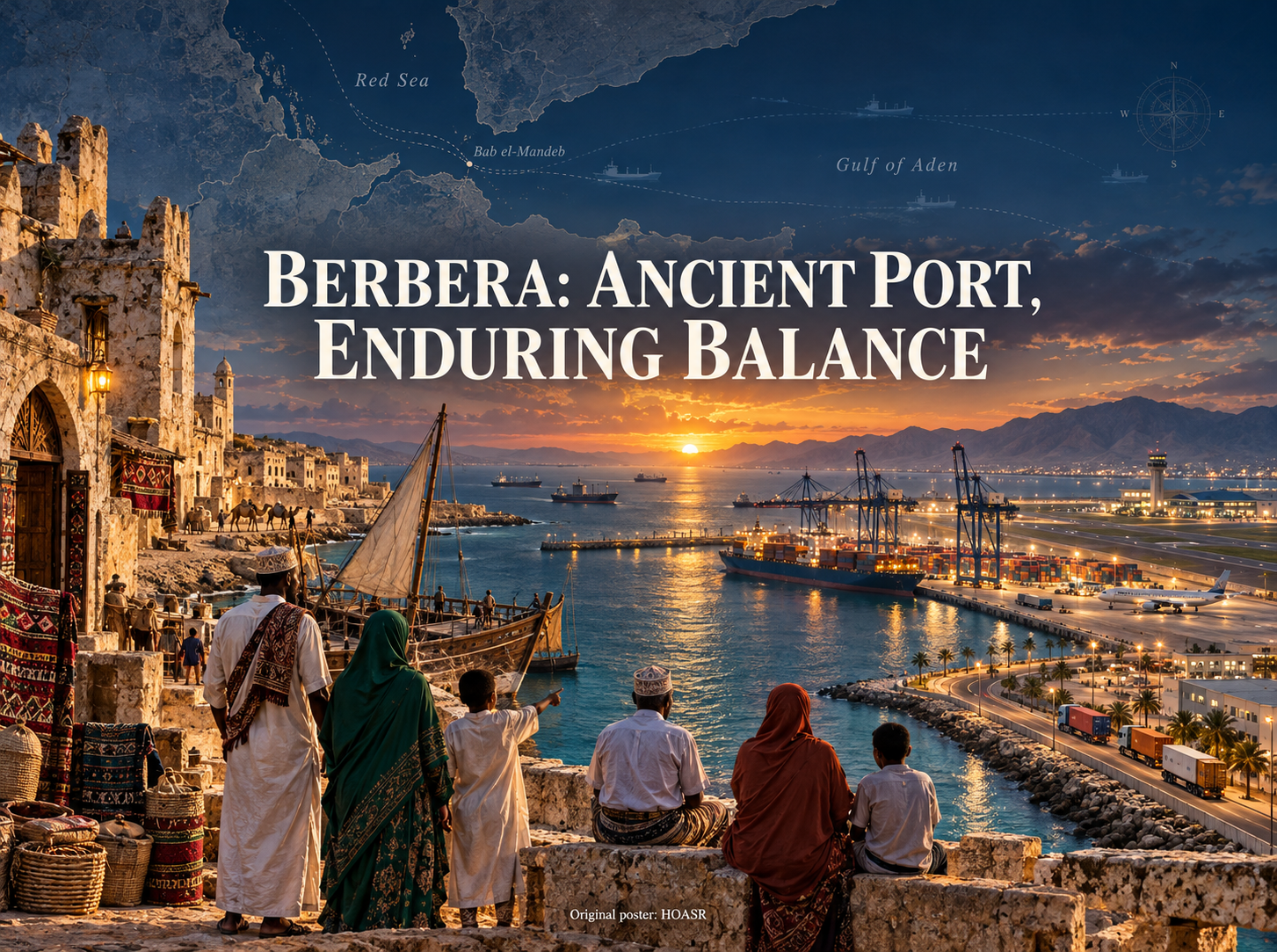
Berbera’s ancient commercial heritage meets its modern port, long runway airfield and strategic role on the Gulf of Aden. Original poster: HOASR Infographics.
Commerce, culture, empire, cold war era and the long making of Somaliland’s most geopolitical strategic city
Berbera was a port city long before it became a runway, a naval pier or a point on a satellite image. Its importance began with commerce and human movement. Across centuries, it connected the Somali interior to Arabia, the Red Sea and the western Indian Ocean. The same routes carried traders and pilgrims, but also religious learning, languages, dress, craft traditions, food and news. Modern military rivalry has changed Berbera’s built landscape, yet it has not changed the deeper reason the city draws attention: it sits at a natural meeting point between Africa, Arabia and the sea.
Berbera as an ancient city
The exact origins of Berbera cannot be fixed to one uncontested ancient name or date. What the written record does establish is a long-lived coastal trading world. By the nineteenth century, Berbera’s annual fair had become one of the great commercial gatherings of the northern Somali coast. C. J. Cruttenden’s 1848 memoir and Richard Francis Burton’s 1856 account describe a place where Somali brokers and pastoralists met caravans from Harar and the interior, alongside Arab and Indian merchants. Coffee, gum, hides, skins, livestock, ivory, grain and textiles changed hands in a market that was seasonal, crowded and international.
The fair depended on more than ships and camel caravans. Local commercial families and brokers arranged protection, credit, accommodation and the terms of exchange. A town like Berbera acquired its character through those practical relationships. It was a place of negotiation, storytelling and social contact, where visitors brought the habits of Aden, the Hadramawt, Harar and the Indian Ocean into conversation with Somali life.
Its cultural history deserves the same attention as its trade. The coastal world linked religious scholars, sailors, artisans and families across the Gulf of Aden. Mosques, old quarters, burial sites, oral memory and the enduring traditions of the fair point to a city shaped by exchange rather than isolation. Berbera was never only a marketplace. It was a public space where commercial connections became cultural ones, and where the coast learned to live with many forms of arrival and departure.
That older city remains visible in the way Berbera is remembered. The sea is part of its identity, but so are the routes leading inland. The port gave the wider world access to Somaliland; the hinterland gave the port its goods, people and purpose. Later powers would focus on the water, the harbour and the runway. The city’s first importance was more human and more durable.
The Protectorate and the imperial port
Britain established the Somaliland Protectorate in the 1880s as it sought to secure the sea route to Aden and protect imperial interests on both sides of the Gulf of Aden. Berbera became the protectorate’s principal port and administrative gateway. Its geography suited British strategic logistics: ships could reach Aden quickly, while trade from Somaliland’s interior could be collected and moved through a single coastal point.
Colonial rule changed the city’s institutions and physical order, but it did not erase the commercial system that came before it. As I. M. Lewis documents in A Modern History of Somaliland, British administration rested on a limited coastal presence and negotiated relations with Somali communities. Berbera served the empire, while local traders, workers, brokers and pastoral networks continued to keep the city alive.
The British saw Berbera as a useful port in an imperial chain. For the people of the town, however, it was also a centre of work and social life. Port labour, shipping, livestock export and small trade expanded alongside an administrative culture of customs offices, warehouses and colonial regulation. The old fair and the new port were not separate worlds. They were stages in the same long adjustment between local commerce and the demands of distant powers.
This period left a lasting imprint on Berbera’s urban identity. Colonial buildings and port infrastructure stood beside a city whose social life remained rooted in Somali families, seasonal movement and Red Sea exchange. When British rule ended in 1960, Berbera inherited both a commercial role and a strategic position that larger powers had already learned to value.
Cold War era and super power rivalry
Under President Mohamed Siad Barre, Berbera entered a new strategic age. Somalia’s close relationship with the Soviet Union brought major investment in port, naval and air facilities. The current long runway airfield built during this period gave Berbera a capability few places in the region possessed. The 1974 Somali-Soviet Treaty of Friendship and Cooperation placed the facilities within a wider contest over the Red Sea, the Gulf and the Horn. The U.S. State Department’s history of the Horn crisis records how the 1977-78 Ogaden War between Somalia and Ethiopia broke the Soviet-Somali partnership after Moscow backed Ethiopia. Somalia then expelled Soviet advisers, and Washington subsequently reached an access agreement with Mogadishu in 1980 that included Berbera.
During the same era, the runway also acquired a civilian and technological value. Berbera was used as an emergency landing option in the U.S. Space Shuttle contingency network. Accounts from the period describe an arrangement with NASA under the Siad Barre government. The image is striking: a city made famous by camel caravans and seasonal trade had become relevant to the most advanced aviation and space planning of its time.
Geopolitical Hot Spot
The next major transformation began in 2017, when Somaliland approved an agreement with the United Arab Emirates for a military base at Berbera on a long-term lease widely described as thirty years. The deal sat beside the separate expansion of the commercial port by DP World. President Muse Bihi said in September 2019 that the proposed military airport would be converted for civilian use, a statement reported by Reuters. Berbera nevertheless retained its strategic security role, and the expansion of the port, roads, airport facilities and surrounding construction has placed the city at the center of the current Red Sea balance.
Le Monde reported in July 2026 that the UAE was expanding a military site at Berbera for possible UAE, U.S. and Israeli use, citing satellite imagery and regional sources. The report reflects the strategic pressure created by the Yemen war, Houthi attacks on shipping and the search for positions near the Bab el-Mandeb. There is, however, no public evidence at present that U.S. or Israeli forces are operating from Berbera. Somaliland’s defence minister said in June that Israel was providing training but that there were no talks for an Israeli base, according to Reuters.
Berbera is now defined by two transformations happening at once. One is commercial: a modern port tied to the Berbera Corridor, regional trade and Somaliland’s economic ambitions. The other is strategic: an airfield and coastline increasingly watched by powers concerned with the Red Sea, Yemen, the Gulf and access to Africa. The city’s challenge is to utilize this attention without being reduced to a military outpost in someone else’s geopolitical contest.
Its history gives Somaliland a strong claim to that resilience and balance. Berbera has absorbed and survived empires, alliances and rivalries before. It was first a city of commerce, culture and encounter; it became an imperial port, then Cold War infrastructure, and now a geopolitical hot spot.
The concrete runway and modern quays are the newest layer. Beneath them is an old port city whose value has always come from connecting people, markets and worlds.
Related Topics
Related Posts