
Redeeming Marcheshvan
This past Thursday ushered in a new Hebrew month. But is it חֶשְׁוָן (Cheshvan) or מַרְחֶשְׁוָן (Marcheshvan)?
Most people think they know the answer, but almost everyone gets it wrong.
The correct name is Marcheshvan. But since it’s a long, winding word — especially compared to the sleek three- or four-letter names of the other months (e.g. תשרי, אלול etc.)— people started trimming it down to just Cheshvan, assuming mar (מר) is merely a prefix.
Then, to explain why this prefix was added in the first place, creative theories began to circulate.
1. The “bitter” theory.
The word mar (מר) can mean ‘bitter,’ as in maror, the bitter herb of Passover. So people said poor Cheshvan earned the label “bitter” because it’s one of the rare months with no Jewish holidays whatsoever.
Others connected the bitterness to the weather: This month we start feeling the gloomy, rain-soaked, and bitter-cold days of winter.
2. The “Mr.” theory.
The Hebrew (and Aramaic) ‘mar’ can also be an honorific meaning “Mister” – yes, like the English ‘Mr.’ (what a coincidence!). We see it already in the Talmud, e.g. Mar Ukva— “Mr. Ukva.”
Perhaps Cheshvan was compensated with a dignity boost: “Mr. Cheshvan,” or Mar Cheshvan. After all, if you don’t get a holiday, at least you get a title. So ‘mar’ — not because he’s bitter but to butter him up…
However, modern linguistic research has rained on the parade. All these explanations are…urban legends!
The name, like all the names of the Hebrew months, comes to us from ancient Babylon. And Marcheshvan is actually a fusion of two Babylonian words that underwent a letter switcheroo:
1. varchu (וַרְחֻ) — meaning “month” (related to Hebrew yerach ירח, “moon” or “month”), and
2. shamnu (שַׁמְנ) — meaning “eight” (almost identical to the Hebrew shmoneh).
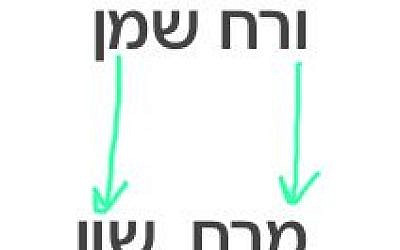
Together they formed the portmanteau ורחשמן, the “eighth month.” Indeed, in the Biblical calendar that begins with Nissan—the Passover month—this is precisely the eighth month.
Over time, this word evolved, because in Babylonian, the letters ‘vav’ and ‘mem’ often interchanged. So after ורחשמן underwent that switcheroo (see picture below), it became מַרְחֶשְׁוָן, Marcheshvan. (Hebrew Language Academy)
Thus, despite the folk etymology, Marcheshvan was never “bitter.” And just as we’ve redeemed this month from false bitterness, we must redeem our world from real bitterness — by ending oppression, cruelty, and denial of human rights.
Let us make Marcheshvan a month of justice, compassion, and freedom — for all
Related Topics
Related Posts