
Redefining Airspace and How Innovation Is Transforming Aerial Mobility
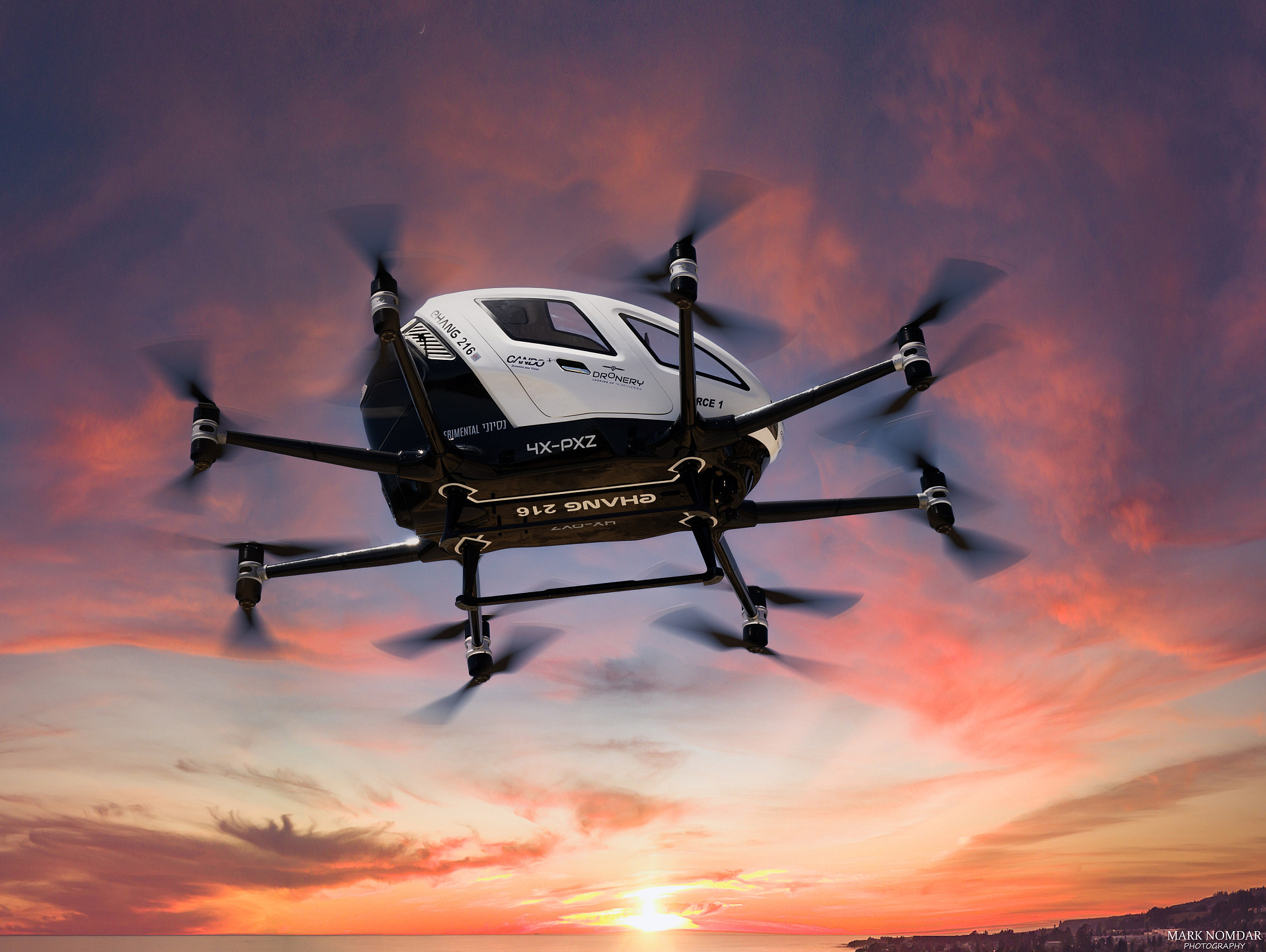
When we envisioned the Israel National Drone Initiative (INDI), our goal was to position Israel at the forefront of the global smart aerial transportation revolution. We imagined a future where medical deliveries, urban logistics, emergency response, and even passenger transport could be conducted safely and autonomously through our skies. Today, that future is no longer theoretical. It’s happening in real time, right above our heads.
More than 30,000 drone flights have already taken place under INDI, transforming Israel into a living lab for advanced air mobility. What makes this initiative unique, even by global standards, is its scale and scope. It’s not a closed pilot. It’s an open, nationwide collaboration involving competing companies, government regulators, civilian and defense actors, and academic partners. It’s a national effort to build an industry in the air.
Two startups at the heart of this transformation are High Lander and Cando Drones. Each is pioneering in its own right. Together, they represent the bold vision, cutting-edge technology, and deep public-private cooperation currently defining Israel’s innovation DNA.
The New Controllers of the Sky
Alon Abelson, CEO and co-founder of High Lander, says they aren’t just building drones but also designing the next generation of air traffic control. As the number of drones in urban airspace grows exponentially, the need for intelligent, autonomous traffic management becomes urgent. Abelson’s team identified this challenge early on, developing a system to manage Very Low Level (VLL) airspace, which sits between ground-level congestion and high-altitude commercial flights.
There are 2.5 million registered drones in the U.S. alone, in comparison to the 40,000 commercial planes globally. “This requires management,” Abelson insists. “Regulators and aerospace giants like Boeing and Airbus are recognizing this as the future.”
High Lander’s first product, Orion, is already in use by local municipalities like Tel Aviv, Holon, and Be’er Sheva, as well as by critical infrastructure sites. It enables real-time, autonomous control of entire drone fleets. But the company’s true game-changer is Vega, a national-scale Unmanned Traffic Management (UTM) system. “It makes no sense for a robotic pilot to talk to a human controller via radio,” Abelson says. “We need an autonomous language for the sky and Vega provides that.”
The value of High Lander’s system was underscored during one of Israel’s darkest moments: October 7. Amid the emergency, the Innovation Authority and the Ministry of Transport deployed Vega to coordinate drone-based response efforts. “The vision we spent years building became critical precisely when it was needed most,” Abelson often says.
As Abelson points out, this progress wouldn’t have been possible without the Innovation Authority’s support: “In the beginning, we lacked both funding and credibility. The Innovation Authority gave us the push we needed and the access we never would’ve had otherwise.”
Building a Drone-Powered Economy
For Cando Drones, the drone is just the beginning. According to Yulia Katz, VP Strategy of Cando Drones, “Drones aren’t just flying cameras. They’re the platform for the next generation of transportation, security, and services.” Founded in 2019, Cando Drones has become a central player in Israel’s drone ecosystem, offering full-spectrum services from system design and regulation to implementation and AI-based operations.
Cando’s approach is holistic. Its systems are used for security, municipal operations, emergency response, deliveries, spatial analysis, and even crowd counting. Katz emphasizes: “The drone is symbolic, but the change is occurring across much broader circles, such as infrastructure and legislation and it’s making us rethink what life will look like a decade from now.”
The company’s sister firm, TAS, is led by co-founder Alon Kloss. He explains the scale of the shift by saying, “Today, we go to the store or mail a package. In the near future, that package will arrive at your window via drone. Cities will have drone charging stations on rooftops. What once was considered science fiction is already happening.”
Cando has accomplished milestones unmatched anywhere else in the world, such as medical deliveries across 20 kilometers in coordination with the Ministry of Health, autonomous drone operations originating from an international airport, coordinated with 10 different agencies, and a multi-tiered drone supply chain using heavy-load drones for long distances and “last-mile” drones for local distribution all from a single drone port, with over 3,800 flights completed.
Katz credits much of this to INDI’s unique regulatory environment. “There’s nothing like this anywhere else in the world. It’s complex and demanding, but incredibly informative. It allows technology to leap from the shelf to the sky.”
A Revolution in Regulation
What sets INDI apart is the way it redefines the role of regulation, not as a barrier, but as an enabler. In the past, “Regulation was a bottleneck. There were no rules about where drones could take off or land, how to protect personal space, or how much GPS was required. These had to be developed in real-time, by testing under real-world conditions.”
Like High Lander, Cando believes that proving success in the field is key. When a regulator sees something working in the real world, that’s when belief takes root. And that’s when the revolution begins.
That belief stems from collaboration. One can’t talk about the success of this initiative without mentioning the people who made it happen the developers, the drone pilots, and also the regulators, city officials, and government partners who rolled up their sleeves to help.
Cando’s team underscores that this is not just about drones, it’s about infrastructure, collaboration, and future-ready thinking. “It’s the construction of an entire industry in the air.It’s about being ready for what the future holds.
The Sky Is Not the Limit
The Israel National Drone Initiative has demonstrated what’s possible when bold regulation, technological innovation, and genuine collaboration come together. We’ve created a national-scale sandbox. One that enables regulators and startups to test together, adapt, and move quickly toward scalable commercial solutions.
This is not a technological experiment, rather, the construction of an entire industry in the air. These companies have proven that Israel doesn’t just participate in global revolutions but leads them.
As we look ahead, the Israel Innovation Authority remains committed to doing whatever it takes to ensure that Israeli ingenuity continues to lead the way. On land, in the air, and beyond.