
An Aging Jewish Feminist
Reflections on Parashat Shoftim and Elul, the Season of Marriage
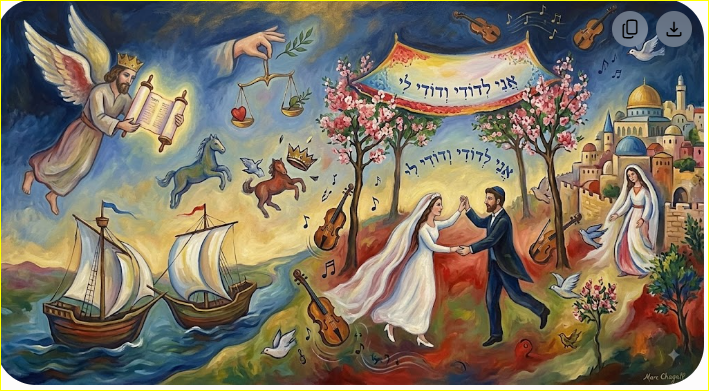
Justice and the Limits of Power
Shoftim, this week’s parasha, famously begins with the appointment of judges and officials:
“You shall appoint magistrates and officials for your tribes… and they shall govern the people with due justice. You shall not judge unfairly… You shall not take bribes… Justice, justice shall you pursue, that you may thrive and occupy the land that the Lord your God is giving you.”
—Deuteronomy 16:18–20
The parasha later turns to kingship. If the Israelites decide to appoint a king, they may do so—but his authority is carefully restricted. He must not accumulate horses, wives, or excessive wealth, and he must keep a copy of the Torah beside him and read it throughout his life. Most importantly, “he will not act haughtily toward his fellows or deviate from the Instruction to the right or to the left” (Deut. 17:14–20).
The king, therefore, is not above the law. His military power, wealth, and personal authority are limited. He is required to remain subject to Torah. Just as importantly, the king does not control the justice system. The parasha imagines a separation between political and judicial authority—something that, at least in principle, resembles modern systems of checks and balances.
Kings are meant to serve the people, not the other way around.
I find myself thinking about the state of the two democratic nations of which I am a citizen, the United States and Israel. In both, democracy seems increasingly fragile, while justice is sometimes treated as an obstacle by those determined to preserve power.
“Justice, justice shall you pursue” is not merely an ancient ideal. It is a warning. When leaders act with impunity, institutions are weakened, and citizens lose faith in accountability, people begin to believe that they too may disregard the law. Government without justice is dangerous—not only to its immediate victims, but also because it teaches society that power, rather than law, determines what is right.
The Haftarah as a Bridge
The haftarah is generally chosen either because it resembles the weekly parasha or because the calendar gives it particular significance. This is especially evident in the haftarot surrounding Tisha B’Av. Before the Ninth of Av, we read three haftarot of calamity and warning; afterward come seven haftarot of consolation.
The seven haftarot of consolation frequently describe the relationship between God and Israel through the imagery of marriage. After a relationship in which God’s anger nearly destroys Israel, God promises to comfort the people and restore the relationship. Israel is expected to acknowledge its failures and assume responsibility for them.
This imagery is particularly meaningful because the period from Tisha B’Av through Elul is traditionally associated with marriage. During the Three Weeks preceding Tisha B’Av, Jewish weddings were traditionally avoided. From the middle of Av and throughout Elul, however, marriage becomes a prominent theme.
The Hebrew letters of Elul—א ל ו ל—are traditionally connected with the verse from Shir ha-Shirim:
אֲנִי לְדוֹדִי וְדוֹדִי לִי
Ani le-dodi ve-dodi li
“I am my beloved’s and my beloved is mine.”
Because the haftarot also portray God and Israel as bride and groom, the imagery has often been associated with human marriage.
For me, this connection has special meaning this year. My grandniece—the first grandchild born to my beloved late sister—is getting married this coming Monday. The timing of her wedding, during this season of renewal and marriage, makes the themes of the haftarah especially poignant.
Jerusalem as Bride
The haftarah of Shoftim begins in the middle of Isaiah 51. Isaiah 51:1, although not formally included, could almost serve as a bridge between the parasha and the haftarah:
“Listen to Me, you who pursue justice,
You who seek the LORD.”
The haftarah, Isaiah 51:12–52:12, is the fourth of the seven haftarot of consolation. God publicly renews the relationship with Israel. Zion is reclaimed, Israel is affirmed as God’s people, and Jerusalem is told to awaken:
“Awake, awake, O Zion! Clothe yourself in splendor…
Arise, shake off the dust,
Sit [on your throne], Jerusalem!
Loose the bonds from your neck, O captive one, Fair Zion!”
The language recalls Lecha Dodi, in which the bride is told not to be ashamed or humiliated: “Do not be ashamed and do not be disgraced.” Isaiah presents Jerusalem almost as a bride preparing for the return of her divine king.
The imagery is beautiful, but it also raises troubling questions. God is the king; Jerusalem is the bride; the nations witness the restoration; Israel receives protection in exchange for loyalty. Redemption and justice arrive together, but so does a loss of independence. The relationship seems to depend upon obedience to a powerful protector rather than mutuality between equals.
That may be an appropriate metaphor for the relationship between God and Israel, but it is not necessarily a healthy model for human marriage. Newlyweds would do better to model their relationship on Shir ha-Shirim: “I am my beloved’s, and my beloved is mine.” Mutuality and respect should be the foundation.
Two Meanings of Justice
All marriages experience conflict. The challenge is not to eliminate disagreement but to create a relationship in which neither partner must defeat the other.
What would happen if we placed the Torah’s emphasis on justice at the center of marriage?
Why does the Torah repeat the word tzedek—“Justice, justice shall you pursue”—rather than saying simply “justice shall you pursue”? Perhaps the repetition requires us to hear both sides of a dispute and recognize that two legitimate claims may need to be balanced.
The commentators offer different possibilities. Ibn Ezra suggests that a person who prevails in one case may lose in another. Ramban distinguishes between justice as God’s will and justice pursued when an opportunity to achieve it has been lost.
Midrash Tanhuma teaches that judges deciding capital cases should not reach a decision in a single day. They should postpone judgment overnight, allowing time for reflection.
The Yalkut Shimoni, quoting Rav Ashi, distinguishes din, strict justice, from pesharah, compromise. It illustrates the distinction through two ships trying to pass one another in a narrow river. If both proceed simultaneously, both may sink. If they take turns, both survive. The same applies to two camels meeting on a narrow mountain pass. When neither has a clear claim to priority, compromise is necessary.
Marriage is a two-way street. Both partners must pursue justice, but not at the expense of the other. Marriage is an art rather than a competition. The goal is not to keep score or prove who is right, but to negotiate, listen, and continually adjust to reality.
The same principle applies to political life. Leaders enter into a kind of covenant with citizens and are supposed to care for their welfare. Yet politics is often a marriage of convenience: alliances shift, principles are abandoned, promises are made with little intention of keeping them, and enormous sums of money are spent to gain and preserve power.
The result is a politics of cynicism—an après moi, le déluge attitude in which no one accepts responsibility for the polis, the community. It becomes all about winning elections and holding on to power.
The Cost of War
The parasha’s concern with justice also extends to war. Deuteronomy first shows remarkable compassion for soldiers who have not yet completed important stages of life. Before battle, officials ask:
“Is there anyone who has built a new house but has not dedicated it? … planted a vineyard but has never harvested it? … paid the bride-price for a wife, but who has not yet taken her [into his household]?”
Such people are sent home.
The order is significant: human compassion comes before military command.
Yet the parasha also contains some of the Bible’s harshest passages about warfare. It commands Israel first to offer peace to a distant city. But concerning the peoples living in the land, the instructions are far more severe:
“In the towns of the latter peoples, however, which your God is giving you as a heritage, you shall not let a soul remain alive.”
—Deuteronomy 20:16
These verses are deeply disturbing, especially when ancient texts are invoked to justify contemporary violence. The parasha places compassion and destruction in painful tension.
We are living through a period in which the desire for revenge competes with the obligation to preserve innocent life. The question is not only how wars begin, but whether leaders are willing to seek an end to them.
A society can become trapped in war when every side regards compromise as betrayal and every pause as weakness.
The Warning of Samuel
The parasha’s laws of kingship acquire additional force when read alongside Samuel’s warning in 1 Samuel 8.
When the Israelites demand a king, Samuel does not celebrate. He warns them that a king will conscript their sons, take their daughters, seize their fields and vineyards, impose taxes, and ultimately reduce them to servitude.
His conclusion is chilling:
“On that day you will cry out because of the king you have chosen, but the LORD will not answer you.”
Samuel is articulating a recurring law of political power: when one leader accumulates too much authority and remains in office too long, the people bear the cost.
Israel remains, so far, a democracy. Yet Samuel’s warning resonates. When a leader remains in power for too long, the political system can begin to bend around him. Coalition agreements may direct national resources toward narrow constituencies, while the burdens of military service, taxation, and civic responsibility fall unevenly on the population.
The attempt in 2023 to weaken the judiciary produced mass demonstrations because many Israelis feared that essential checks and balances were being dismantled to protect political power.
Samuel’s warning—“You will cry out because of the king you have chosen”—therefore speaks not only to monarchies. It speaks to any democracy that allows citizens to surrender too much of their agency to a leader.
There is still hope. The mass protests demonstrated that citizens retain a voice and that institutions can resist political pressure. But Samuel’s message remains urgent: leaders who stay too long can begin to “take” rather than serve.
Horses, Security, and Slavery
The prohibition against a king acquiring many horses deserves particular attention. Horses evoke Egypt and Pharaoh’s chariots, whose pursuit of the Israelites ended in the sea.
God does not want Israel to place its ultimate trust in military technology, royal power, or the strength of horses and chariots. Dependence on such power can become a return to Egypt—a return to slavery.
The image has contemporary resonance. When authorities use overwhelming force to control demonstrations or citizens, the elevated position of those in power can symbolize the distance between government and the people it is supposed to serve.
The horses in Shoftim are therefore more than animals. They represent the false security produced by accumulated power.
When a nation trusts its weapons and its ruler more than justice, it risks becoming captive to the very structures meant to protect it.
The Bible repeatedly warns that the sins of leaders have consequences for those who come after them. Political corruption trickles downward. When leaders are permitted to lie, abuse power, and evade accountability, citizens learn that morality is optional. If those at the top can transgress without consequence, why should ordinary people continue to behave ethically?
The damage can be transmitted to the next generation.
That is why the question of how much injustice corrupt leaders can inflict upon a society should be part of our everyday conversation—and especially of our Shabbat-table discussions.
A Prayer for Repair
The haftarah contains, hidden in plain sight, two related covenants: the marriage covenant and the social contract between citizens and their leaders.
In each, one side may betray the other, and the consequences can extend far beyond the original rupture. When neither side recognizes the other’s equal rights, relationships between spouses, God and Israel, citizens and government, political partners—even two ships trying to pass—can descend into chaos.
What is needed is not another advocate determined to win at any cost, but a megasher—a bridge-builder, mediator, or arbitrator.
We need people willing to reconcile opposing claims rather than exploit them. Lawyers may have a professional obligation to pursue their clients’ interests, but a society cannot survive if every conflict is treated as a battle in which compromise means defeat.
I no longer dare to hope for a perfect world to leave my grandchildren. I hope instead for a sustainable one: a society in which institutions function, leaders are accountable, civilians are valued, and justice is pursued even when it is difficult.
Isaiah offers a vision of collective joy:
“How welcome on the mountain are the footsteps of the herald announcing happiness… announcing victory, telling Zion, ‘Your God is King!’ Hark! Your watchmen raise their voices; as one they shout for joy… Raise a shout together, O ruins of Jerusalem! For the LORD will comfort His people; will redeem Jerusalem.”
That is my prayer for the coming Shabbat: that we may once again learn to shout for joy together—not because our fears have disappeared, but because we have chosen justice, mutual responsibility, and repair.
For now, I will suspend my cynicism and prepare to celebrate with my family the wedding of my grandniece and her bashert.
May her marriage—and all marriages—be founded not on domination or dependence, but on the words of Shir ha-Shirim: I am my beloved’s, and my beloved is mine.
Related Topics
Related Posts