An Aging Jewish Feminist
Reflections on Sukkot and Simchat Torah
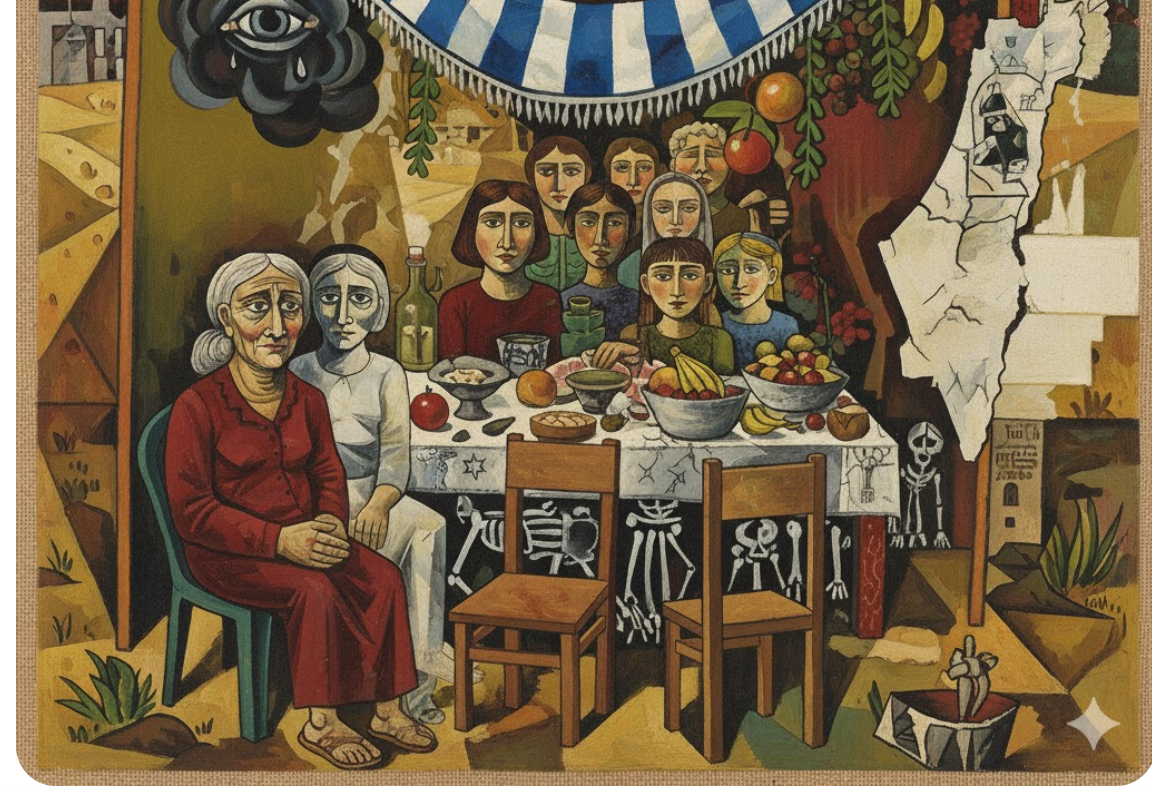
On Sukkot, we are explicitly commanded to be joyful: “And You Shall Rejoice in Your Festival–ve-samachta be-chagecha.” This is the only holiday where such a command appears. But the question arises: What is there about Sukkot to be happy about?
In Israel, Sukkot often means sitting outside in the evening, which can be pleasant (mosquitoes aside). But lunchtime can bring 38°C in the shade — at which point flies take over from the mosquitoes. At my age, there is little joy in plastic chairs and schlepping food from the kitchen to the sukkah.
For the first time ever, I did not build a sukkah this year. In the past, ours was an open house. We hosted every night: friends, family, congregants. We celebrated October birthdays there. I found joy watching my grandchildren decorate the sukkah with the same plastic fruit I once found discarded on the streets of the East 90s in New York while walking to the 92nd Street Y with my mother in the 1980s — a story I’ve told my children and grandchildren, who may one day tell theirs.
We used to pray in our synagogue’s sukkah — battling flies, sweating without air conditioning, and sitting again on those plastic chairs–people respected our age and brought two real chairs for me and my husband.
This year, there is no synagogue sukkah. All prayers are indoors.
Am I nostalgic for the past? Not really. It was a lot of work. Early morning minyanim were not for me — they were my husband’s thing. What I miss are the moments: the joy of entertaining in our sukkah, surrounded by loved ones. This year I celebrated in the sukkot of friends and our rabbi. And I drove up North with friends to be with my daughter’s family and go to her synagogue in Haifa.
USHPIZOT AND FAMILY VISITORS
I miss putting up the pictures of family — especially the women — and the traditional biblical couples. Ushpizin is an Aramaic word meaning “guests.” According to the Zohar, seven biblical figures traditionally visit our sukkah each night — like Elijah at the Seder. Abraham, who greeted angels in the heat of the day, usually gets top billing.
On store-bought sukkah walls, the ushpizin appear: Abraham, Isaac, Jacob, Joseph, Moses, Aaron, and David — all men. But influenced by feminism, many now include ushpizot — female guests: Sarah, Miriam, Deborah, Hannah, Abigail, Huldah, and Esther. More controversial women — Eve, Rebecca, Leah, Rachel, Dinah, Bathsheba, Ruth — spark deeper conversations.
We might also invite historical women: Dona Gracia, Emma Lazarus, the poet Rachel, Golda Meir, Shulamit Aloni, Ruth Bader Ginsburg, and even Gal Gadot.
These choices — sometimes political — invite wonderful (and hopefully peaceful!) discussions around the table. You can also include couples, or family members from photo albums or old computer files. Let your imagination guide you — and perhaps ask AI about people you don’t yet know.
SIMCHAT TORAH — A HOLIDAY OF JOY AND GRIEF
Two years ago, on October 7th, everything changed. These past two years have flown for most — except for the families of those kidnapped or murdered by Hamas, who’ve felt every second. This year, I cannot look forward to Simchat Torah. It is the yahrzeit of over 1,200 men, women, and children massacred. As of this writing, despite formal declarations of peace, to me they are still glimmers of hope, I feel it is too soon for celebration. I feel we should wait and see—what will be the condition of the soon to be released hostages. And what about the bodies, which will still remain behind. Despite the fanfare, the open bottles of champagne—I feel it’s too soon.
On Simchat Torah, we finish reading the Five Books of Moses and begin anew. Deuteronomy ends with Moses’ death — “his eyes were undimmed and his vigor unabated” (Deut. 33:7). Genesis begins with the creation of humanity in God’s image. We also recite va-yechulu hashamayim — the completion of creation — during Friday night kiddush.
Two years ago, many synagogues in Israel, including ours in Omer, never finished Devarim or began Bereshit. We were in shelters. Under attack. The Hallel we recite on Sukkot includes these chilling words: “The dead cannot praise the LORD, nor any who go down into silence” (Psalm 115:17).Usually sung joyfully, these words now bring to mind the dead, and those silenced in Gaza’s tunnels.
I shared this reflection in an impromptu sermon, which sparked meaningful conversation. Is it good that we do not know where Moses is buried — just as we still do not know the fate of some of our dead. Are they buried in tunnels? Are they waiting to be returned? Do they even know about the peace treaty? These morbid thoughts stay with me, even now.
THE BLESSING OF CHILDREN
A poignant moment on Simchat Torah is the blessing of the children during the special Aliyah for them, Kol HaNe’arim:
“The Messenger who has redeemed me from all harm—Bless the lads. In them may my name be recalled, and the names of my fathers Abraham and Isaac, and may they be teeming multitudes upon the earth” (Genesis 48:15–16).
We sing this under a giant tallit, surrounding the children. But it still echoes with the cries of the children who were murdered or orphaned. Will this blessing help redeem them? Will peace come? Our young rabbi — newly 50 — reminds us we are commanded to rejoice on Sukkot.
We respond: Moadim le-simchah
And answer: Chagim u’zmanim le-sasson.
“YOU SHALL NOT CROSS OVER”
At the end of Deuteronomy, God shows Moses the Land of Israel and says:
I have let you see it with your own eyes, but you shall not cross over there (Deut. 34:4).
The stark Hebrew: “ve-shama lo ta’avor.”
Cruel, isn’t it? A rabbi once tried to comfort me, after I finished reading this, saying: “Don’t worry, Moses will be born again next year in Shemot.” But this year, many will not be born again. Many have not survived.
Some commentators have struggled with this passage.
Sforno (Italy, 16th c.) offers a metaphysical rationale: Moses’ exclusion preserves the sanctity of the people’s future resurrection.
HaKetav VehaKabbalah(Mecklenburg, 19th century) is less apologetic: God did not mean to hurt Moses. Perhaps Moses had already seen enough — not needing to go further.
Even so, I find their justifications thin.
We admire that Moses died “with undimmed eyes and full strength.” But I wonder: is that truly a blessing? Is it not better to die unaware, than to be conscious and told you are being punished?
From our perspective, yes — we want our loved ones alert enough to say goodbye. But would the dying choose differently? I still think about the different scenarios when my husband died, fully alert and aware that it was the end, although with humor, still hoping for a miracle. Whereas my sister, did not allow me to say goodbye to her, saying that she was not planning to die and we would speak the next day. Unfortunately, we did not.
Perhaps we protest too much, trying to soften the blow of God’s refusal.
THE GOD WHO LOVES AND THE GOD WHO TAKES
On the Shabbat of Chol HaMoed, we read about the “jealous God” (El Kana) in Exodus 34. God shows Moses His back and speaks to him intimately. Then, two days later on Simchat Torah, Moses will die — alone, buried in an unmarked grave.
To a newcomer, this would seem cruelly ironic. She must wonder, How can a God who loves Moses so deeply kill him off so suddenly?
The Torah portion, Zot HaBeracha, is mysterious. Many verses are obscure. Perhaps it is included primarily to reiterate the tribal inheritances and the promise of the land. But it ends not with triumph, but with unresolved tension.
A FINAL NOTE
As we move through this season — from Sukkot to Shemini Atzeret and Simchat Torah — may we hold both joy and grief. May we find space for reflection, for hope, for discussion, for memory.
And may the blessing of hamalach ha-goel oti truly reach our children, and redeem them — and all of us — from harm. And may we start to repair the nation and the lives of all those who have suffered and are still suffering.
Moadim le-simchah
Continue to have a meaningful and joyful holiday.
Related Topics
Related Posts