Rabbi in the Heartland of the USA
Reform Judaism Chose Zionism. That Was Not a Mistake.
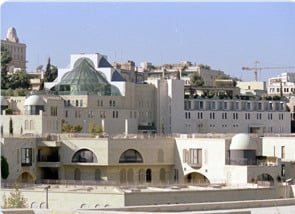
Mercaz Shimshon-Beit Shmuel in Jerusalem. (Credit Magister at Hebrew Wikimedia)
There is a strange argument making the rounds in certain progressive Jewish circles. It goes something like this: Reform Judaism’s embrace of Zionism was a historical accident, an overcorrection born of trauma, and the movement would be healthier if it returned to its original universalist vocation and loosened its bond with Israel. A piece last year in Jewish Currents argued that the movement should build an identity beyond Israel. The Reconstructionist movement is hemorrhaging credibility over the same fault line, and at Hebrew Union College, some rabbinical students reportedly find it easier to discuss Israel with secular friends than with their own seminary classmates, as more and more of the antizionist fringe is accepted.
There is a word for a Judaism that has shed its peoplehood, abandoned its claim to a homeland, and redefined itself as a set of portable ethical principles available to anyone. That word is not “Reform.” It is “gone.”
I want to say this as clearly as I can, as a Reform rabbi who loves this movement and refuses to eulogize it: Reform Judaism without Zionism is not a bolder version of Reform Judaism. It is a return to the most discredited idea in modern Jewish history.
The 1885 Pittsburgh Platform did mistakenly declare that Jews were “no longer a nation, but a religious community” and expected “neither a return…nor the restoration of any of the laws concerning the Jewish state.” That was not prophetic universalism. That was a wager, that if Jews became indistinguishable from their neighbors in every respect but Sunday worship, the world would leave us alone. Within fifty years, the Jews of Germany, who had more thoroughly pursued that project than anyone, were being loaded into cattle cars. The Columbus Platform of 1937 did not reverse course because Reform leaders lost their nerve. It reversed course because reality intervened.
And yet here we are, nearly a century later, being told that the movement’s return to peoplehood and nationhood was a detour. That the real Reform Judaism is the one that preceded the 1930s and the Holocaust, not the one that learned from it.
This is not a serious historical argument. It is a fantasy dressed up in universalist, utopian, academic language.
The deeper error is theological, and it cuts to the heart of what Reform Judaism is supposed to be. The claim that we must choose between universalism and particularism misunderstands both concepts and, frankly, misunderstands Torah. God’s covenant with Israel at Sinai does not cancel the covenant with Noah. It fulfills it. The particular is the vehicle through which the universal becomes real. As Rabbi Jonathan Sacks wrote in A Letter in the Scroll, Judaism is “the particular case that exemplifies the universal rule that the world exists under the sovereignty of God, and that every person is the image of God.” You cannot speak a language “in general” without speaking one language in particular. You cannot love humanity in the abstract while refusing to take responsibility for your own people in the concrete.
This is not an Orthodox insight foreign to Reform ears. It is Reform Judaism’s own conviction. The 1997 Miami Platform, the CCAR’s first statement dedicated entirely to Zionism, affirmed that the “renewal and perpetuation of Jewish national life in Eretz Israel is a necessary condition for the realization of the physical and spiritual redemption of the Jewish people.” Read that line again. A necessary condition. Not an optional accessory. Not a nice cultural add-on for those who happen to feel it. A necessary condition for redemption itself. That is a Reform Jewish statement, adopted by Reform rabbis, in the language of Reform theology.
Those who want to sever this bond are not innovating. They are regressing. They are dragging us back to a 19th-century ideology that collapsed under the weight of history and has nothing useful to say to a Jewish world still reeling from October 7th. On that date, the largest massacre of Jews since the Holocaust was carried out by people who did not ask their victims whether they were secular or religious, Ashkenazi or Mizrachi, left or right. They attacked Jews because they were Jews living as a free people in their homeland. If that does not clarify the stakes of Jewish sovereignty for a Reform rabbi, nothing will.
I serve a congregation in Topeka, Kansas. We are not in Brooklyn or Berkeley. My congregants are not agonizing over whether Zionism is fashionable on campus. They are raising Jewish children in a place where being Jewish already requires intentionality, where every Shabbat dinner is a small act of resistance against assimilation. They understand instinctively what some in our seminaries seem to have forgotten: that Jewish continuity requires content. It requires land, language, memory, obligation, and the unapologetic conviction that the Jewish people deserve to exist not just as individuals with nice values but as a civilization with a homeland.
Unlimited universalism, unmoored from covenant and peoplehood, does not produce prophetic Judaism. It produces something closer to Ethical Culture with better music. It produces a Judaism so eager to be everything to everyone that it ceases to be anything in particular. And movements that stand for nothing in particular do not survive. They do not inspire sacrifice, or loyalty, or the kind of stubborn devotion that has kept Jews Jewish for three thousand years.
This is not a call to silence dissent. Reform Judaism has always valued machloket l’shem shamayim, argument for the sake of heaven. We can and should debate Israeli policy, the character of Israeli democracy, the rights of non-Orthodox Jews in Israel, and a hundred other urgent questions. I do, regularly. But the argument must take place on Zionist ground. The existence of Israel as a Jewish state is not one opinion among many for Reform Jews. It is a plank of every platform we have adopted since 1937. It is woven into our liturgy, embedded in our theology, and confirmed by our history. To treat it as optional is to misread our own movement.
I became a rabbi because I believe Reform Judaism has something irreplaceable to offer the Jewish people: a Judaism that takes modernity and Jewish tradition seriously without surrendering the particular covenantal identity that makes us who we are. That project has always required and included Zionism as a theological commitment to the radical idea that the Jewish people are entitled to collective self-determination in the land where our story began. If we lose that, we have not freed ourselves. We have simply made ourselves smaller.
The late Rabbi Lord Sacks liked to say that non-Jews respect Jews who respect Judaism, and that non-Jews are embarrassed by Jews who are embarrassed by Judaism. I would add: a movement that is embarrassed by its own peoplehood will not long command the loyalty of a people.
Reform Judaism chose Zionism. It did so with eyes open, after the most catastrophic century in Jewish history. That choice was not a mistake. It was a homecoming. And those of us who understand this have an obligation to say so, without apology, and without waiting for permission.
—
Sources
1885 Pittsburgh Platform, Central Conference of American Rabbis. Full text via CCAR: ccarnet.org/rabbinic-voice/platforms
1937 Columbus Platform (“Guiding Principles of Reform Judaism”), CCAR. Full text via CCAR: ccarnet.org/rabbinic-voice/platforms
1997 Miami Platform (“Reform Judaism & Zionism: A Centenary Platform”), CCAR. Full text: ccarnet.org/rabbinic-voice/platforms/article-reform-judaism-zionism-centenary-platform/
Rabbi Jonathan Sacks, A Letter in the Scroll (2001), p. 87: “the particular case that exemplifies the universal rule.”
Related Topics
Related Posts