
Urban sociologist and geopolitical commentator
Regime Change in Iran and the Reordering of the Gulf
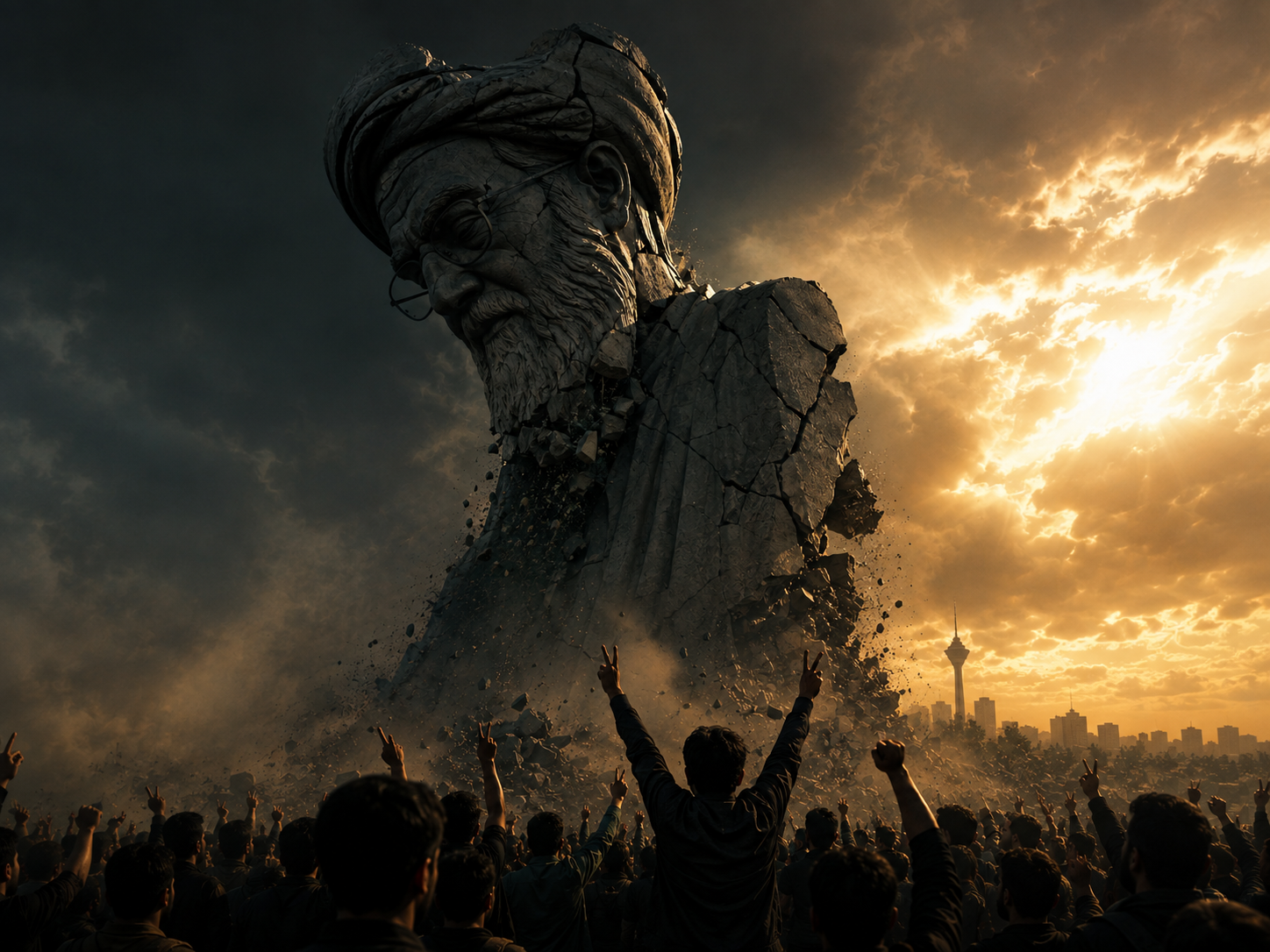
Regime Change in Iran. An AI Illustration.
Discussions of “regime change” in Iran typically conflate two distinct questions: whether the Islamic Republic can be removed, and whether removing it would produce a stable successor. Comparative politics offers a useful distinction here: between a regime (a ruling coalition and its institutional arrangements) and a state (the underlying apparatus of bureaucracy, coercion, and territorial control that persists across regimes). Political scientists studying externally induced transitions, most systematically in the Iraq and Libya literature, have shown that regime collapse without state continuity does not produce a transition; it produces a vacuum that rival actors compete to fill. Any serious analysis of Iran must therefore evaluate not whether the Islamic Republic can be weakened, but whether the Iranian state can survive the weakening of its regime.
This distinction reframes the strategic stakes. Iran’s relevance to Gulf security does not derive primarily from the ideology of its government but from structural facts that would persist under almost any Iranian regime: its size and population, its position astride the Strait of Hormuz, its missile and asymmetric capabilities, and its decades-old networks of regional influence. A change of government in Tehran does not eliminate these structural facts. It only changes who controls them.
Why Weakness Does Not Equal Fragility
A recurring error in regime-change analysis is treating regime weakness and regime fragility as synonymous. They are not. Weakness refers to declining capacity: economic contraction, military attrition, diminished legitimacy. Fragility refers to the probability of collapse under stress. A regime can be historically weak while remaining institutionally resilient, particularly where coercive institutions are diversified and ideologically embedded rather than dependent on a single leader or apparatus.
Iran’s post-war trajectory illustrates this. Military and economic pressure has visibly degraded state capacity: inflation, currency depreciation, and infrastructure damage are not in serious dispute. Yet degraded capacity has historically coexisted with durable authoritarian survival where the regime controls multiple, overlapping coercive structures. The Revolutionary Guard functions simultaneously as a military, economic, and intelligence actor; the Basij provides a parallel mobilizational structure; clerical institutions supply ideological legitimacy independent of material performance. This redundancy is precisely what makes authoritarian institutions in the “durable authoritarianism” literature (associated with scholars like Joseph Wright & Abel Escribà-Folch; Barbara Geddes; and Beatriz Magaloy on regime survival) resistant to attrition strategies: no single point of failure removes the whole structure, and external pressure can consolidate rather than divide the coercive coalition.
The Nationalism-Legitimacy Substitution Effect
The most consequential dynamic of the current period is what might be called a legitimacy substitution effect: a regime that has lost ideological or performance legitimacy can partially replace it with nationalist legitimacy when confronted by external attack. This is not unique to Iran; it is a recurring pattern in states under external military pressure, from wartime consolidation effects observed in besieged states historically. The mechanism is straightforward: external attack reframes the political conflict from “citizens versus regime” to “nation versus foreign aggressor,” a frame that can generate compliance or acquiescence even among citizens who reject the regime’s domestic governance.
This produces a critical strategic implication that regime-change proponents frequently underweight: opposition to the Islamic Republic is not equivalent to support for externally imposed regime change. An Iranian citizen may hold both positions simultaneously, which are, resentment of clerical rule and rejection of foreign-directed political transformation, without contradiction. Strategies premised on the assumption that domestic discontent will translate into welcome for outside intervention misread this distinction, and risk strengthening the very nationalist legitimacy they seek to erode.
A further implication follows: a post-Islamic Republic Iran is not guaranteed to be more accommodating toward Western or Gulf interests. Persian nationalism predates the Islamic Republic and is not contingent on it. A secular or democratic successor state could retain, or even intensify, claims to regional strategic weight, simply expressed through nationalist rather than revolutionary-Islamic vocabulary.
Hormuz as Structural, Not Contingent, Leverage
The Strait of Hormuz converts an internal Iranian political question into a global economic constraint. Roughly a fifth of global oil consumption and a comparable share of LNG trade transits the strait, and neither Saudi Arabia nor the UAE possesses pipeline capacity sufficient to fully substitute for it. This gives Iran a form of leverage that does not depend on military victory: the ability to raise insurance and shipping costs enough to generate inflationary pressure on oil-importing economies, without needing to close the strait outright or defeat any adversary militarily. This is a coercive logic built on cost imposition and resilience, not conquest, and it is a capability inherent in Iran’s geography rather than in its regime type. Whoever governs Iran inherits this leverage; regime change does not neutralize it.
Divergent Preferences Among Gulf States
A further analytical gap in most regime-change discourse is the assumption that Gulf states share Washington’s preferences. They do not, straightforwardly. Gulf monarchies fear Iranian coercive capacity, but they have stronger reasons to fear Iranian state collapse than Iranian regime survival, because collapse risks refugee flows, proliferation of weapons and militias, and a security vacuum on the Gulf’s northern shore that outside powers (Turkey, Russia, China) could exploit. Their revealed preference, as visible in the divergence between Gulf capitals and Washington over engagement strategies, and in emerging Gulf hedging behavior toward Turkey, Pakistan, China, and India, is best described as a preference for managed weakness: an Iran unable to dominate its neighbors but stable enough to be contained diplomatically. This is a materially different objective from regime elimination, and it explains why Gulf states are increasingly pursuing autonomous security diversification rather than simply amplifying U.S. policy.
The Succession Problem
The central unresolved question in any regime-change scenario is institutional succession: what happens to the coercive apparatus if clerical leadership is removed. At least four trajectories are plausible: negotiated transition, military guardianship (an IRGC-dominated security state that discards clerical control while preserving coercive continuity), fragmentation among competing armed factions, or genuine civilian-led democratization. The second and third scenarios receive insufficient attention in policy discourse, despite being at least as probable as the fourth on the basis of comparative transition literature, which finds that entrenched security services rarely dissolve voluntarily and more commonly either capture the successor state or fracture along factional lines.
This is also why symbolic opposition figures, among them Reza Pahlavi being the most visible example, cannot be equated with governing capacity. Symbolic legitimacy is acquired quickly through visibility and historical association; governing capacity requires territorial organization, elite defections, and control or neutralization of the coercive apparatus, none of which visibility alone provides.
Toward a Coherent Framework
The analytically defensible position is that regime change is an outcome, not a strategy. A coherent policy would treat it as a sequenced political process rather than a military event: containment of Iran’s coercive and proliferation capacity; strategic isolation without triggering existential fusion of regime and nation; support for domestic civil society without converting it into a visible foreign instrument (which would delegitimize it); differentiation between ideological leadership and the technocratic and military personnel needed for state continuity; and abstention from pre-selecting Iran’s constitutional outcome.
The strategic objective this implies is narrower and harder than “regime change” as conventionally used: creating conditions under which Iranians can replace the Islamic Republic without dismantling the Iranian state, while preventing whatever government emerges from translating Iran’s structural advantages, notably size, geography, and control of Hormuz, into regional domination. That formulation, unlike slogans about overthrowing Tehran, corresponds to the actual structure of the problem: a contest not simply over who rules Iran, but over the balance of power in a Gulf order that is becoming progressively less dependent on any single external guarantor.
Related Topics
Related Posts