London based entrepreneur, cybersecurity analyst doing a PhD in AI
Regulating emotion in uncertainty.
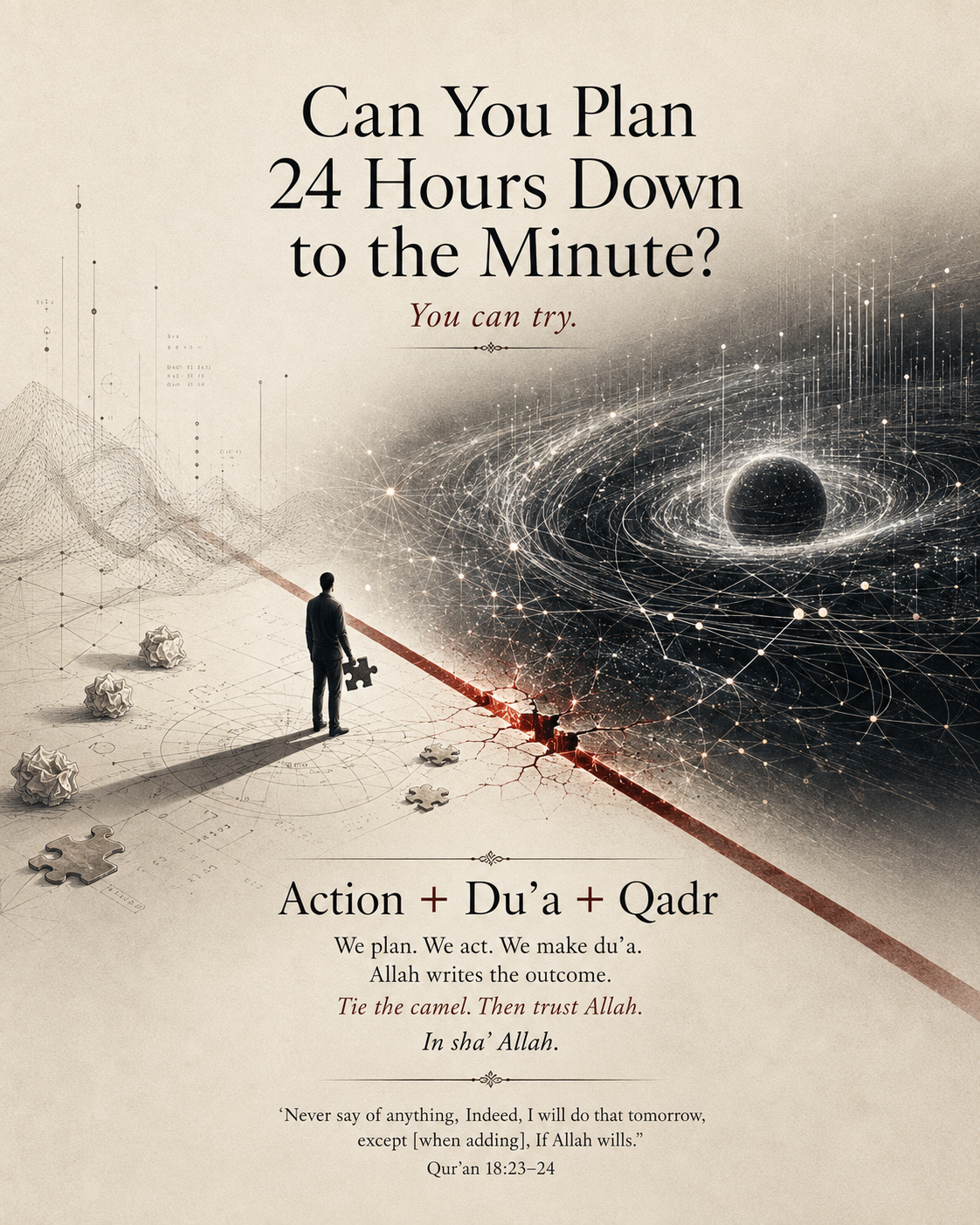
Can You Plan 24 Hours Down to the Minute?
Can you plan the next twenty-four hours of your life down to the minute?
You can try.
6:00 — wake.
6:05 — pray.
6:30 — breakfast.
7:15 — leave home.
8:00 — meeting.
12:30 — lunch.
14:00 — call.
18:00 — gym.
21:00 — read.
23:00 — sleep.
It looks precise.
But precision is not the same thing as knowledge.
At 7:13 your train may be cancelled. At 9:22 somebody may telephone with news you did not expect. At 13:47 you may meet somebody you did not know existed yesterday. At 20:16 an idea may occur that changes the next five years of your life.
Or none of those things may happen.
This is the position of the human reasoner: we can plan, infer, model, estimate and prepare, but we cannot turn a model of tomorrow into possession of tomorrow.
The Qur’an places a boundary around precisely that temptation:
“And never say of anything, ‘I will definitely do this tomorrow,’ without adding, ‘If Allah wills.’”
— Qur’an 18:23–24
Ibn Kathīr رحمه الله explains that Allah is teaching the Prophet Muhammad ﷺ the proper etiquette of intending future action: the intention is real, but it is referred to the will of Allah, the Knower of the unseen. (Quran.com)
Qur’an 18:23–24 with Tafsīr Ibn Kathīr
This is not an argument against planning.
It is an argument against confusing planning with omniscience.
The pens have been lifted
Ibn ʿAbbās رضي الله عنهما recalled being behind the Prophet Muhammad ﷺ when the Prophet ﷺ taught him an extraordinary lesson about agency, reliance and destiny:
“When you ask, ask Allah; and when you seek aid, seek Allah’s aid.”
The Prophet Muhammad ﷺ then explained that if the whole creation gathered to benefit or harm a person, nothing could occur except what Allah had already written, concluding:
“The pens are lifted and the pages are dried.”
This is Jāmiʿ al-Tirmidhī 2516. Al-Tirmidhī himself called it ḥasan ṣaḥīḥ; the Darussalam grading displayed by Sunnah.com is ḥasan. (Sunnah.com)
Jāmiʿ al-Tirmidhī 2516 — full hadith
Put that beside your calendar.
You are looking forward:
7:15 — train.
8:00 — meeting.
14:00 — call.
Your schedule is provisional.
Allah’s knowledge is not.
You do not know tomorrow.
Allah does.
The Preserved Record
The Qur’an refers explicitly to the Lawḥ Maḥfūẓ, the Preserved Tablet:
“Rather, it is a glorious Qur’an, in a Preserved Tablet.”
— Qur’an 85:21–22
Qur’an 85:21–22 and Tafsīr Ibn Kathīr
The Qur’an also says:
“No calamity occurs on earth or within yourselves except that it is in a Record before We bring it into being.”
— Qur’an 57:22
Ibn Kathīr رحمه الله interprets this as Allah’s prior knowledge and determination of events before creation. (Quran.com)
Qur’an 57:22 with Tafsīr Ibn Kathīr
So the human planner exists inside a larger epistemological picture:
We plan forward.
Allah knows completely.
That is part of Qadr.
If everything is written, why plan?
This is the obvious question.
Why study medicine?
Why construct bridges?
Why save money?
Why secure computer systems?
Why set the alarm?
Why make duʿāʾ?
Because Islam does not teach that acknowledging Qadr means abandoning causes.
A man asked the Prophet Muhammad ﷺ whether he should leave his camel loose and rely upon Allah or tie it.
The Prophet Muhammad ﷺ replied:
“Tie it and rely.”
This is Jāmiʿ al-Tirmidhī 2517. (Sunnah.com)
Jāmiʿ al-Tirmidhī 2517 — “Tie it and rely”
That sentence contains the balance.
Tie it: take the means.
Rely: recognise that the means do not control reality independently of Allah.
The Islamic position is therefore neither helpless fatalism nor an illusion of total control.
Agency: act, ask, rely
The practical model is simple:
Act. Ask. Rely.
Apply for the job—and make duʿāʾ.
Prepare for the examination—and make duʿāʾ.
Seek medical treatment—and make duʿāʾ.
Design the bridge, test its tolerances and add redundancy—and say:
In shāʾ Allāh.
This does not weaken planning.
It puts planning in its proper epistemic place.
Can duʿāʾ affect what happens?
Salmān رضي الله عنه narrated that the Prophet Muhammad ﷺ said:
“Nothing turns back the decree except supplication.”
This is Jāmiʿ al-Tirmidhī 2139. Al-Tirmidhī called it ḥasan gharīb, while the later Darussalam grading displayed by Sunnah.com is ḍaʿīf. That qualification should be preserved when quoting it. (Sunnah.com)
Jāmiʿ al-Tirmidhī 2139 — full text and grading
The theological point should not be misunderstood.
Duʿāʾ does not give Allah new information.
If you will make duʿāʾ tomorrow, Allah already knows it. If an outcome follows from that supplication, Allah already knows the prayer, the cause and the result.
So duʿāʾ is not something that arrives from outside Qadr and rewrites Allah’s knowledge.
Duʿāʾ is itself among the causes encompassed within Qadr.
The Qur’an therefore commands:
“Call upon Me; I will respond to you.”
— Qur’an 40:60
Ibn Kathīr رحمه الله explicitly interprets the verse as Allah encouraging His servants to call upon Him and cites the Prophetic teaching that supplication is worship. (Quran.com)
Qur’an 40:60 with Tafsīr Ibn Kathīr
The most incapable person
Abū Hurayrah رضي الله عنه transmitted:
“The most incapable of people is the one incapable of supplication.”
Al-Albānī رحمه الله graded this wording ṣaḥīḥ in Ṣaḥīḥ al-Jāmiʿ, no. 1519, with routes through al-Ṭabarānī’s al-Muʿjam al-Awsaṭ no. 5591, Abū al-Shaykh no. 247, and al-Bayhaqī’s Shuʿab al-Īmān no. 8392. (dorar.net)
Hadith details and grading at al-Durar al-Saniyyah
The psychology is powerful.
You may not control the diagnosis, employer, economy, weather or another person’s heart.
Islam does not therefore tell you that nothing remains.
There remains a form of agency:
ask Allah.
“Duʿāʾ is the weapon of the believer”
The popular wording:
“Duʿāʾ is the weapon of the believer, the pillar of religion and the light of the heavens and the earth.”
is attributed to ʿAlī ibn Abī Ṭālib رضي الله عنه and appears in Abū Yaʿlā’s Musnad no. 439 and al-Ḥākim’s al-Mustadrak. Al-Ḥākim regarded it as authentic, while other hadith critics criticised its chain; it should therefore not be presented as an undisputed ṣaḥīḥ hadith. (dorar.net)
Transmission and hadith-critical information
Its broad meaning is adequately established without depending upon the disputed wording: Qur’an 40:60 commands duʿāʾ, and authentic Sunnah repeatedly records the Prophet Muhammad ﷺ supplicating.
“In shāʾ Allāh” is epistemic humility
Surat Luqmān sharpens the original twenty-four-hour question:
“No soul knows what it will earn tomorrow, and no soul knows in what land it will die.”
— Qur’an 31:34
Ibn Kathīr رحمه الله describes this among the keys of the unseen and explains that a person does not know what tomorrow will bring or where death will reach them. (Quran.com)
Qur’an 31:34 with Tafsīr Ibn Kathīr
A meteorologist can forecast rain.
A doctor can estimate prognosis.
An engineer can estimate structural failure.
An AI model can assign probabilities.
These can be genuine forms of knowledge.
But probability is not ʿilm al-ghayb.
The distinction is not between science and religion.
It is between inference and omniscience.
Qadr should regulate emotion, not abolish effort
The verse immediately following the Qur’anic statement that events are written explains one purpose of knowing this:
“So that you do not grieve over what escapes you, nor boast over what He has granted you.”
— Qur’an 57:23
Ibn Kathīr رحمه الله connects the verse directly to prior Divine knowledge and writing: what reaches a person could not have missed them, and what misses them could not have reached them. He adds a report from ʿIkrimah رحمه الله: everyone experiences joy and grief, but turn joy into gratitude and grief into patience. (Quran.com)
Qur’an 57:23 with Tafsīr Ibn Kathīr
Qadr therefore restrains two distortions:
despair after failure and arrogance after success.
Reasoning under uncertainty: Yūsuf عليه السلام
The Qur’an gives a practical example through Yūsuf عليه السلام.
After interpreting the ruler’s dream as seven years of abundance followed by severe scarcity, Yūsuf عليه السلام recommends a storage policy:
“You will plant for seven consecutive years; leave whatever you harvest in its ear, except the little you eat.”
— Qur’an 12:47
Ibn Kathīr رحمه الله explains that keeping the grain in its ears would preserve it better and protect it from rapid spoilage so that it could be used during the coming years of famine. (Quran.com)
Qur’an 12:47 with Tafsīr Ibn Kathīr
This is not fatalism.
It is contingency planning.
Future uncertainty produces preparation rather than paralysis.
The same logic appears in engineering safety margins, medical risk assessment, disaster preparedness and cybersecurity.
Reasoning can also compress complexity
The Qur’an repeatedly uses amthāl—parables and analogies:
“We have certainly set forth every kind of parable for people in this Qur’an so that they may remember.”
— Qur’an 39:27
Ibn Kathīr رحمه الله explains that the parable brings meaning closer to the mind. (Quran.com)
Qur’an 39:27 with Tafsīr Ibn Kathīr
A few words can therefore carry a large conceptual structure.
That is not Shannon’s mathematical information compression, and it would be anachronistic to claim that the Qur’an “predicted information theory.”
The useful parallel is more modest:
good reasoning often converts complexity into a representation that preserves the relationships that matter.
What this means for artificial intelligence
AI systems face the same epistemic dangers.
They can confuse:
prediction with fact,
fluency with knowledge,
correlation with causation,
confidence with certainty.
A trustworthy system should therefore distinguish:
This is observed evidence.
This is an inference.
This is a forecast.
This remains uncertain.
These assumptions produced the conclusion.
This evidence would change the answer.
And Islamic theology adds a final boundary:
No amount of computation becomes omniscience.
A trillion parameters are still not the Lawḥ al-Maḥfūẓ.
Plan tomorrow
So write the schedule.
Set the alarm.
Prepare your clothes.
Buy the ticket.
Study.
Take the medicine.
Make the call.
Tie the camel.
Make duʿāʾ.
Then say:
In shāʾ Allāh.
The Islamic position lies between two errors.
Fatalism says:
Everything is written, therefore nothing I do matters.
The illusion of total control says:
I planned it, therefore I command the outcome.
Islam permits neither.
Your actions matter.
Your preparation matters.
Your duʿāʾ matters.
But none makes you the sovereign author of reality.
The pens have been lifted and the pages have dried—and the same hadith still tells you:
“When you ask, ask Allah.”
— Jāmiʿ al-Tirmidhī 2516 (Sunnah.com)
That is not a contradiction.
It is the balance.
Reason carefully.
Plan responsibly.
Take the means.
Ask Allah.
Accept uncertainty.
Trust the outcome to Him.
You do not need to know tomorrow in order to act intelligently today.
Perhaps that is the deepest lesson contained in the simple words:
In shāʾ Allāh.
Related Posts