Re’im: Before the Stones Are Set
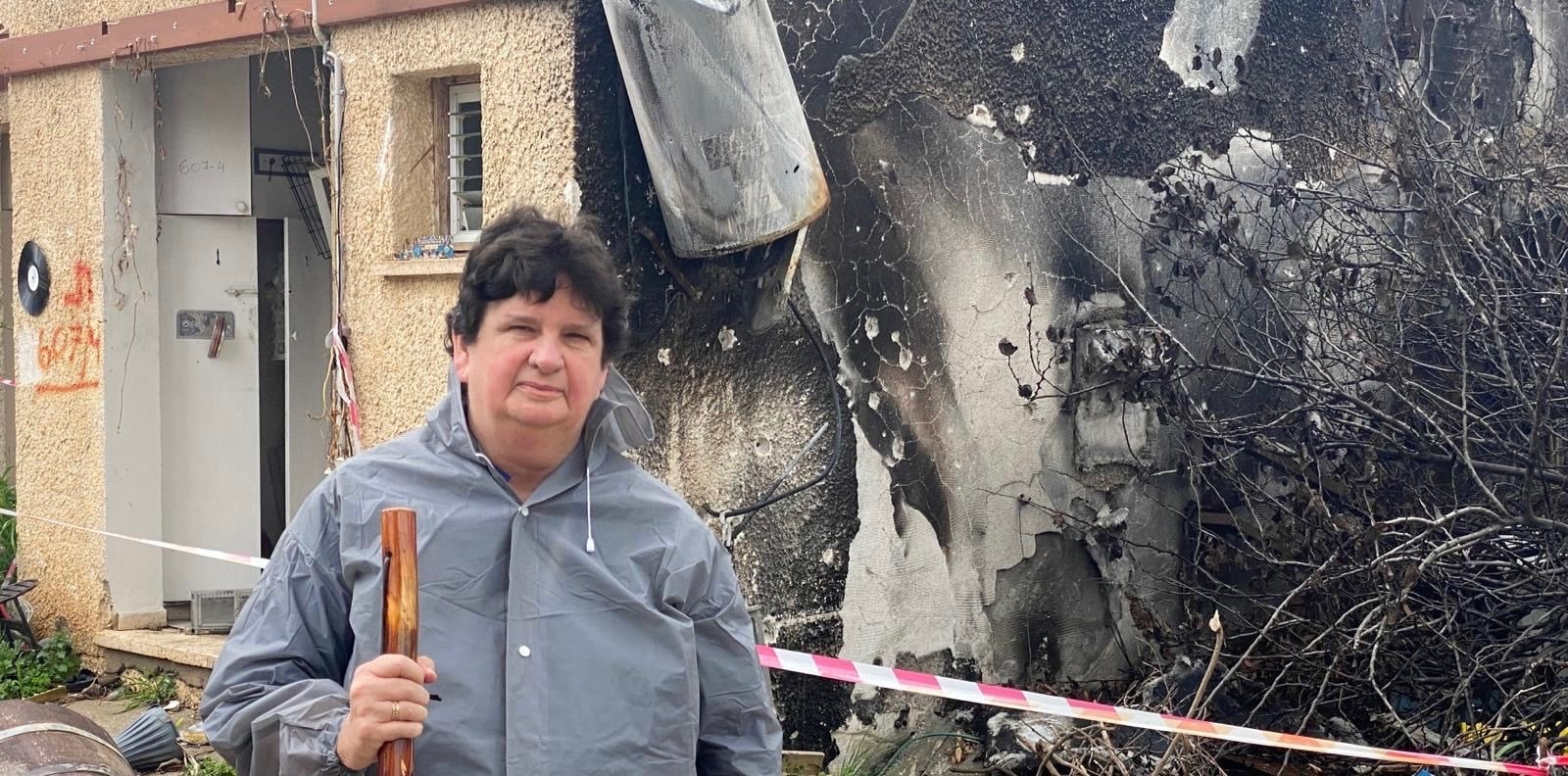
In February 2024, five months into the war, I stood in the ruins of Kibbutz Kfar Aza. (My trip had been sponsored by the American Friends of Sheba Medical Center, supporting the hospital in Ramat Gan, Israel.)
At the kibbutz, I saw houses gutted by fire. Charred possessions lay scattered in rooms and yards. Bullet holes were stitched across the walls, inside and out. Photographs of the murdered and the taken were hung on the facades.
Here, entire lives had been reduced to ash and rubble. Standing in the devastation nearby, several parents spoke quietly about their children, who were held as hostages. Their voices were the only sounds in the otherwise heavy silence hanging over the place.
The ruins invited a comparison I don’t make cheaply. The silence I heard in Kfar Aza belonged to history.
I had heard that silence before—thirty years earlier at Majdanek. In 1994, I went there with two Jewish friends, second-generation survivors I had first met in a teachers’ course at Yad Vashem. Unlike Auschwitz, the camp had not been turned into a polished museum. It remained as the SS garrison left it: no gift shops, no cafés, no tour crowds. That day we were the only three visitors.
The open fields, the barbed wire, the intact gas chambers, and the huge concrete mausoleum over a mound of ashes needed no commentary. Inside the dark barracks the air smelled of old rot. I brushed the rough wooden bunks and held a pair of empty shoes. We passed the crematorium ovens and sat beside the ashes, fragments of bone still visible.
What I recognized at Kfar Aza wasn’t similar in terms of scale. The Holocaust was an industrialized, state-sponsored genocide of six million. Jews today have what they lacked in 1944: a sovereign state and an army.
What I recognized was continuity: the same hunting of Jews, the same sudden rupture of ordinary life, the same silence after the killing. The fact that the Jews had a country did not cancel that morning.
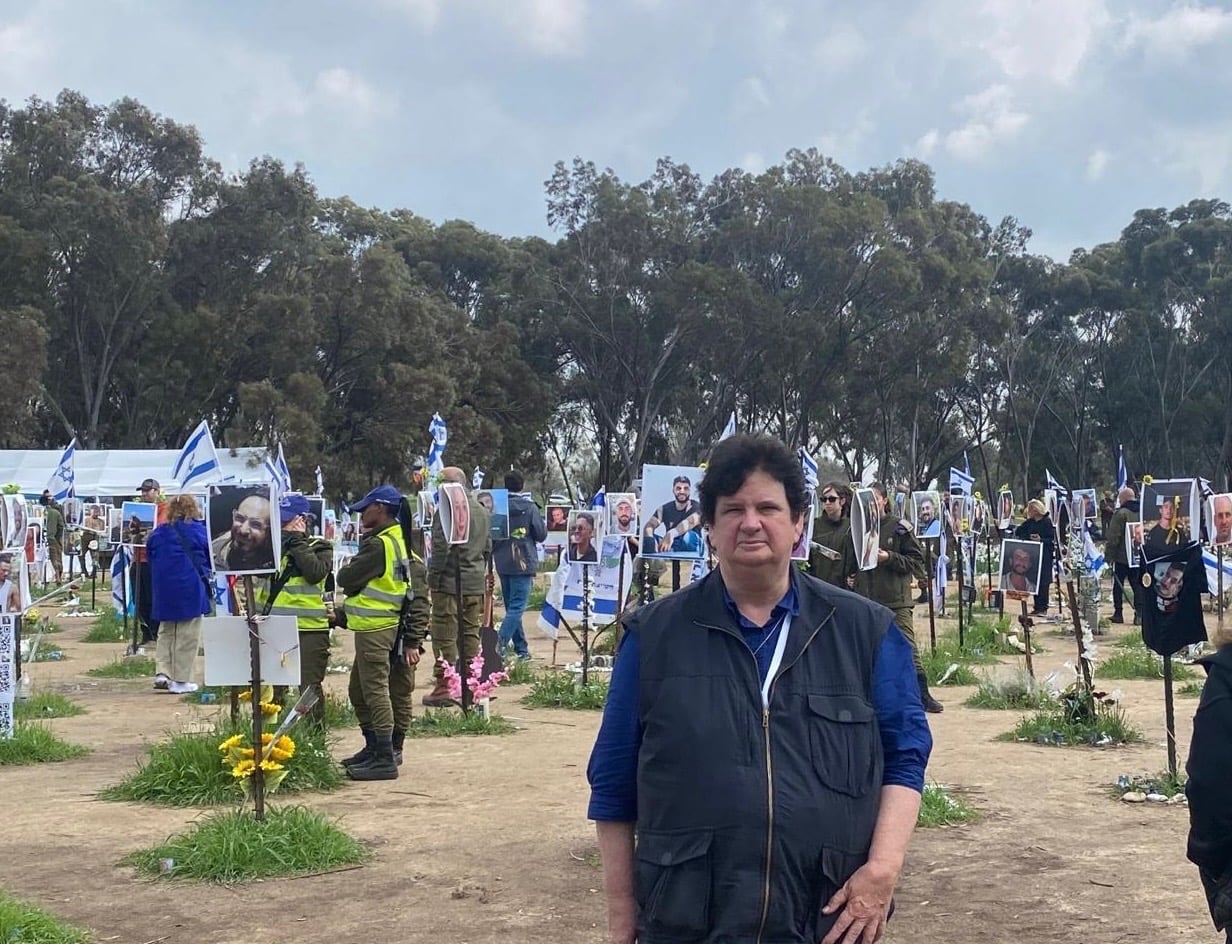
Thirty years after visiting Majdanek, during our solidarity trip, we drove away from Kfar Aza, Israel and proceeded south on Route 232—the road Hamas used on October 7.
Here, we reached the open field at Re’im where the Nova festival had been held. There were no ruined houses here and no charred walls. There was a field, quiet as a cemetery, turned into a field of faces. Large portraits of the young victims stood on poles. People walked among them and wept. A place of joy had become a place of grief.
The sadism of that October morning and the sudden rupture of Jewish safety still correspond across the decades. So does the silence. It’s the silence that follows “Jew Hunting.”
Measuring a tragedy by body count is a moral failure. In international law, genocide requires specific intent to destroy, in whole or in part, a national, ethnic, racial, or religious group. That’s not the same as Crimes against Humanity, which result in death—without the aim of erasing that population.
The war in Gaza is a war Hamas started and still refuses to end. Its written goal is not a border. Its public statement includes the vehement shout that Israel should not exist. There’s no equivalency to Israel striking the territory from which the massacre was launched.
Cruelty in war is a horror. A program to erase a people is a different crime.
If church assemblies want a public document that states such a specific genocidal aim, they need only open the 1988 Hamas Covenant. Here, the document begins by declaring that Israel will exist only “until Islam will obliterate it.”
In 2026, the General Assembly of the Presbyterian Church (USA), meeting in Milwaukee, voted 454–15 to declare Israel’s war in Gaza a genocide. On a separate vote, the same assembly affirmed Kairos Palestine II 447–21. That November 2025 text, A Moment of Truth: Faith in a Time of Genocide, declares Israel’s war a genocide and calls churches to isolate Israel, impose sanctions and boycotts, and ban arms exports. Those votes are not the whole Church. They are a warning of how quickly explanation becomes indictment, and indictment becomes permission to look away from Jewish dead.
We don’t have to ignore Palestinian suffering to reject this shift. Civilian deaths in Gaza are real. Their deaths, however, don’t turn a pogrom like October 7 into justified action. It’s now common in church assemblies to mention October 7 only as the prelude to Gaza, as if the murdered at Kfar Aza and Re’im were an opening clause. Here, it seems the Jewish dead become “context” for an indictment of Israel. How can we let a massacre be rewritten as a preface?
In Christian Antisemitism: A History of Hate (1993), William Nicholls wrote that many Jewish writers said the Nazis chose the Jews “because two thousand years of Christian teaching had accustomed the world to do so.” He judged the claim “correct, though perhaps needing fuller substantiation.” The substantiation he named was the charge that ran through Christian centuries with unique force: that the Jews had killed Christ.
I’m not saying October 7 was produced by a Sunday sermon. I’m saying a Church informed by that charge is still tempted to treat Jewish death as a puzzle to be explained rather than a crime to be named.
Before 1948, Christian complicity often wore the face of silence. Confronting a sovereign Jewish state, the bystander’s temptation has mutated into explanation.
For mainline Christians, it’s tempting to treat time as an eraser, obliterating the past to justify the present. On a church trip to the Holy Land in 2018, a fellow Christian asked, “I wonder when Jews will stop using the Holocaust as a pass.” The callousness of that statement left me stunned.
European churches once taught the West to see Jews as a problem in the drama of redemption. Some Palestinian Christian theologies taught the West to see Jewish sovereignty as the new form of that problem. Western mainline churches did not arrive at their present language by a sudden discovery of human rights. They absorbed a political theology refined and transmitted through Palestinian Christian networks—Sabeel and Naim Ateek, Mitri Raheb, the Kairos texts—then baptized as Christian witness.
Although the men who killed on October 7 were not the SS, the bystanders’ temptation is to look away or to call the looking-away, “analysis.” Finding excuses for such violence is a betrayal. This time—unlike the Christian churches after the Holocaust—our Christian task should not become another confession after the fact.
My mind goes back to another field in Poland: Treblinka. After the war the Nazis razed the camp and plowed the earth to hide the crime. Decades later a sea of jagged stones was set into the ground as a memorial.
That’s one fate awaiting the field at Re’im. Memorials are already rising—portraits, a trail, trees, stone paths—at the Nova Festival Victims Memorial Site, a sacred enclave created within the Re’im parking lot.
Gaza’s ruins are the wreckage of a war. Re’im’s field is the wreckage of a massacre planned against peaceful civilians who were attending a dance. A church that cannot tell those two ruins apart has already chosen a side.
Kfar Aza is a home and will be rebuilt. Re’im is a killing field. Look at the faces before a finished monument tidies the horror. Christians now must refuse to be this generation’s silent bystanders before the memorial stones are set.