CFO | Empower Society for Good I Author
Remember Why We Are Here
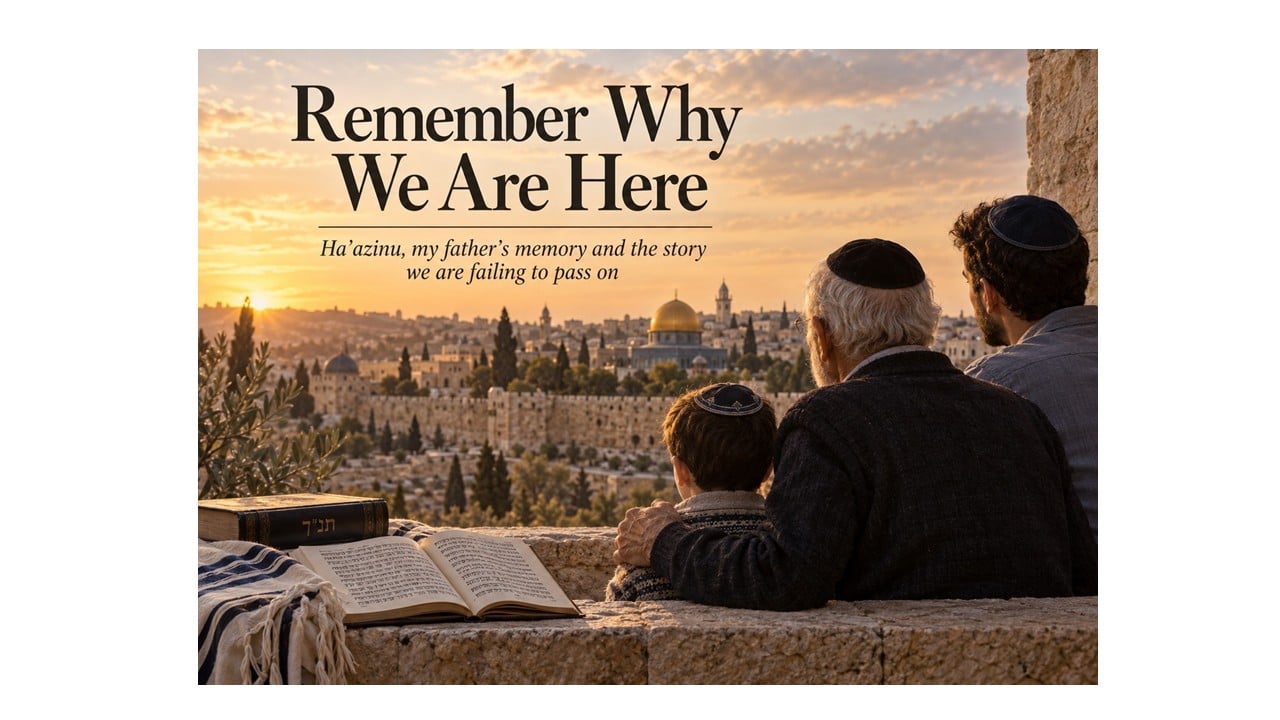
Ha’azinu, my father’s memory and the story we are failing to pass on
This Shabbat, Shabbat Shuva, I will make a kiddush in memory of my father.
He died forty-one years ago, at only 50. Yet some of the things he taught me remain remarkably vivid.
One comes back every year between Rosh Hashanah and Yom Kippur:
בְּרֹאשׁ הַשָּׁנָה יִכָּתֵבוּן וּבְיוֹם צוֹם כִּפּוּר יֵחָתֵמוּן
“On Rosh Hashanah it is written; on Yom Kippur it is sealed.”
I remember my father explaining those words to me. I remember understanding, even as a boy, that these were not two disconnected holidays but one journey — judgment, reflection, repentance and return.
More than four decades later, his words are still with me.
That is memory.
But as I prepare for his yahrzeit, I find myself asking a less comfortable question.
My father passed something on to me.
How much of it have I passed on?
I have children and grandchildren. They know they are Jewish. They know Israel is home. They know our family story.
But if I am completely candid, I sometimes wonder whether I have transmitted even half of what I received — not the practices alone, but their meaning. Not simply what we do, but why we do it. Not merely the rituals, but the story underneath them.
And then I came to Ha’azinu.
Suddenly I understood what had been bothering me.
Moshe is approaching the end of his life. The Jewish people are about to enter the Land that he himself will only see from afar. And among his final instructions are these words:
זְכֹר יְמוֹת עוֹלָם
בִּינוּ שְׁנוֹת דֹּר־וָדֹר
שְׁאַל אָבִיךָ וְיַגֵּדְךָ
זְקֵנֶיךָ וְיֹאמְרוּ לָךְ
“Remember the days of old. Understand the years of generation after generation. Ask your father and he will tell you, your elders and they will say to you.”
Ask your father.
For me, this year, those words land differently.
My father is no longer here to ask.
I have only what he managed to give me while he was alive.
And my children will one day have only what I manage to give them.
Perhaps that is what Ha’azinu is really about: not memory as nostalgia, but transmission.
Jewish life is built around it.
At Pesach, we do not simply study the Exodus; we tell the next generation that we left Egypt. On Rosh Hashanah, Zichronot — remembrance — stands at the centre of Mussaf. We invoke Creation, the covenant, Abraham, Sinai and generations of Jewish history.
But here is the uncomfortable Shabbat Shuva question:
Do we understand what we are saying?
We can spend hours in synagogue, say every word, stand at the correct moments, hear the shofar and still miss the extraordinary ideas contained in the service.
And the problem is not confined to religious Jews.
An Israeli can speak Hebrew, serve in the army, walk through Jerusalem and live an entirely Jewish calendar — yet know remarkably little about the story that made Jewish sovereignty possible.
One can inherit the forms of Jewish life while losing their meaning.
That, I think, is where the personal problem becomes the national one.
Perhaps I transmitted only half of what my father gave me.
Have we, as a people, done much better?
We inherited one of humanity’s longest continuous civilizational memories: Egypt and Sinai; kingdom and exile; Jerusalem destroyed and Jerusalem remembered; communities built and destroyed across continents; persecution, renewal and eventually return.
And then, after generations of praying towards Jerusalem, we came home.
But Moshe anticipated the danger that would come next:
וַיִּשְׁמַן יְשֻׁרוּן וַיִּבְעָט
“Yeshurun grew fat and kicked.”
It is an extraordinary warning because the threat is not poverty or weakness.
It is success.
You build. You prosper. You become secure. And slowly you begin to forget how extraordinary your situation is — and what was required to create it.
October 7 shattered many assumptions.
Among them was the comfortable belief that Jewish sovereignty had somehow lifted us outside the patterns of Jewish history.
It had not.
But if the only lesson we take from October 7 is that people still hate us, then I fear we have learned too little.
Ha’azinu demands something more difficult.
It asks us to remember ourselves.
Why are we here?
What does this Land mean within the Jewish story?
What responsibilities come with having sovereignty again?
And what kind of society did generations of Jews dream of building if they ever returned?
Those questions matter because something else has become increasingly clear to me.
We frequently complain that the world does not understand Israel.
But perhaps the prior question is:
Do we understand our own story well enough to tell it?
Because if we do not tell it, someone else will.
And they may begin the story in 1967.
Or 1948.
Or with yesterday’s photograph.
Or this morning’s headline.
Thousands of years can disappear behind a slogan.
Exile disappears. The prayers for Zion disappear. The repeated vulnerability of Jewish minorities disappears. The destruction of Jewish communities disappears. The return disappears.
Then Zionism can be presented as though Jews suddenly appeared in this corner of the Middle East with no memory, no history and no connection to the place.
That does not mean our history settles every argument.
It does not excuse every Israeli policy.
It certainly does not release us from moral responsibility toward Palestinians or anyone else with whom we share this land.
Quite the opposite.
Ha’azinu establishes the standard almost at its beginning:
הַצּוּר תָּמִים פָּעֳלוֹ
כִּי כָל־דְּרָכָיו מִשְׁפָּט
אֵל אֱמוּנָה וְאֵין עָוֶל
צַדִּיק וְיָשָׁר הוּא
“The Rock, His work is perfect, for all His ways are justice; a God of faithfulness and without injustice, righteous and upright is He.”
If Jewish sovereignty means anything, it must carry obligations as well as rights.
That is why remembering our story should lead not only to the question how do we keep Israel?
It should lead to the harder question:
What kind of Israel are we trying to keep?
Can we build a society worthy of the Jewish return?
Can we remain strong without worshipping strength?
Can we remember persecution without allowing persecution to define us?
Can we disagree ferociously and still understand that we belong to one story?
Can we create a country that is not merely capable of surviving, but worth the sacrifices required to defend it?
For me, those questions begin this year not with geopolitics but with my father.
At the kiddush on Shabbat, there will be tastes from the South African Jewish world in which I grew up. There will be memories. Stories. Children and grandchildren.
And there will be an empty place that has been empty for more than forty years.
My father cannot tell me anything new.
I live now from what he already told me.
And perhaps that is the responsibility every generation eventually inherits.
We receive a story.
We understand some of it.
We lose some of it.
We add something of our own.
And then, before our opportunity disappears, we try to hand it on.
Moshe knew that memory could fail. That is why, before Israel entered the Land, he told them:
זְכֹר יְמוֹת עוֹלָם. בִּינוּ שְׁנוֹת דֹּר־וָדֹר. שְׁאַל אָבִיךָ וְיַגֵּדְךָ.
Remember. Understand. Ask your father.
Maybe I passed on only 50% of what I received.
That thought bothers me.
But perhaps Shabbat Shuva is precisely the time to be bothered by it.
Teshuvah means return.
And before a person — or a nation — can return, it must remember what it is returning to.
Before we demand that the world understand why the Jewish people are here, we need to remember why we are here ourselves.
Before we complain that others are rewriting our story, we need to learn how to tell it.
And before we decide what the next chapter of Israel should look like, we need to make sure the next generation knows the story that brought us home.
Related Topics