Remembering 9/11: We must not look away
I remember exactly where I was 25 years ago this week. I suspect all Americans who were alive that day do as well.
The date is seared into our national memory with a particular kind of permanence that comes only from collective trauma. The towers. The smoke. The ash everywhere. The silence that followed. For nearly 3,000 families, September 11, 2001 was not just a moment of national awakening; it was the day the world cracked open and swallowed someone they loved.
We owe it to those families, and to the memory of everyone who perished, to be honest about what we’ve learned in the quarter century since. Not just about the nature of Islamist terrorism. But about the hatred that drives it.
Here is what the data and the history make undeniably clear: The fight against terrorism and the fight against antisemitism are indivisible. You cannot successfully defeat the former while refusing to confront the latter.
For many Americans, 9/11 was a shattering surprise. For the Jewish community, however, the warning alarm about the threat of Islamist terror had been sounding for decades.
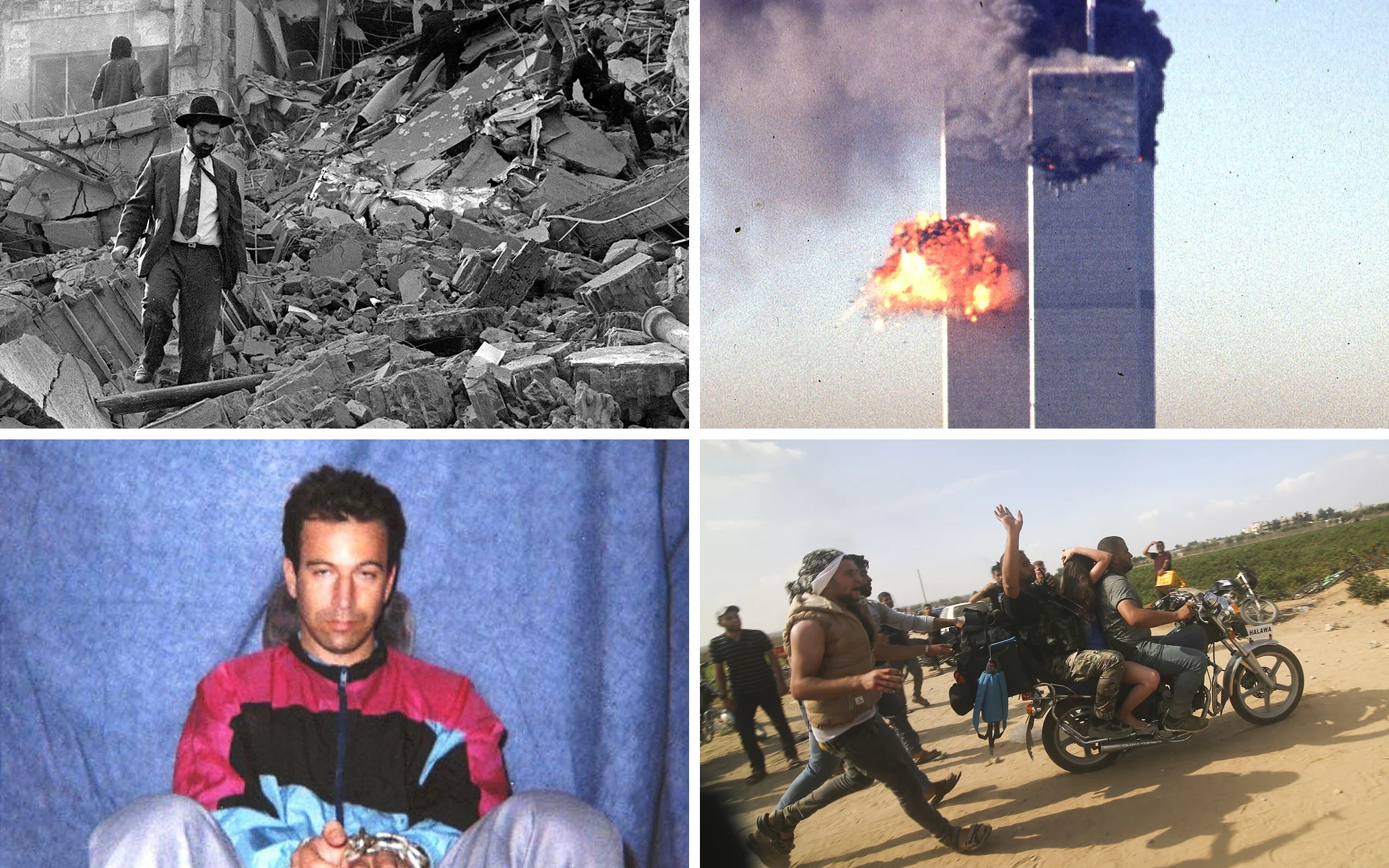
There are so many examples in recent years of people singling out and murdering Jews simply for the crime of being Jewish. The Entebbe hijacking in 1976. Attacks on synagogues in Antwerp and Vienna in 1981. The Achille Lauro in 1985. The AMIA bombing in Buenos Aires in 1994. In France, the Toulouse Jewish school shooting in 2012, and the Hyper Cacher supermarket in 2015. Bondi Beach, Australia, in 2025. And so many more.
In all these cases, terrorists from various Islamist terrorist groups assaulted and murdered Jews simply because of their identities. They were not combatants in some conflict. They were flying on a plane or walking into synagogue, lounging on a cruise ship or working at a desk.
But these disparate incidents confirmed a single truth that some still struggle to internalize: Modern terrorism and antisemitism are inextricably linked. The hatred fueling mass violence almost always affects Jewish people before it infects entire societies.
Seven years after 854 people were murdered in Argentina, that same murderous ideology took the lives of nearly 3,000 people in New York, Virginia and Pennsylvania. And within days of the towers falling, the antisemitism followed like a shadow. Conspiracy theories spread globally, falsely accusing Jews and Israelis of orchestrating the attacks. Those lies did not disappear with time. In fact, they have surged in popularity thanks to Instagram and TikTok.
Months after 9/11, that shadow reached Daniel Pearl, the American journalist kidnapped in Pakistan by al-Qaida. Before they beheaded him on camera, his captors forced him to make a statement. Instead of cowering, the courageous reporter offered a profound message of defiance and dignity: “My father is Jewish, my mother is Jewish, I am Jewish.”
Those words should echo in our minds today.
Because this is not a coincidence — it is a pattern. The radical ideology that drives terrorists to murder a man in a wheelchair, execute a journalist on camera or fly commercial airplanes into office buildings almost always encompasses a pathological hatred of Jews. Antisemitism is not a byproduct of Islamist extremism. It is often the animating force behind it.
We saw it again on October 7, 2023, when Hamas terrorists committed the deadliest massacre of Jews since the Holocaust. They murdered, raped and kidnapped innocent people with deliberate, methodical brutality. And as with 9/11, the atrocity was immediately followed by a global surge of antisemitism, grotesque victim-blaming and a flood of conspiracy theories designed to justify the carnage.
The pattern is unmistakable. We ignore it at our peril.
As I reflect on 9/11, there are lessons that many in the Jewish community have learned, but others still fail to grasp.
- Threats do not stay contained. When left unchallenged, extremism will grow like a cancer. And more than that, it migrates, recruits and scales. What festers in the margins of society one decade can reach the mainstream the next. We saw this with the emergence of ISIS from an affiliate of al-Qaida. We see it now with the spread of Islamist extremism into Western Europe and, increasingly, onto American college campuses and social media platforms.
- Silence is complicity. After the attacks, the American government mobilized resources, built coalitions and made clear to the world that there would be consequences for those who harbored or celebrated this ideology. We must bring that same clarity to combating the antisemitism that we know precedes and accompanies political violence.
- Antisemitism is not a Jewish problem; it is an American problem and a global problem. When we allow anti-Jewish hatred to fester in our communities, on our campuses or online, we create the conditions that enable radicalization. We almost guarantee it.
History has demonstrated this with terrible consistency: Those who first target the Jewish community eventually turn their violence outward toward the broader democratic world.
Twenty-five years is a milestone that demands not just mourning, but reckoning.
Looking ahead, we must be honest about where we are. Antisemitism has reached record levels in recent years. The threats have evolved, shifting from training camps hidden in the mountains to algorithms and group chats hidden in plain sight. But the fundamental danger, the ideology of jihadist extremism and eliminationist hatred, has not changed.
And so our resolve must not change either.
We will not honor the memory of the nearly 3,000 people who perished on 9/11 by looking away from the threat of Islamist terrorism. We will not honor Daniel Pearl by treating antisemitism as somehow separate from the broader threat of extremism. We will not honor the victims of October 7 by allowing the conspiracy theories and the victim-blaming to go unanswered.
We honor all of these martyrs by being clear-eyed. We honor them by being vigilant. We honor them by understanding that America’s ongoing fight against terrorism requires us to confront the world’s oldest hatred, directly, seriously and unapologetically.
Twenty-five years later, that fight is not behind us. That fight is upon us right now. In many ways, it is more urgent than ever.
We must not look away.