"These fragments I have shored against my ruins"
Remembering and Forgetting in the Other Europe: In Memoriam Filip David
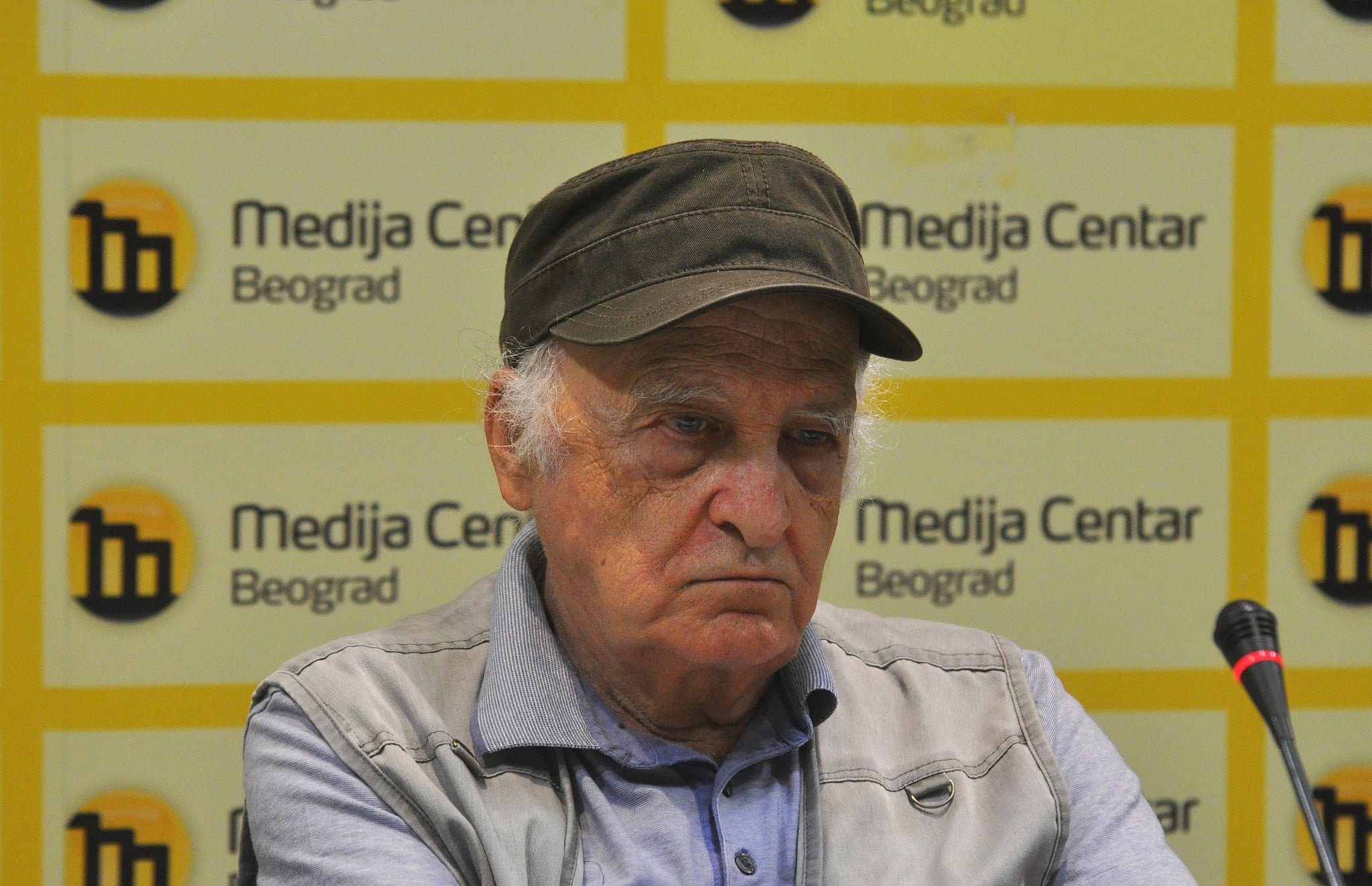
Filip David in 2019 (Photo: By Medija Centar Beograd - http://arhiva.mc.rs/upload/photoservice/2019/septembar/190910_forum//forum_09.jpg, CC BY-SA 3.0)
When Filip David (1940–2025) died this spring, his passing went largely unnoticed outside the Balkans, particularly in the English-speaking world. Like much of his life and work, his death attracted little attention, despite his contribution to European Holocaust literature.
Philip Roth coined the phrase “the other Europe” in the 1970s to describe the literary world east of the Iron Curtain; a region culturally rich yet politically sealed off, linguistically fragmented, and largely invisible to Anglophone readers. It was “Europe,” but not the Europe that dominated the Western imagination. Its writers lived in small languages, under censorship, in countries rarely translated, rarely reviewed, and rarely admitted into the mainstream European canon. This marginality was structural, not aesthetic.
Roth’s Writers from the Other Europe series in the 1970s and 1980s was an attempt to correct this imbalance. Over seventeen volumes, he introduced English-language readers to authors from Poland, Czechoslovakia, Hungary, and Yugoslavia; a geographical project, not a Jewish one. Jewish writers appeared in the series because they were part of the region’s literary fabric, not because the project sought them out. Decades later, Penguin tried again with its Central European Classics series (2010), publishing ten titles that revived some of these voices. Both initiatives were indispensable, but neither was sufficient to shift the deeper hierarchies of visibility.
It is here that the trajectories of individual writers become revealing. Inclusion in Roth’s series helped, but it did not guarantee lasting visibility. Danilo Kiš, for instance, gained early international attention not only because of his inclusion, but because exile, politics, Paris, PEN networks, and a cosmopolitan aura made him legible to Western critics. György Konrád likewise benefited from the Western appetite for the dissident intellectual; his political profile amplified his literary one. Their visibility was constructed through circumstance, geography, and the cultural fantasies of the West.
Filip David belongs to this “other Europe” in the most literal sense: a Jewish writer who emerged from socialist Yugoslavia, whose work bears the marks of occupation, censorship, and small-language marginality.
But absence reveals even more sharply how much a writer’s fate depends on background and infrastructure. Imre Kertész, though not part of Roth’s series, wrote in Hungarian, a language with a stronger translation ecosystem and a more institutionally resilient post-war Jewish community. His eventual Nobel Prize was not inevitable, but it was structurally possible.
For a Jewish writer living in Belgrade, the odds were harsher. David wrote in Serbian, a language with far weaker translation pipelines. He came from a Jewish community that was small even before the Shoah and nearly extinguished afterwards. There were few institutions left to advocate for him, few translators, few cultural intermediaries. He had no exile to make him cosmopolitan, no internationally recognised dissident profile to make him politically legible, no large linguistic ecosystem to carry his work outward. His near-invisibility is not a reflection of his writing, but of the structural forces that determine which voices travel, and which remain unheard.
In this sense, the contrast between Kiš, Konrád, Kertész, and David is not one of merit. It is about geography, infrastructure, and the fragile or absent institutions of memory. Kiš and Konrád show that inclusion can help but guarantees nothing. Kertész and David show that exclusion exposes deeper regional inequalities — inequalities that made global recognition possible for one and nearly impossible for the other.
The wars of the 1990s compounded this disadvantage. While Central Europe reoriented itself towards EU integration, cultural funding, and translation networks, Yugoslavia disintegrated into civil war, sanctions, and international isolation. Serbia, in particular, became synonymous with conflict rather than literature. Balkan Jewish communities — already decimated by the Shoah — emigrated or retreated further from view. For David, in the Milošević era, this double marginality was absolute: no exile networks, no institutional support, no post-Cold War renaissance to carry his voice outward.
It is within this landscape that Filip David’s death in 2025 must be understood: as the loss of a writer whose work embodies the moral and metaphysical questions of the twentieth century, yet whose voice remained largely unheard outside the Balkans; not because it lacked resonance, but because the world lacked the structures to hear it.
Although little known beyond the region, David was a significant, if under-acknowledged, figure in post-war Serbian and Jewish literature. His influence within Yugoslavia, and later the post-Yugoslav states, was considerable. He bridged Serbian literary traditions with Jewish historical experience in ways that ought to have made him central to post-war European Jewish writing. That recognition never fully materialised, largely for the geopolitical and historical reasons outlined above.
Over his career, he wrote novels, short stories, essays, and screenplays, while working for many years as an editor of the drama program at Television Belgrade. He also served as a professor of dramaturgy at the Faculty of Dramatic Arts in Belgrade.
A child survivor of the Holocaust and a consistent critic of nationalism, his writing explores the psychological and metaphysical dimensions of evil, memory, trauma, and Jewish fate. His novels and essays — particularly Kuća sećanja i zaborava (The House of Remembering and Forgetting, 2014) — weave a Kabbalistic and Kafkaesque meditation on evil and survival. The book echoes many of Danilo Kiš’s concerns, though articulated in a quieter, more allegorical register.
For this non-linear, semi-autobiographical novel of barely 160 pages, David received the NIN Award for Novel of the Year in 2014. In interviews, he described it as his most personal work.
It contains my biography and the biography of my family. We survived because we hid in a village during the Second World War under a false name. Fascinatingly, the villagers knew who we were, and no one betrayed us. Had the Nazis or the Ustaše — a Croatian fascist organisation — discovered our identity, the entire village would have perished.
Born in Kragujevac just months before the city was scarred by one of the most infamous atrocities of the German occupation — the October 1941 massacre, in which thousands of civilians, including schoolchildren, were executed in reprisal, David lost members of his mother’s family in that event; others were murdered in the Sajmište concentration camp or in Jasenovac. Though he himself was a hidden child and not a direct witness, his literary sensibility bears the imprint of this history: not only the violence itself, but the silences that followed; the tension between remembrance and erasure; the metaphysical residue of evil; and the ethical responsibility of literature.
His cultural role extended beyond his books. David was a public intellectual who consistently advocated democracy, human rights, and remembrance. Like Kiš, with whom he shared both friendship and thematic terrain, he wrote against national myth, favouring ambiguity, memory, and moral restlessness over certainty — and he paid the price. As a founder of the Independent Writers’ Association in 1989 and later the Belgrade Circle, he opposed the Milošević regime and was increasingly marginalised in mainstream Serbian literary discourse. He stood for something rare: an ethical voice that neither succumbed to despair nor yielded to ideological fashion.
David’s death in April 2025 marks the quiet departure of one of the last Serbian-Jewish writers whose life and work bridged Holocaust survival and post-war ideological critique. It underscores the fading presence of those who bore personal witness to Europe’s twentieth-century catastrophes while remaining morally and intellectually resistant to simplification.
One line from The House of Remembering and Forgetting would serve as a powerful epigraph:
The greatest punishment for those who survived is memory. (Najveća kazna za one koji su preživeli jeste pamćenje.)
In much post-war discourse, memory is treated as a moral good in itself: to remember is to repair, redeem, prevent repetition. Yet for many survivors and post-survivor cultures, memory functions differently. It is not healing, but corrosive; not redemptive, but binding. It persists not as narrative resolution, but as residue; a remainder, not a consolation.
This darker understanding of memory places David in the company of thinkers such as Primo Levi, Jean Améry, and Yosef Hayim Yerushalmi, for whom remembrance is less a moral triumph than an ongoing wound.
Primo Levi dismantles the comforting belief that survival carries inherent meaning. Survival, for him, is contingent, morally accidental, often entangled with compromise. The survivor is not a moral victor but a flawed intermediary. The true witnesses, Levi insists, are those who did not survive. Survivors remember in place of others, and therefore inadequately, painfully, without authority. Memory becomes an obligation one cannot fulfil; a demand permanently marked by failure.
Jean Améry radicalises this further by refusing reconciliation altogether. For him, memory is punitive because it resists the violence of time. Time collaborates with perpetrators by smoothing, contextualising, historicising. Memory that refuses to fade becomes socially intolerable: it disrupts progress, closure, moral comfort. To remember is to live out of sync with the world. Memory, in Améry’s sense, exiles the one who remembers.
Yosef Hayim Yerushalmi adds a structural dimension by distinguishing Jewish memory from modern historical consciousness. Jewish memory is selective, ritualised, ethical, and sustained within a living community. The crisis arises when memory survives but its communal containers collapse. Modernity preserves memory through archives and museums but strips it of ritual absorption. What remains is memory without grammar, obligation without transmission; memory that does not disappear but becomes unbearable.
This is where marginal Jewish cultures — Balkan, post-Yugoslav, small-language communities — are especially exposed. Memory persists without the structures that once sustained it. It becomes homeless. This is the architecture of David’s novel: a “house” that shelters both memory and oblivion, where survival binds one to an ethical obligation that cannot be fulfilled.
Here a deep incompatibility emerges with the Anglophone mainstream, which tends to approach memory as communicable, pedagogical, and ultimately reassuring. It favors narratives that universalise easily and promise ethical clarity. Memory as punishment resists this logic; it does not console, it does not resolve but speaks in small languages, fractured forms, allegory, and silence. It refuses the implicit contract that suffering must yield meaning legible to a broad audience. In this sense, memory-as-punishment is structurally untranslatable; not linguistically, but ethically. And so, certain Jewish voices remain unread, not because they are obscure, but because they refuse the moral ergonomics of the Anglophone imagination.
When memory is burden rather than lesson, marginality is not an injustice to be corrected but a condition to be endured. Writers like David do not fail to enter the canon; their exclusion reveals what the canon cannot contain: memory that demands without promising resolution.
Writing in Serbian, emerging from a nearly extinguished Jewish community, without exile capital or institutional advocacy, David carried memory without promise of reception. His work insists on remembering even when there is no audience prepared to receive it. In such cases, invisibility is not a contradiction of memory’s importance, but its confirmation.
Memory as punishment is not heroic. It exhausts, isolates, and demands fidelity without reward. Abandoned synagogues, forgotten graves, unread books, languages with no speakers left are not merely signs of neglect. They are traces of memory outliving its social viability. To insist on them is not nostalgia, but ethical refusal: refusal to accept that only what translates easily deserves to survive. Filip David wrote within this refusal, and his work remains as a testament to memory’s endurance, even when unreceived.
Related Topics
Related Posts