Historian, Librarian, Educator, and Artist
Remembering Café Hillel in the Shadow of Ramot Junction
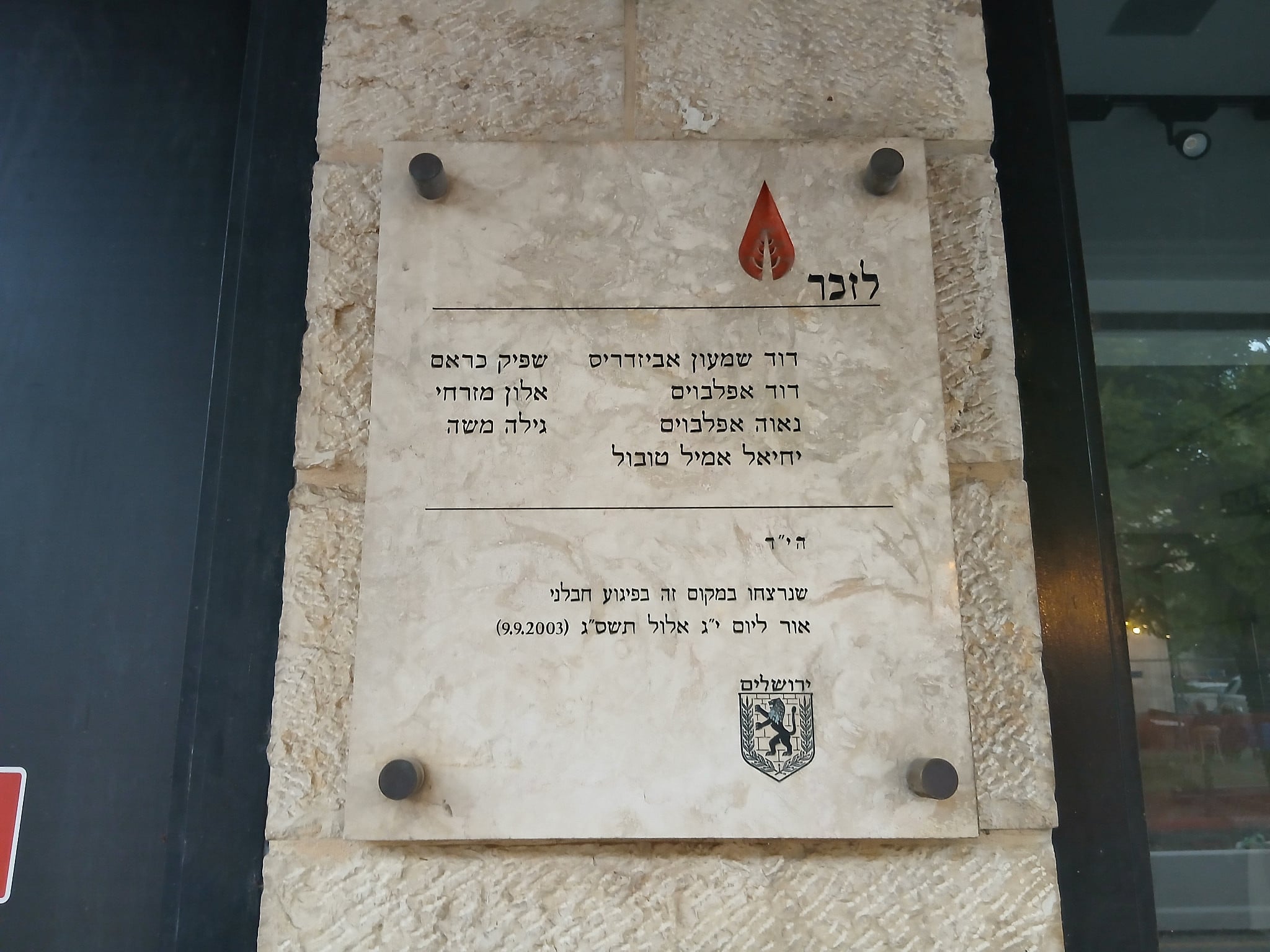
The Cafe Hillel memorial on Emek Refaim in September 2025 (Author Photo)
On This Day in History September 9, 2003, Terror hit the German Colony, Jerusalem
By Bonnie K. Goodman, BA, MLIS
For the past year the German Colony has become my second home. It is one of Jerusalem’s most beautiful and desirable neighborhoods, with flowering gardens, flowered trees spreading above your head, red-tiled Templar houses, and quiet tree-lined streets forming canopies as you walk, such as Smuts, Yitzhak Cremieux, Josiah Wedgewood, and Lloyd George Streets. I walk here every day and feel a calm and serenity that is hard to find in a city that lives under constant pressure; it feels like a small town planted in the larger hustle and bustle. Tourists admire the architecture, families fill the cafés, and guides bring groups down Emek Refaim and the side streets to hear stories about the Templar settlers, the churches, and the neighborhood’s revival as a cultural hub.
As I was researching the history of the Colony, I came across another story, one rarely told on these tours. At that time, while living in an insular bubble in Canada, I was unaware of this story. It was an anniversary that had just passed. On September 9, 2003, Emek Refaim was the scene of one of the most painful terror attacks of the Second Intifada. At Café Hillel, a place people went for coffee, conversation, and community, a suicide bomber exploded at the entrance. Seven people were murdered and more than fifty injured.
Among the victims were Dr. David Applebaum, head of Shaare Zedek’s emergency department, and his daughter Nava, who was killed on the eve of her wedding. He had devoted his life to saving terror victims, only to die as one himself, together with his daughter, in what should have been a moment of joy. Others killed included David Shimon Avidris, Yechiel Emil Tobol, Shafik Karam, Alon Mizrahi, and Gila Moshe.
These names deserve to be spoken. They had families, lives, and futures. Their loss was devastating. The bombing shocked the city, but it was one of many horrors in those years. The broken glass was cleared away, and the café reopened. Emek Refaim returned to its routines. Israel carried on because it had to. But survival is not the same as remembrance.
Today the German Colony appears idyllic. The cafés are full again, the sidewalks are shaded with flowers, and the talk is about the disruption of the light rail construction and the archaeological artifacts uncovered under the street. Tour guides pause to point out nineteenth-century architecture and the neighborhood’s cosmopolitan character, but they rarely stop outside what was Café Hillel. The memory of September 10 has become almost invisible.
This trend is part of a broader pattern. Cities curate their stories. Jerusalem emphasizes antiquity, archaeology, and religious tradition, while the more recent scars fade into silence. Yet history is not only the deep past of stone walls and artifacts. It also includes the tragedies of our own lifetimes. To walk through the German Colony without remembering Café Hillel is to accept a version of history that omits pain and loss.
The memory of Café Hillel feels even more urgent this year because Jerusalem has just been wounded again. On September 8, 2025, two days before this anniversary, terror struck at Ramot Junction in Northern Jerusalem. At a bus stop, six people were killed and more than twenty injured.
The victims were Levi Yitzhak Pash, 57, Yaakov Pinto, 25, Yisrael Matzner, 28, Rabbi Yosef David, 43, Rabbi Mordechai Steintzag, 79, and Sarah Mendelson, 60. Most of the victims were Jerusalem residents. Once again, lives full of promise were cut short in an ordinary place where people gather every day.
The parallels are chilling. A café in 2003, a bus stop in 2025. Both places that should have been safe transformed in an instant into sites of chaos and grief, a pattern in terror attacks here. Both times families were broken and the city left reeling. And yet, as always, life continued. Resilience is the rhythm of Jerusalem, but it can easily turn into numbness.
This is the paradox of living in Israel. We know danger is near, yet we keep going. Strength becomes survival, but survival carries the risk of forgetting. Each new attack threatens to eclipse the memory of those that came before. Café Hillel is already fading into the background, and unless we insist on remembrance, Ramot Junction will follow.
The German Colony itself shows how memory is shaped. Guides present it as a story of beauty, revival, and heritage. City planners celebrate the light rail and the ancient artifacts found under Emek Refaim. But very little is said about the people who lost their lives here, on the same street, not long ago. We celebrate stones, stones soaked in blood, but we forget the lives lost.
Living here has made me more aware of this silence. When I sit in a café, I will now think of Café Hillel. When I see groups walk down Smuts Street, I notice what they are not told. When I hear complaints about construction, I remember that the worst disruption came on a September night when lives were destroyed. Beauty and tragedy are not opposites in Jerusalem; they are layers of the same place.
On September 10, 2003, seven people were murdered at Café Hillel. On September 8, 2025, six were murdered at Ramot Junction. These are not just numbers, not just anniversaries. They are names, faces, families, and futures cut short.
The German Colony today is placid and full of life, but its streets carry scars. To remember is not only to mourn. It is to resist erasure. Terror seeks to kill but also to erase, to turn people into statistics, to make us numb. Memory pushes back.
During this past Shabbat lunch, my hosts asked me what I had learned the previous week, and each person shared their own story. This week my answer would be different. It would be to remember the memory of these lives lost, ones I had probably heard of so distantly as I lived thousands of miles away, disconnected from an area that has become such an important part of my daily life.
As we walk through Jerusalem, whether under the trees of the German Colony or past a bus stop in Ramot, we must choose to remember. We must remember not only the beauty of the stones, but also the lives lost. Memory itself is a form of resistance. It is how we say that those who were lost still matter and that they will not be forgotten.
Bonnie K. Goodman, BA, MLIS, is a historian, librarian, journalist, and artist. She is the author of On This Day in History…: Significant Events in the American Year (2023) and A Constant Battle: McGill University’s Complicated History of Antisemitism and Now Anti-Zionism.
Goodman holds a BA in History and Art History and an MLIS from McGill University. She pursued graduate studies in Jewish History at Concordia University (MA in Judaic Studies) and Jewish Education at the Hebrew University of Jerusalem.
She contributed to History of American Presidential Elections, 1789–2008 (2011), edited by Gil Troy, Arthur M. Schlesinger Jr., and Fred L. Israel. A former Features Editor at the History News Network, where she launched influential series such as Top Young Historians and History Doyens, Goodman has also worked as a political reporter at Examiner.com, covering U.S. politics, universities, religion, and culture.
Her scholarship and journalism span over 2,000 publications and are widely available on Academia.edu, Medium, and Substack (History Musings: OTD in History).
Related Topics
Related Posts