
Remembering Mileva Marić-Einstein, Wife of Israel’s Would Be 2nd President
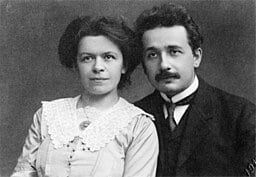
This past Friday marked the 150th birthday of Mileva Marić, the intellectual and first wife of famed mathematician and physicist Albert Einstein. In science history, Mileva Marić-Einstein occupies a complex and increasingly significant place, not only as the first wife of Albert Einstein but as a trained physicist and mathematician whose life illuminates the structural barriers faced by women in science at the turn of the twentieth century.
Marić was born in 1875 to a Serbian family in the town of Titel in the Austro-Hungarian Empire, which lies in the present-day province of Vojvodina, Serbia. At a time when women were largely excluded from higher scientific education, she gained admission to the Zurich Polytechnic (ETH Zurich), one of Europe’s leading technical institutions. This alone positioned her as an outlier: she was among the very first women in Europe to receive advanced training in theoretical physics, studying alongside future luminaries, including Albert Einstein. In fact, she was the only woman in the same class as Albert Einstein at Zurich Polytechnic and became his intellectual peer and eventual lover.
Marić’s importance lies partly in her documented intellectual partnership with Einstein during their student years and early marriage. Their correspondence reveals sustained discussions of physics, including references to “our work” and shared scientific problems. While historians continue to debate the extent of her direct contribution to Einstein’s 1905 papers—the four annus mirabilis works that reshaped modern physic, explaining the photoelectric effect, Brownian motion, special relativity, and mass-energy equivalence (the famed E=mc2) — there is broad scholarly consensus that Marić functioned as an intellectual sounding board at a formative stage in Einstein’s career. In an era when collaborative norms were informal and women’s authorship was routinely marginalized, the absence of her name from published work should be understood in the context of prevailing social constraints.
After failing her final diploma examination—reportedly due in part to grading bias and personal upheaval related to a pregnancy with Einstein’s illegitimate daughter—she never completed a formal degree. Marriage, motherhood, and later divorce effectively removed her from academic life.
As per her 1919 divorce agreement with Albert Einstein, who would go on to marry his cousin Elsa Löwenthal, Mileva received the money from his 1921 Nobel Prize award to invest in Zurich real estate to support herself and their two surviving sons. Their illegitimate daughter died at a young age.
In Israel, Mileva is little-spoken about despite Albert Einstein’s close ties with Hebrew University and his being offered Israel’s presidency after the death of Chaim Weizmann. But in her home country of Serbia, she has achieved widespread appreciation. Last year, the Serbian Ministry of Culture purchased 55 love letters and correspondence from Albert Einstein to and from Mileva Marić at an auction by Christie’s. The acquisition was a financially astute one, with the final price paid just one-third of the low estimate of their value, leading to a lawsuit by the owner, renowned collector and Jewish banking scion Jacqui Safra against Christie’s.
Meanwhile, similar to how the rights to her former husband Albert’s image belong to Hebrew University, a bust of Mileva Marić-Einstein gifted to Serbia’s leading exam-based school in STEM subjects, the Mathematical Grammar School, sat in Serbia’s National Assembly hall last week to pay tribute to her achievements.
Hopefully, the shared greatness of Albert and Mileva Marić-Einstein, is a subject that can be explored in greater detail by the academic bridge between the University of Belgrade and Ono Academic College in Jerusalem that created the Jewish-Serbian Center for the Study of Common Heritage.