Remembering the Rebbe, Finding my mother
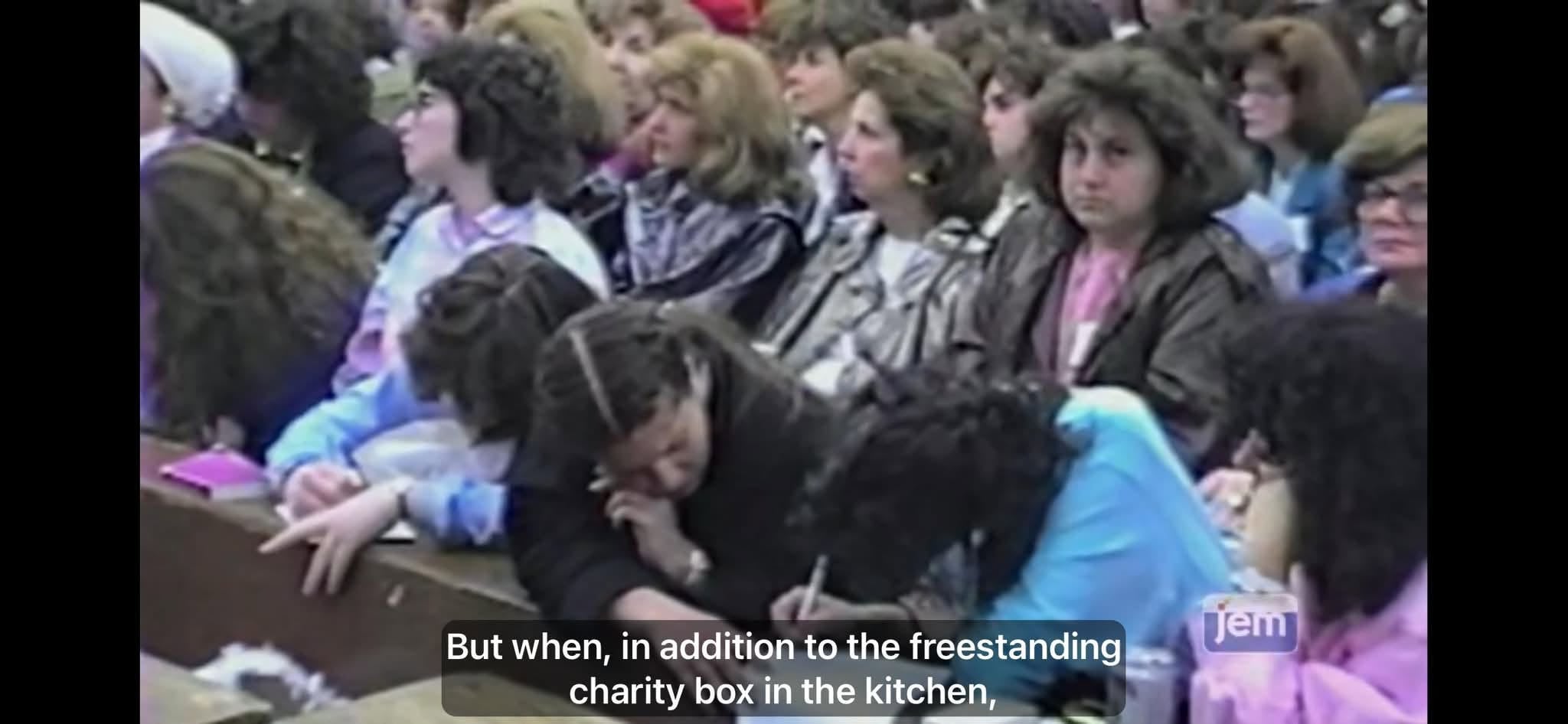
A few weeks ago, my sister sent me some images over Whatsapp, footage of my mother that I had never seen before. It was filmed in 1987. She was looking directly at the camera. She was sitting in the audience at a N’shei Chabad women’s convention. The footage appeared during a Saturday-night screening of videos of the Lubavitcher Rebbe at a Chabad house in Toronto. There, among the women gathered to hear him, was my mother.
My mother died in 2010 on the 5th of Kislev. Photographs of her are precious to me. To discover an image I had never seen, captured nearly 40 years ago, felt like receiving something I had long since stopped imagining could arrive. The timing made it especially moving: her yahrzeit was approaching. But there was another layer to this discovery. Thirty years ago, I wrote a master’s thesis about precisely the technology that had now returned this glimpse of my mother to me.
When the Lubavitcher Rebbe, Rabbi Menachem Mendel Schneerson z”l, died in 1994, his passing sent shockwaves through Chabad communities around the world. For many Chabadniks, it was difficult to imagine a movement without the Rebbe at its center. In 1995–96, while studying at Concordia University in Montreal, I explored how that relationship might endure. My prediction was that technology would play a central role in keeping the Rebbe present in the collective memory of Chabad and the broader Jewish world.
There was already considerable evidence for that argument. The Rebbe had understood the possibilities of communications technology long before carrying a screen in one’s pocket became ordinary. Beginning in 1970, telephone hookups connected listeners far beyond Brooklyn to his farbrengens, the gatherings at which he taught, spoke and sang with his followers. By 1980, those gatherings were being broadcast through satellite and cable television. Distance no longer determined who could hear him as he spoke.
I experienced that reach as a child. At Camp Emunah, a Chabad sleepaway camp I attended in the 1980s, once a session, the Rebbe’s farbrengens were piped in for us to hear. We were away from home, in the middle of the Catskill Mountains, but still connected to the center of the movement. The technology helped make that connection part of the rhythm of our lives.
By 1989, “Chanukah Live” was linking menorah lightings across continents, allowing Jewish communities thousands of miles apart to celebrate together. In 1991, participants in New York, Paris, Moscow, Melbourne, Hong Kong and Jerusalem could take part in a shared celebration. The familiar Chanukah obligation to publicize the miracle acquired a worldwide technological reach.
Radio was another vehicle. Torah teaching could enter a home through the same instrument that carried news and entertainment. The Rebbe defended using these tools for religious purposes, understanding their capacity to bring Jewish learning to people wherever they were. That approach continued into the internet age. Chabad.org has grown into a widely used destination for Jewish learning, reporting tens of millions of visitors across its family of websites. Its reach extends far beyond people who identify as Chabad: someone searching for candle-lighting times, an explanation of a holiday or a Torah commentary can encounter its teachings without ever entering a Chabad house.
Meanwhile, Jewish Educational Media (where the image was found) has undertaken the painstaking work of restoring, archiving and publishing recordings of the Rebbe. Its weekly “Living Torah” videos give those recordings a recurring place in communal life. An archive becomes something people gather to watch.
My thesis concerned the preservation of a leader’s presence. The footage of my mother reminded me that a camera records more than its intended subject. Someone set out to document the Rebbe and the women assembled to hear him. In doing so, they also preserved my mother: her face, her expression, her presence in a room. She was part of the audience. To me, decades later, she became the center of the frame.
Chabad’s willingness to include images of women in its publications and recordings also helped make this discovery possible. At a time when some Orthodox publications erase women from view, that choice preserves a fuller record of Jewish communal life, and, in this case, a glimpse of my mother.
That discovery carries a lesson for how we preserve Jewish history. Our communal records should make room for the people who fill the seats, organize the gatherings, raise the children and sustain the institutions. Women’s lives, especially, deserve to be documented with the care we give to the leaders standing before them. Preservation also requires people: someone to keep a recording, someone to restore it, someone to make it accessible, someone to press play. Technology creates possibilities. Human decisions determine what survives and who gets to encounter it.
Thirty years ago, I asked how a movement would remember its Rebbe. I did not think to ask who else those recordings would preserve. Now I think about the women sitting beside my mother in that audience. Someone may be searching for their faces, too. Each was part of the Jewish life unfolding in that room. Each deserves a place in its history.
We cannot know what a recording will mean to someone decades from now. But we can choose whose faces we include, whose voices we preserve, and whose lives we consider worthy of remembering. My mother looked toward a camera in 1987. Nearly forty years later, her daughter was grateful that someone had kept it running.
May the neshama of Lea bat Zahava have an aliya, and may her memory always be for a blessing.