London based entrepreneur, cybersecurity analyst doing a PhD in AI
One Idea Tafsir No.12 – The Product Manual
Your design is deliberate. Your life has purpose.
One Idea Tafsīr — No. 12 – Surah Ath Dhariyat.
The Product Came With a Manual, and two SIM cards. All you need to do is activate it.
The Designer gave us extraordinary capabilities. Then He told us what they were for.
1. The Unboxing Experience
Imagine purchasing the most advanced technological product ever made. Like the New iPhone 18 Pro. Or a Remarkable Tablet. Or getting your new BMW car from the dealership.
It can learn languages, recognise faces, compose music, solve mathematical problems, experience emotions, imagine the future and remember the past. It can heal some of its own injuries, adapt to new environments and produce entirely new ideas. What a brilliant product!
It is, of course, a human being.
Now imagine opening the box and discovering something else: a manual.
The manual explains why the product exists, how it should be used, what its limits are, how to protect it from damage and what constitutes successful operation.
Would you discard the manual before switching on the machine?
Curiously, that is what human beings frequently do with themselves.
2. The Purpose Was Never Hidden
وَمَا خَلَقْتُ ٱلْجِنَّ وَٱلْإِنسَ إِلَّا لِيَعْبُدُونِ ٥٦
I did not create jinn and humans except to worship Me. (Quran 51:56)
This is one of the clearest statements of human purpose in the Qur’an.
In his commentary on this verse, Ibn Kathīr [Rahimahullah (Arabic: رَحِمَهُ ٱللَّٰهُ). May Allah have mercy on him] explains that Allah created human beings and jinn so that He might command them to worship Him—not because He requires anything from them.
The following two verses remove any possibility that divine worship is intended to satisfy some deficiency in the Creator.
Allah declares that He seeks neither provision nor food from His creation, and identifies Himself as the Provider, the Possessor of strength (51:57–58).
مَآ أُرِيدُ مِنْهُم مِّن رِّزْقٍ وَمَآ أُرِيدُ أَن يُطْعِمُونِ ٥٧
I seek no provision from them, nor do I need them to feed Me (Quran 51:57).إِنَّ ٱللَّهَ هُوَ ٱلرَّزَّاقُ ذُو ٱلْقُوَّةِ ٱلْمَتِينُ ٥٨
Indeed, Allah ˹alone˺ is the Supreme Provider—Lord of all Power, Ever Mighty. (Quran 51:58)
Allah is self-sufficient. Human worship adds nothing to His perfection, and human disobedience diminishes nothing of His greatness.
The benefit belongs to the worshipper. You do it, good for you. You don’t, your loss.
Or, think of an engineer designing an advanced aircraft. Its operating instructions exist not because the engineer needs the aircraft to obey, but because the aircraft has been designed to operate within particular conditions.
The analogy is imperfect: Allah is unlike His creation, and we are morally responsible beings rather than machines. Nevertheless, it illuminates something important.
Instructions can be an expression of knowledge and care, not merely authority.
The Qur’an reinforces this in 23:115, asking humanity whether it imagined it had been created without purpose and would not return to its Creator.
أَفَحَسِبْتُمْ أَنَّمَا خَلَقْنَـٰكُمْ عَبَثًا وَأَنَّكُمْ إِلَيْنَا لَا تُرْجَعُونَ ١١٥
Did you then think that We had created you without purpose, and that you would never be returned to Us?”
We are not left without an answer to the question of existence.
The answer precedes us.
3. The Most Extraordinary Hardware
To appreciate the metaphor, consider the hardware.
The human brain contains approximately 86 billion neurons, connected through an estimated 100 trillion synapses, although estimates vary and some are considerably higher.
Modern large language models contain hundreds of billions, and in some cases trillions, of learned parameters.
Imagine a hypothetical AI system containing ten trillion parameters. Set beside an estimate of one hundred trillion human synapses, the numerical difference is tenfold.
But there is a crucial scientific distinction.
A synapse is not equivalent to an AI parameter.
And yet the comparison provides perspective.
We are constructing vast data centres, consuming enormous computing resources, to reproduce selected capabilities of an organ that an ordinary human being carries inside a skull. And the brain consumes a mere 20 Watts of biological power, whereas an AI model takes 6 to 15 kWH to run queries, 300 to 750 times more power-hungry
But extraordinary intelligence is not itself the measure of human worth.
The Qur’an says:
لَقَدْ خَلَقْنَا ٱلْإِنسَـٰنَ فِىٓ أَحْسَنِ تَقْوِيمٍ ٤
Indeed, We created humans in the best form. (Quran 95:4)
And elsewhere:
وَلَقَدْ كَرَّمْنَا بَنِىٓ ءَادَمَ وَحَمَلْنَـٰهُمْ فِى ٱلْبَرِّ وَٱلْبَحْرِ وَرَزَقْنَـٰهُم مِّنَ ٱلطَّيِّبَـٰتِ وَفَضَّلْنَـٰهُمْ عَلَىٰ كَثِيرٍ مِّمَّنْ خَلَقْنَا تَفْضِيلًا ٧٠
Indeed, We have dignified the children of Adam, carried them on land and sea, granted them good and lawful provisions, and privileged them far above many of Our creatures. (Quran 17:70)
Ibn Kathīr, explaining 17:70, draws attention to the human form and the faculties of hearing, sight and understanding, through which people distinguish beneficial things from harmful ones.
These are statements about human dignity and divine favour, not claims about computational benchmarks.
Our most remarkable capability may not be the speed at which we calculate.
It may be our capacity to understand a moral command, recognise our responsibility and freely choose to obey.
4. Are We the Highest Version?
The technology industry has trained us to think in versions.
Version 1.0 becomes Version 2.0. A new operating system replaces an old one. Newer chips promise greater performance, efficiency and intelligence.
But the Qur’an provides a different measure of advancement.
Sūrat al-Bayyinah says:
إِنَّ ٱلَّذِينَ ءَامَنُوا۟ وَعَمِلُوا۟ ٱلصَّـٰلِحَـٰتِ أُو۟لَـٰٓئِكَ هُمْ خَيْرُ ٱلْبَرِيَّةِ ٧
Indeed, those who believe and do good—they are the best of ˹all˺ beings. (Quran 98:7)
Notice the qualification.
Humanity has been honoured, but moral excellence requires something from us.
A powerful computer used to commit fraud or AI models used to commit cybercrime is not morally superior to a modest one used to assist someone in need. Likewise, a brilliant person who deliberately harms others has not fulfilled the purpose of his intelligence.
Allah says that the most honoured in His sight are those with the greatest taqwā, or God-consciousness (49:13).
يَـٰٓأَيُّهَا ٱلنَّاسُ إِنَّا خَلَقْنَـٰكُم مِّن ذَكَرٍ وَأُنثَىٰ وَجَعَلْنَـٰكُمْ شُعُوبًا وَقَبَآئِلَ لِتَعَارَفُوٓا۟ ۚ إِنَّ أَكْرَمَكُمْ عِندَ ٱللَّهِ أَتْقَىٰكُمْ ۚ إِنَّ ٱللَّهَ عَلِيمٌ خَبِيرٌ ١٣
O humanity! Indeed, We created you from a male and a female, and made you into peoples and tribes so that you may ˹get to˺ know one another. Surely the most noble of you in the sight of Allah is the most righteous among you. Allah is truly All-Knowing, All-Aware. (Quran 49:13)
The Qur’anic ideal of the highest human version is therefore not an individual with the greatest processing speed, the highest income, the longest lifespan or the most impressive qualifications.
It is a person whose knowledge, abilities and conduct are directed towards what is right.
The highest use of our capabilities is not simply to become more capable. It is to become more righteous.
5. The Manual Explains the Operating System
Every sophisticated machine comes with an operating environment.
There are conditions under which it functions properly, limits which should be respected, and procedures for maintaining its performance. We intuitively understand this about the need of our bodies. For example, the need to get adequate downtime, rest, food and sleep.
In the Islamic analogy, the Qur’an provides guidance for living, the literal word of God (let that sink in), while the Sunnah of the Prophet Muhammad (صَلَّى اللّٰهُ عَلَيْهِ وَسَلَّمَ) teaches the believer how that guidance is understood and practised.
Allah describes the Qur’an as guiding towards what is most upright (17:9).
إِنَّ هَـٰذَا ٱلْقُرْءَانَ يَهْدِى لِلَّتِى هِىَ أَقْوَمُ وَيُبَشِّرُ ٱلْمُؤْمِنِينَ ٱلَّذِينَ يَعْمَلُونَ ٱلصَّـٰلِحَـٰتِ أَنَّ لَهُمْ أَجْرًا كَبِيرًا ٩
Surely this Quran guides to what is most upright, and gives good news to the believers—who do good—that they will have a mighty reward.
Its guidance is far more substantial than an instruction sheet for physical maintenance.
An especially beautiful sequence appears in Sūrat al-Baqarah.
In verse 151, Allah describes sending a Messenger who recites His revelations, purifies people and teaches them the Book and wisdom.
كَمَآ أَرْسَلْنَا فِيكُمْ رَسُولًا مِّنكُمْ يَتْلُوا۟ عَلَيْكُمْ ءَايَـٰتِنَا وَيُزَكِّيكُمْ وَيُعَلِّمُكُمُ ٱلْكِتَـٰبَ وَٱلْحِكْمَةَ وَيُعَلِّمُكُم مَّا لَمْ تَكُونُوا۟ تَعْلَمُونَ ١٥١
Since We have sent you a messenger from among yourselves—reciting to you Our revelations, purifying you, teaching you the Book and wisdom, and teaching you what you never knew (Quran 2:151)
The very next verse declares:
فَٱذْكُرُونِىٓ أَذْكُرْكُمْ وَٱشْكُرُوا۟ لِى وَلَا تَكْفُرُونِ ١٥٢
remember Me; I will remember you. And thank Me, and never be ungrateful. (Quran 2:152)
And the following verse directs believers to seek help through patience and prayer (2:153).
يَـٰٓأَيُّهَا ٱلَّذِينَ ءَامَنُوا۟ ٱسْتَعِينُوا۟ بِٱلصَّبْرِ وَٱلصَّلَوٰةِ ۚ إِنَّ ٱللَّهَ مَعَ ٱلصَّـٰبِرِينَ ١٥٣
O believers! Seek comfort in patience and prayer. Allah is truly with those who are patient. (Quran 2:153)
Observe the progression.
Revelation provides knowledge. Knowledge points towards remembrance. Remembrance is accompanied by gratitude, patience and prayer.
The manual is not designed merely to be read.
It is meant to transform its reader.
6. Remember Me, and I Will Remember You
This is perhaps the most astonishing feature of the entire metaphor.
Most devices have an impressive interface but no relationship with their manufacturer.
You can use an expensive smartphone for years without its designer knowing you exist.
The Qur’an describes something fundamentally different.
Allah does not merely command remembrance.
He promises a response.
“Remember Me; I will remember you.”
Ibn Kathīr, explaining 2:152, records the teaching that Allah remembers those who remember Him.
In an authentic hadith narrated by Abū Hurayrah (raḍiya Allāhu ʿanhu), the Prophet Muhammad (ṣallā Allāhu ʿalayhi wa sallam) relates that Allah remembers the servant who remembers Him, and responds generously to the servant who draws near to Him.
The Prophet (ﷺ) said, “Allah says: ‘I am just as My slave thinks I am, (i.e. I am able to do for him what he thinks I can do for him) and I am with him if He remembers Me. If he remembers Me in himself, I too, remember him in Myself; and if he remembers Me in a group of people, I remember him in a group that is better than they; and if he comes one span nearer to Me, I go one cubit nearer to him; and if he comes one cubit nearer to Me, I go a distance of two outstretched arms nearer to him; and if he comes to Me walking, I go to him running.’ ”
The narration appears in Ṣaḥīḥ al-Bukhārī 7405. This will be covered in another article.
The language of divine nearness and remembrance is accepted as revelation, without reducing Allah to a physical location, a communications network or any created mechanism.
Nevertheless, consider the significance.
The Creator of the universe invites an individual human being to remember Him.
Not necessarily a king, scientist, scholar or someone famous.
An ordinary person, standing in a quiet room before dawn.
This is not a request for the Creator to acquire information about a servant. Allah already knows His creation completely.
It is a promise of divine attention, favour and response in the manner befitting Him. In a society where we constantly crave attention, here we can get attention from the one who made us, and matters most in our lives.
We spend much of our lives attempting to become important enough for other people to remember us.
The Qur’an offers an extraordinary alternative.
Remember the One who created you. He will remember you.
7. Prayer Is Not an Optional Application
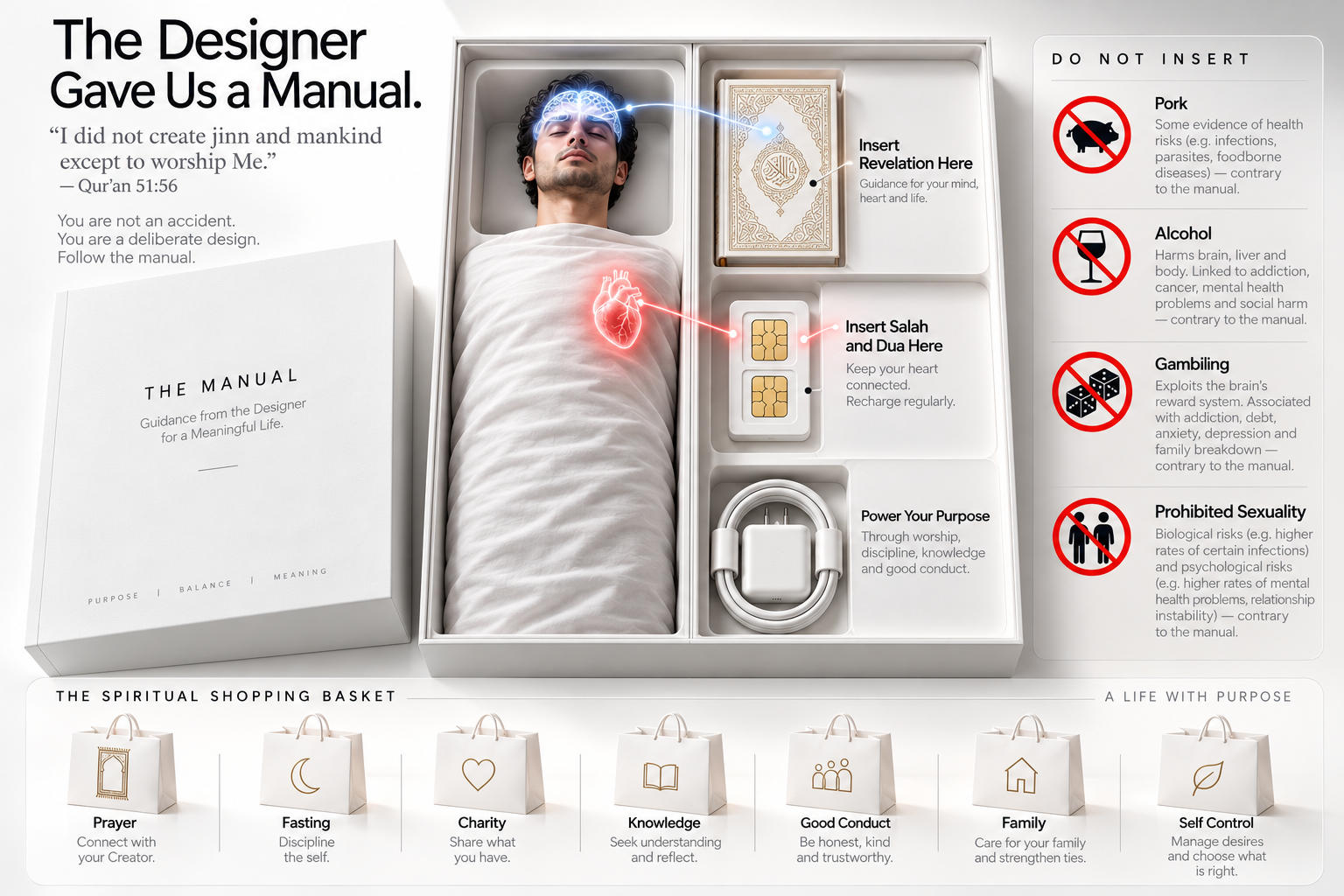
In the illustration accompanying this article, prayer and supplication appear almost like communication modules inserted into the human system.
It is a playful technological metaphor for a serious religious truth.
Allah commands Mūsā (ʿalayhi al-salām):
إِنَّنِىٓ أَنَا ٱللَّهُ لَآ إِلَـٰهَ إِلَّآ أَنَا۠ فَٱعْبُدْنِى وَأَقِمِ ٱلصَّلَوٰةَ لِذِكْرِىٓ ١٤
‘It is truly I. I am Allah! There is no god ˹worthy of worship˺ except Me. So worship Me ˹alone˺, and establish prayer for My remembrance. (Quran 20:14)
Prayer is not merely a cultural ritual. Nor should its significance be reduced to whatever psychological benefits modern researchers might measure.
It is worship.
It also structures a believer’s day around repeated acts of remembrance.
Imagine a person completely absorbed in professional ambitions, financial obligations, social relationships and the demands of modern technology.
Five times daily, ṣalāh interrupts the illusion that these activities constitute the entirety of existence.
For a few minutes, the believer turns away from the world and towards its Creator.
The Qur’an also states that prayer restrains from indecency and wrongdoing (29:45).
ٱتْلُ مَآ أُوحِىَ إِلَيْكَ مِنَ ٱلْكِتَـٰبِ وَأَقِمِ ٱلصَّلَوٰةَ ۖ إِنَّ ٱلصَّلَوٰةَ تَنْهَىٰ عَنِ ٱلْفَحْشَآءِ وَٱلْمُنكَرِ ۗ وَلَذِكْرُ ٱللَّهِ أَكْبَرُ ۗ وَٱللَّهُ يَعْلَمُ مَا تَصْنَعُونَ ٤٥
Recite what has been revealed to you of the Book and establish prayer. Indeed, ˹genuine˺ prayer should deter ˹one˺ from indecency and wickedness. The remembrance of Allah is ˹an˺ even greater ˹deterrent˺. And Allah ˹fully˺ knows what you ˹all˺ do. (Quran 29:45)
That does not mean everyone who prays automatically becomes morally excellent. Rather, sincere prayer should influence the life lived between prayers.
And Sūrat al-Raʿd states that hearts find tranquillity through the remembrance of Allah (13:28).
ٱلَّذِينَ ءَامَنُوا۟ وَتَطْمَئِنُّ قُلُوبُهُم بِذِكْرِ ٱللَّهِ ۗ أَلَا بِذِكْرِ ٱللَّهِ تَطْمَئِنُّ ٱلْقُلُوبُ ٢٨
those who believe and whose hearts find comfort in the remembrance of Allah. Surely in the remembrance of Allah do hearts find comfort.
This is a spiritual promise, not a claim that religious observance makes somebody immune to grief, illness or psychological distress.
In technological language, prayer resembles a regular reconnection with one’s intended purpose.
But unlike a machine connecting to a server, the believer is consciously worshipping Allah.
The distinction matters.
Technology provides the metaphor. Revelation provides the meaning.
8. The Warnings Printed on the Box
Almost every technical product contains warnings.
Do not expose this device to excessive heat. Do not insert unsuitable materials. Do not operate under dangerous conditions.
The Qur’an likewise establishes boundaries for human conduct.
The accompanying illustration highlights four examples: pork, alcohol, gambling and prohibited sexual conduct.
The Qur’an prohibits consuming pork in specified contexts (2:173), commands believers to avoid intoxicants and gambling (5:90–91), and warns against approaching unlawful sexual intercourse (17:32).
Modern science can illuminate some consequences of behaviour. Alcohol is associated with serious health and social harms. Gambling can exploit reward mechanisms and lead to addiction and financial distress. Sexual behaviour carries questions of health, consent, fidelity and responsibility.
Yet a crucial theological point must not be lost.
These prohibitions do not become Islamic law because a modern scientific study discovers a health risk.
Their religious authority comes from revelation.
Pork, for example, is not prohibited simply because it is invariably unsafe to eat. Its prohibition is a religious command.
Likewise, the Islamic limits governing sexual conduct are not reducible to medical statistics.
To explain every prohibition through scientific harm would make revelation dependent upon changing scientific evidence.
The deeper principle is that the Creator establishes boundaries, while human knowledge may help us understand some of their wisdom.
The manual also instructs us to avoid injustice, dishonesty, arrogance and cruelty.
And its warnings must never become a licence to despise people struggling with temptation or wrongdoing. The same revelation that establishes boundaries also teaches repentance and mercy.
9. The Spiritual Shopping Basket
A beautiful part of the accompanying illustration presents seven ordinary-looking shopping bags.
Prayer. Fasting. Charity. Knowledge. Good conduct. Family. Self-control.
Imagine these as the essentials of a meaningful human life.
Prayer directs the heart towards Allah. Fasting cultivates taqwā, as Sūrat al-Baqarah explains in 2:183. Charity reminds us that wealth is a trust rather than the entire purpose of existence.
Knowledge trains the intellect to seek understanding rather than merely accumulate information.
Good conduct means treating others with fairness and honesty. Family life creates responsibilities of care, patience and mercy. Self-control allows a person to resist desires that would otherwise dominate decisions.
These are not optional luxury accessories for unusually religious people.
They are elements of the life Islam teaches believers to cultivate.
10. Maintenance, Failure and Repair
There is one final advantage to the manual metaphor.
What happens when the product malfunctions?
Human beings make mistakes. We become distracted, neglect obligations, injure relationships and sometimes knowingly choose what is wrong.
Islam does not teach that human excellence consists of never committing an error.
It teaches that human beings remain accountable and can turn back to Allah. We know from Hadith that every human being will sin.
Anas (RAA) narrated that Allah’s Messenger (ﷺ) said:“All the sons of Adam are sinners, but the best of sinners are those who repent often.” Related by At·Tirmidhi and Ibn Majah with a strong chain of narrators (Sahih Bukhari, Book 16, Hadith 41) .
In Sūrat al-Zumar, Allah tells His servants who have transgressed against themselves not to despair of His mercy (39:53).
قُلْ يَـٰعِبَادِىَ ٱلَّذِينَ أَسْرَفُوا۟ عَلَىٰٓ أَنفُسِهِمْ لَا تَقْنَطُوا۟ مِن رَّحْمَةِ ٱللَّهِ ۚ إِنَّ ٱللَّهَ يَغْفِرُ ٱلذُّنُوبَ جَمِيعًا ۚ إِنَّهُۥ هُوَ ٱلْغَفُورُ ٱلرَّحِيمُ ٥٣
Say, ˹O Prophet, that Allah says,˺ “O My servants who have exceeded the limits against their souls! Do not lose hope in Allah’s mercy, for Allah certainly forgives all sins. He is indeed the All-Forgiving, Most Merciful. (Quran 39:53)
11. The Designer Did Not Forget the Instructions
The image of a human being arriving in a beautifully packaged box, or picking one up from a dealership.
The Creator did not leave humanity without guidance.
And perhaps the greatest tragedy is not that we sometimes struggle to understand the manual.
It is that we can spend an entire lifetime admiring the product, upgrading its capabilities, polishing its appearance and competing over its specifications—without ever opening the instructions.
The Qur’an offers an answer in one short verse:
“I did not create the jinn and mankind except to worship Me.” (51:56)
And it offers an invitation in another:
“Remember Me; I will remember you.” (2:152)
References and explanatory notes
Neuroscience: Harvard Medical School, “A New Field of Neuroscience Aims to Map Connections in the Brain,” 19 January 2023; National Institutes of Health, “Understanding How Visual Information Is Processed in the Brain,” 29 April 2025.
Related Topics